 [
[

Researchers at the Federal University of São Paulo (UNIFESP) in Brazil have identified a molecule on the surface of cells that could be a promising therapeutic target against cancer. This molecule plays an important role in tumor progression by regulating cellular behavior. The research is published in the journal Cytotechnology.
The work showed that overexpression of the syndecan-4 (SDC4) receptor provides tumor cells with a protective shield. In a laboratory experiment, the researchers silenced the receptor and halted the accelerated growth of tumor cells, causing them to resume responding to natural programmed cell death mechanisms.
Our study shows that SDC4 could become a promising therapeutic target and serve as a diagnostic marker for monitoring disease progression. The strategy of silencing this molecule has the potential to prevent the proliferation of cancer cells, but we’re still in the early stages of research and need to validate the results for each specific case of the disease,” said Carla Cristina Lopes, full professor in the Department of Biological Sciences at UNIFESP and lead author of the study.
How tumor cells evade death
Lopes explained that under normal conditions, cells express the SDC4 macromolecule for essential functions, such as signaling and adhering to other cells and tissues. However, changes in SDC4 expression, or when a cell produces an excessive amount of the macromolecule, are associated with the development and progression of cancer.
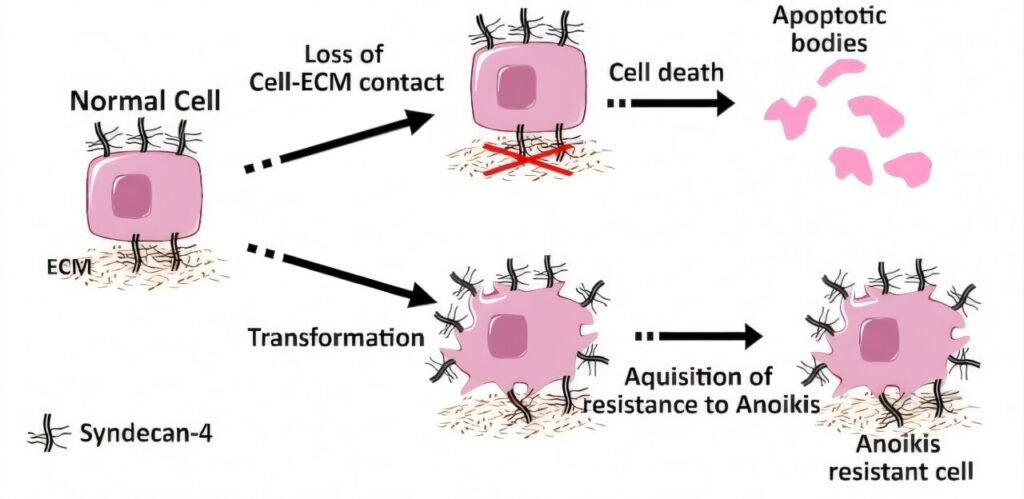
“Syndecan-4 protects tumor cells from a specific type of cell death called anoikis, which occurs when a cell detaches from tissue,” Lopes explained.
She said that for cells to form tissues, they need to be anchored—that is, “glued” to one another and to the extracellular matrix, a kind of filler between cells. Thus, when a normal cell detaches from tissue, it activates a self-destruction mechanism called anoikis, a Greek term meaning “death by homelessness.”
In cancer, however, this process is subverted, and the most aggressive tumor cells can survive and migrate through the bloodstream until they colonize other organs (metastasis).
“What is metastasis? Metastasis is simply that tumor-forming cell that leaves a tissue and enters the bloodstream until it invades other tissues. That happens because these cells manage to circumvent anoikis, a form of cell death caused by loss of adhesion to their substrate,” Lopes explained.
Silencing SDC4 reversed malignancy
In experiments conducted on adherent aortic endothelial cells from rabbits cultured in a laboratory setting, the researchers observed that fewer than 5% survived disruption of adhesion and remained alive in suspension. This small group, however, became highly aggressive and exhibited SDC4 overexpression. When the researchers silenced the molecule using genetic engineering techniques, the cells lost their malignant properties and became dependent on adhesion to survive once again.
“This reversal significantly increased programmed cell death and reduced the invasive capacity of the cells, making SDC4 a promising therapeutic target for stopping metastasis before it begins,” Lopes said.
The research also showed that the mechanism of action of SDC4 involves modulating the cell cycle as early as its initial phases.
“When we silenced SDC4, there was an increase in an inhibitor of cell division [p27] that acts early in the cell division process [G1 phase] by blocking uncontrolled proliferation. In addition, there was regulation of the expression of cyclin and CDK [cyclin-dependent kinase], which are regulators of cell cycle progression,” Lopes said.
The study on the role of SDC4 in cell cycle modulation resulted in the master’s dissertation of first author Bianca Zaia F. Ferreira.
CBD is the next question
After describing the role of SDC4 in the survival and aggressiveness of tumor cells, the researchers at UNIFESP are now investigating whether cannabidiol (CBD) can act on SDC4 molecules.
“The discovery of the role of SDC4 in metastasis paves the way for a series of new studies. One of our lines of investigation is to verify whether cannabidiol can reverse the malignant behavior of anoikis-resistant cells by modulating SDC4 expression or interfering with the signaling pathways that sustain uncontrolled growth. It would be an interesting approach, but we’re still in the early stages of investigation,” Ferreira said.
More information
Bianca Zaia Franco Ferreira et al, SDC4 silencing promotes cell cycle arrest at the restriction point (R point) in anoikis-resistant endothelial cells, Cytotechnology (2026). DOI: 10.1007/s10616-026-00931-x
Key medical concepts
Clinical categories


Citation:
Molecule found on cancer cell surfaces may lead to new therapies (2026, June 18)
retrieved 18 June 2026
from https://medicalxpress.com/news/2026-06-molecule-cancer-cell-surfaces-therapies.html
This document is subject to copyright. Apart from any fair dealing for the purpose of private study or research, no
part may be reproduced without the written permission. The content is provided for information purposes only.

Khamrah by Lattafa for Men - 3.4 oz EDP Spray
4% Off
Ghost Sweetheart Eau de Toilette | Pineapple, Jasmine and Sandalwood | Perfume for Women 50 ml
50% Off
Marc Jacobs Dot Eau De Parfum for Women, 100 ml
42% Off
Ted Baker W Eau de Toilette for Her, Fig Leaf, White Peony and Violet Top Notes, Pink Orchid and Raspberry Middle Notes, 75ml
£11.77 (£15.69 / 100 ml) (as of 18/06/2026 03:33 GMT +01:00 - More infoProduct prices and availability are accurate as of the date/time indicated and are subject to change. Any price and availability information displayed on [relevant Amazon Site(s), as applicable] at the time of purchase will apply to the purchase of this product.)
Ted Baker Woman Pink Eau de Toilette Spray Floral Green Feminine Fragrance, Opening Notes are Fresh Peach, Bergamot and Tangerine with Warm Musk, Vanilla and Vetiver Base, 100ml
11% Off
Vera Wang Princess Eau de Toilette - 30 ml

Choco Musk 50ml Eau De Parfum for men and women | Chocolate Musk by Jannat Aromas
17% Off
Christina Aguilera Signature Eau de Parfum (50ml) Floral, Fruity & Exotic Scent, Luxury Fragrance for Women
9% Off
Calvin Klein - Eau De Toilette CKIN2U - Calvin Klein Women, Ladies Perfume, Women's Perfume, Calvin Klein Perfume, Calvin Klein One - 150 ml
5% Off
Jimmy Choo Flash Eau de Parfum, 60 ml (Pack of 1)
3% Off
Fruit of the Loom Men's Heavy T Shirt, White, XL UK
28% Off
ATNKE LED Lighted Beanie Cap,USB Rechargeable Running Hat Ultra Bright 4 LED Waterproof Light Winter Warm Gifts for Men and Women/Pink
17% Off
Men's 1/4 Zip Pullover UK Sale Clearance, Fleece Sweatshirt Casual Jumper Long Sleeve T-shirt Top Stand Collar Sweater Plain Pullover Sports Leisure Workwear Quarter Zip Sweater Lightweight Jumpers
£5.88 (as of 12/11/2025 00:52 GMT +01:00 - More infoProduct prices and availability are accurate as of the date/time indicated and are subject to change. Any price and availability information displayed on [relevant Amazon Site(s), as applicable] at the time of purchase will apply to the purchase of this product.)
Crevice Cleaning Brush, Bathroom Tile Groove Gap Cleaning Brush,Premium Crevice Cleaning Tool Aluminum Support with 15° Angle Magic Brush, Thin Brush for Home Kitchen
19% Off
Wireless Earbuds, Bluetooth 5.3 Headphones in Ear with HiFi Stereo Deep Bass, 4 ENC Noise Cancelling Mic Wireless Earphones 40H Playtime, Bluetooth Earbuds Dual LED Display, IP7 Waterproof, USB-C
42% Off