Politics reporter

 House of Commons
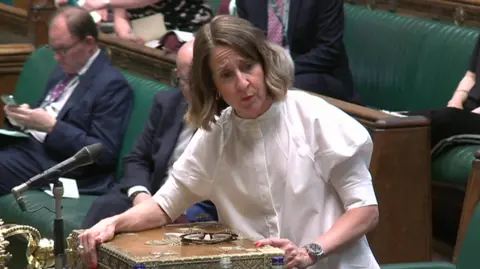
Work and Pensions Secretary Liz Kendall has faced repeated questions from Labour MPs over the rollout of changes to the benefit system, as the government attempts to defuse a backbench rebellion.
As part of a U-turn last week, the government said stricter eligibility criteria for getting the personal independence payment (Pip) would only apply to those claiming after November 2026, rather than existing claimants.
It also promised a review into the assessment process in partnership with disability organisations, due to be completed in autumn 2026.
But many Labour backbenchers questioned the rationale for making changes to the qualifying criteria before the review was finished.
Kendall said any recommendations from the review – to be led by disability minister Sir Stephen Timms – would be implemented “as soon as possible” following its completion.
She added that the Timms review would not be “driven by an objective of making savings” adding: “It’s about making sure that this really vital benefit is fair and fit for the future.”
Pip assessments involve questions about tasks like preparing and eating food, washing and getting dressed. Each is scored from zero – for no difficulty, to 12 – for the most severe.
Under the government’s proposed system, new claimants would have to score at least four points for one activity to qualify for the benefit, instead of qualifying for support across a broad range of tasks.
Debbie Abrahams, chair of the work and pensions committee, said: “If this is being truly co-produced with disabled people in their organisations, the review should determine both the new process, the new points and the new descriptors, and we shouldn’t predetermine it at four points.”
Dame Meg Hillier – chair of the Treasury Committee – asked Kendall for “the rationale for settling on those four points in one category prior to the Timms review”.
Another Labour MP, Sarah Owens, asked: “What is the logic of making changes to future claimants before producing the Timms review?”
The government was forced into a climbdown after more than 120 Labour MPs – including Dame Meg and Abrahams – threatened to block the Universal Credit and Personal Independence Payments Bill.
Ministers had hoped concessions made last week had reassured MPs, although around 50 Labour MPs are still expected to oppose the bill.
Speaking in Parliament, Kendall said she had “listened carefully” and was “making positive changes as a result”.
As a result of changes to the bill, no existing claimant would be pushed into poverty, she said.
She also defended the need for the bill telling MPs that the government had inherited a system that was “failing on all fronts”.
“The welfare state must be fair, both for those who need support and for taxpayers, so it is sustainable for generations to come.”
The government had initially estimated its plans would save around £5bn by 2030 from the growing welfare bill. During the statement Kendall confirmed the government’s concessions would cost £2.5bn by 2030.
Conservative shadow work and pensions secretary Helen Whately said the government had produced a “rushed and chaotic compromise” which would save £2.5bn from a £100bn bill.
Tory leader Kemi Badenoch, later confirmed her party would be voting against the bill, arguing it did not offer “serious welfare reform”.
Liberal Democrat spokesman Steve Darling said the legislation was rushed and warned it would lead to “unintended consequences”.
Some MPs raised concern that a “two-tier” system would be created if the government restricted eligibility for new claimants.
Kendall defended the move arguing that the benefits system “often protects existing claimants from new rates or new rules, because lives have been built around that support, and it’s often very hard for people to adjust”.
Earlier in the day the government produced new modelling estimating that around 150,000 people would be pushed into poverty by 2030 as a result of the welfare cuts – lower than the 250,000 predicted before the government’s U-turn.
A Downing Street spokesman said the modelling “doesn’t reflect the full picture” and was “subject to uncertainty”.
BBC News

Khamrah by Lattafa for Men - 3.4 oz EDP Spray
4% Off
Ghost Sweetheart Eau de Toilette | Pineapple, Jasmine and Sandalwood | Perfume for Women 50 ml
50% Off
Marc Jacobs Dot Eau De Parfum for Women, 100 ml
42% Off
Ted Baker W Eau de Toilette for Her, Fig Leaf, White Peony and Violet Top Notes, Pink Orchid and Raspberry Middle Notes, 75ml
£11.77 (£15.69 / 100 ml) (as of 03/07/2026 03:53 GMT +01:00 - More infoProduct prices and availability are accurate as of the date/time indicated and are subject to change. Any price and availability information displayed on [relevant Amazon Site(s), as applicable] at the time of purchase will apply to the purchase of this product.)
Ted Baker Woman Pink Eau de Toilette Spray Floral Green Feminine Fragrance, Opening Notes are Fresh Peach, Bergamot and Tangerine with Warm Musk, Vanilla and Vetiver Base, 100ml
11% Off
Vera Wang Princess Eau de Toilette - 30 ml

Choco Musk 50ml Eau De Parfum for men and women | Chocolate Musk by Jannat Aromas
17% Off
Christina Aguilera Signature Eau de Parfum (50ml) Floral, Fruity & Exotic Scent, Luxury Fragrance for Women
9% Off
Calvin Klein - Eau De Toilette CKIN2U - Calvin Klein Women, Ladies Perfume, Women's Perfume, Calvin Klein Perfume, Calvin Klein One - 150 ml
5% Off
Jimmy Choo Flash Eau de Parfum, 60 ml (Pack of 1)
3% Off
Fruit of the Loom Men's Heavy T Shirt, White, XL UK
28% Off
ATNKE LED Lighted Beanie Cap,USB Rechargeable Running Hat Ultra Bright 4 LED Waterproof Light Winter Warm Gifts for Men and Women/Pink
17% Off
Men's 1/4 Zip Pullover UK Sale Clearance, Fleece Sweatshirt Casual Jumper Long Sleeve T-shirt Top Stand Collar Sweater Plain Pullover Sports Leisure Workwear Quarter Zip Sweater Lightweight Jumpers
£5.88 (as of 12/11/2025 00:52 GMT +01:00 - More infoProduct prices and availability are accurate as of the date/time indicated and are subject to change. Any price and availability information displayed on [relevant Amazon Site(s), as applicable] at the time of purchase will apply to the purchase of this product.)
Crevice Cleaning Brush, Bathroom Tile Groove Gap Cleaning Brush,Premium Crevice Cleaning Tool Aluminum Support with 15° Angle Magic Brush, Thin Brush for Home Kitchen
19% Off
Wireless Earbuds, Bluetooth 5.3 Headphones in Ear with HiFi Stereo Deep Bass, 4 ENC Noise Cancelling Mic Wireless Earphones 40H Playtime, Bluetooth Earbuds Dual LED Display, IP7 Waterproof, USB-C
42% Off