 [
[

Northwestern Medicine scientists have, for the first time, described the underlying mechanisms that regulate how cells rapidly change gene expression in response to hypoxia, a key feature of many treatment-resistant tumors, according to a recent study published in Science Advances.
Ali Shilatifard, Ph.D., the chair and Robert Francis Furchgott Professor of Biochemistry and Molecular Genetics, was the senior author of the study.
How tumors switch under hypoxia
The P-TEFb transcriptional kinase complex regulates the pause-release checkpoint step in transcription by RNA polymerase II, a multiprotein complex that transcribes DNA into precursors of mRNA as well as most small nuclear RNA (snRNA) and microRNA.
P-TEFb is also essential for gene expression during hypoxia, a period of low oxygen within solid tumor microenvironments, and it reduces the effectiveness of chemotherapy, radiation therapy and immunotherapy. How these cancer cells rapidly shift gene expression in response to hypoxia has remained unclear, according to the authors.
“We wanted to understand how cells activate hypoxia-responsive genes beyond the well-known HIF pathway. Since P-TEFb is essential for hypoxic gene expression, we used an unbiased proteomics approach to identify proteins that interact with P-TEFb specifically during hypoxia,” said Shimaa Soliman, Ph.D., a former postdoctoral research fellow in the Shilatifard laboratory and lead author of the study.
Tracing the pathway step by step
In the study, the scientists used a combination of proteomics, genetics and genomics approaches to better characterize the P-TEFb pathway.
First, they compared proteins associated with the transcriptional regulator P-TEFb under normal and low-oxygen conditions using immunoprecipitation and mass spectrometry. Next, they used CRISPR gene editing and RNA interference to remove or reduce these proteins and determine their functional importance. Finally, they used genome-wide chromatin profiling (ChIP-seq) to measure how these factors affect the recruitment of RNA polymerase II and the activation of hypoxia-responsive genes.
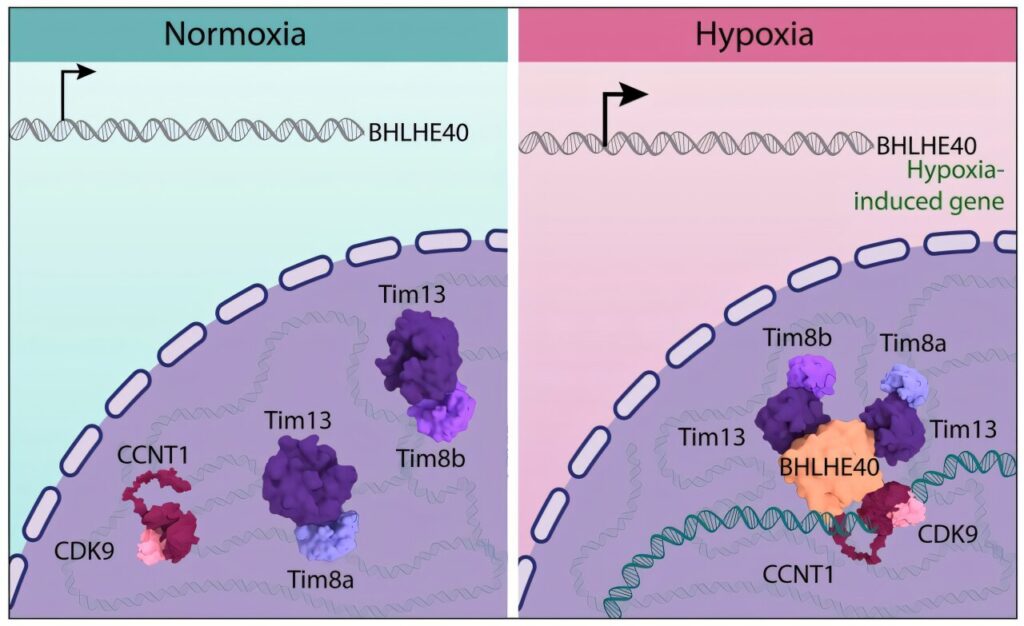
Using these approaches, they found that Tim8-Tim13 proteins are present in the nucleus and help regulate hypoxic gene expression.
They also discovered that the DNA-binding transcription factor BHLHE40 acts as a bridge between Tim8-Tim13 complexes and P-TEFb, creating a novel regulatory pathway that supports the hypoxic transcriptional response.
A target beyond HIF
Together, the findings identify a new regulatory axis in which Tim8-Tim13 complexes and BHLHE40 modulate P-TEFb activity in the transcriptional response to hypoxia, which could help inform future treatment opportunities for patients who respond poorly to HIF-targeted treatments, Soliman said.
“Our work expands that framework by identifying a previously unrecognized regulatory axis involving P-TEFb, BHLHE40 and Tim8-Tim13 complexes. Importantly, this mechanism functions partially independently of HIF. From a therapeutic perspective, this is particularly relevant for cancers such as clear cell renal cell carcinoma, where hypoxia signaling is chronically activated,” Soliman said.
Building on these findings, Soliman said her team seeks to better understand how Tim8-Tim13 complexes function in the nucleus, define how they regulate transcription and determine whether disrupting the BHLHE40-Tim8/Tim13-P-TEFb interaction could be therapeutically beneficial in hypoxia-driven cancers.
“This work uncovers an unexpected link between mitochondria and gene regulation in the nucleus, highlighting new layers of complexity in how cells sense and respond to low oxygen,” Soliman said.
Publication details
Shimaa Hassan AbdelAziz Soliman et al, Hypoxia-responsive interaction between P-TEFb, BHLHE40, and Tim8-Tim13 regulates hypoxic gene transcription, Science Advances (2026). DOI: 10.1126/sciadv.adz9295
Journal information:
Science Advances
Key medical concepts
Clinical categories


Citation:
Intracellular mechanisms promote tumor survival during hypoxia (2026, June 27)
retrieved 27 June 2026
from https://medicalxpress.com/news/2026-06-intracellular-mechanisms-tumor-survival-hypoxia.html
This document is subject to copyright. Apart from any fair dealing for the purpose of private study or research, no
part may be reproduced without the written permission. The content is provided for information purposes only.

Khamrah by Lattafa for Men - 3.4 oz EDP Spray
4% Off
Ghost Sweetheart Eau de Toilette | Pineapple, Jasmine and Sandalwood | Perfume for Women 50 ml
50% Off
Marc Jacobs Dot Eau De Parfum for Women, 100 ml
42% Off
Ted Baker W Eau de Toilette for Her, Fig Leaf, White Peony and Violet Top Notes, Pink Orchid and Raspberry Middle Notes, 75ml
£11.77 (£15.69 / 100 ml) (as of 01/09/2026 04:56 GMT +01:00 - More infoProduct prices and availability are accurate as of the date/time indicated and are subject to change. Any price and availability information displayed on [relevant Amazon Site(s), as applicable] at the time of purchase will apply to the purchase of this product.)
Ted Baker Woman Pink Eau de Toilette Spray Floral Green Feminine Fragrance, Opening Notes are Fresh Peach, Bergamot and Tangerine with Warm Musk, Vanilla and Vetiver Base, 100ml
11% Off
Vera Wang Princess Eau de Toilette - 30 ml

Choco Musk 50ml Eau De Parfum for men and women | Chocolate Musk by Jannat Aromas
17% Off
Christina Aguilera Signature Eau de Parfum (50ml) Floral, Fruity & Exotic Scent, Luxury Fragrance for Women
9% Off
Calvin Klein - Eau De Toilette CKIN2U - Calvin Klein Women, Ladies Perfume, Women's Perfume, Calvin Klein Perfume, Calvin Klein One - 150 ml
5% Off
Jimmy Choo Flash Eau de Parfum, 60 ml (Pack of 1)
3% Off
Fruit of the Loom Men's Heavy T Shirt, White, XL UK
28% Off
ATNKE LED Lighted Beanie Cap,USB Rechargeable Running Hat Ultra Bright 4 LED Waterproof Light Winter Warm Gifts for Men and Women/Pink
17% Off
Men's 1/4 Zip Pullover UK Sale Clearance, Fleece Sweatshirt Casual Jumper Long Sleeve T-shirt Top Stand Collar Sweater Plain Pullover Sports Leisure Workwear Quarter Zip Sweater Lightweight Jumpers
£5.88 (as of 12/11/2025 00:52 GMT +01:00 - More infoProduct prices and availability are accurate as of the date/time indicated and are subject to change. Any price and availability information displayed on [relevant Amazon Site(s), as applicable] at the time of purchase will apply to the purchase of this product.)
Crevice Cleaning Brush, Bathroom Tile Groove Gap Cleaning Brush,Premium Crevice Cleaning Tool Aluminum Support with 15° Angle Magic Brush, Thin Brush for Home Kitchen
19% Off
Wireless Earbuds, Bluetooth 5.3 Headphones in Ear with HiFi Stereo Deep Bass, 4 ENC Noise Cancelling Mic Wireless Earphones 40H Playtime, Bluetooth Earbuds Dual LED Display, IP7 Waterproof, USB-C
42% Off