 [
[

For decades, neuroscientists have been trying to uncover the neural processes that allow humans and various other animals to recall emotional experiences of past events. Past studies have identified a network of brain regions that support the encoding and consolidation of these memories. These regions include the hippocampus and the amygdala, as well as the para-hippocampal, perirhinal, prefrontal, parietal and retrosplenial cortices.
Researchers at Neuroscience NeuroSU and the Institute of Biology Paris-Seine- IBPS carried out a study on rats aimed at better understanding how the dorsal and ventral hippocampus, two segments of the hippocampus known to have different functions, contribute to the consolidation of emotional memories of past events.
Their findings, published in Nature Neuroscience, suggest that these two regions coordinate during sleep to consolidate memories of past experiences and the emotions associated with them.
“We already knew a lot about the role of sleep-dependent reactivation in the dorsal hippocampus, but comparatively much less is known about the ventral part of the hippocampus,” Gabrielle Girardeau, senior author of the paper, told Medical Xpress.
“In addition, it was previously shown that the dorsal part of the hippocampus communicates during sleep with other structures related to emotions, like the amygdala. However, the anatomy shows that the dorsal hippocampus is not connected to these structures.”
How rats process emotional experiences while sleeping
Earlier neuroscience studies found that the dorsal hippocampus is not connected to other brain regions associated with the processing of emotions. This suggests that it communicates with these regions via an intermediate brain region when consolidating emotional memories of past events.
Girardeau and her colleagues hypothesized that this intermediate region is the ventral hippocampus, the other segment of the hippocampus. Contrarily to the dorsal hippocampus, this region is known to communicate with emotion-processing brain regions.
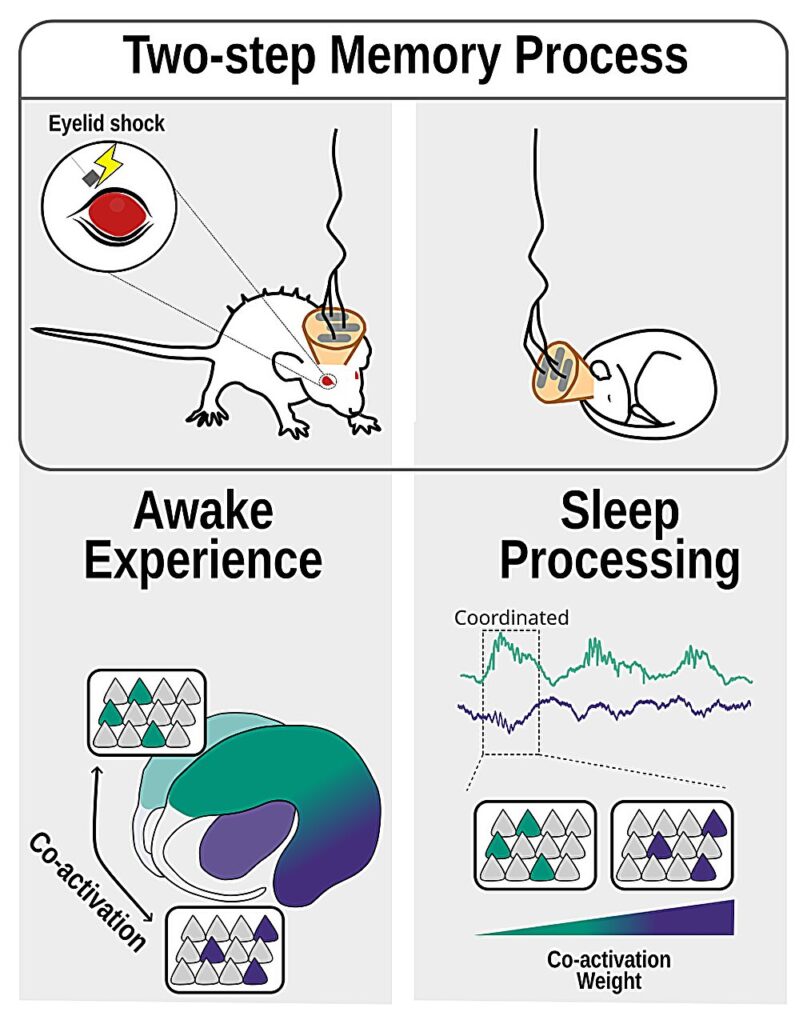
“We hypothesized that the dorsal and ventral parts of the hippocampus coordinate during sleep to associate contextual and emotional information, and potentially mediate the communication with the rest of the emotional network,” said Girardeau. “We wanted to test this, as it was not known how dorso-ventral communication occurred during sleep following emotional experiences.”
To test their hypothesis, the researchers carried out a series of experiments involving freely moving rats. These rats had tiny electrodes implanted in their brains, which recorded the activity of many neurons simultaneously both in the dorsal and ventral hippocampus.
“We collected electrophysiological recordings while the rats were undergoing an emotional experience, and then sleeping,” explained Girardeau. “We used computational methods to analyze the activity of these neurons and examine how they coordinate/dialogue during sleep, and how accurately this coordination reflects the preceding emotional experience.”
While they were awake, some rats experienced a small electric shock, while others received a reward. The researchers looked at the activity of neurons in the dorsal and ventral hippocampus both during these experiences and after them, while the rats were sleeping.
“We observed neural reactivation (a phenomenon known to support sleep-dependent memory-processing) during sleep that spans the entire axis of the hippocampus following an emotional positive or negative experience,” said Girardeau.
Towards a better understanding of emotional memory consolidation
The recordings collected by this research team confirmed that while rats are sleeping, their brain consolidates memories of emotional experiences they had while awake. The consolidation of both aversive and pleasurable experiences appears to be supported by coordinated activity between the dorsal and ventral hippocampus.
“We also found that reactivation is more faithful to the original experience when the experience was negative,” said Girardeau. “This might explain the bias towards better memories of negative compared to positive events. More broadly, it identifies a mechanism that allows us to form memories combining context and emotions, positive or negative.”
If validated in humans, the results of this recent study could help to shed more light on the intricate neural processes that support the consolidation of traumatic memories and could play a role in trauma-related mental health conditions. For instance, they might improve the understanding of post-traumatic stress disorder (PTSD) and other mental health disorders that are linked to intrusive and sometimes debilitating memories of traumatic events.
“We are now planning to move beyond the hippocampus and extend our understanding of cross-area communication involved in emotional-memory consolidation to other structures like the amygdala or prefrontal cortex,” added Girardeau. “We also hope to understand how stress might additionally influence these sleep-dependent processes.”
Written for you by our author Ingrid Fadelli, edited by Sadie Harley, and fact-checked and reviewed by Robert Egan—this article is the result of careful human work. We rely on readers like you to keep independent science journalism alive.
If this reporting matters to you, please consider a donation (especially monthly). You’ll get an ad-free account as a thank-you.
Publication details
Juan Facundo Morici et al, Dorsoventral hippocampus neural assemblies reactivate during sleep following an aversive experience, Nature Neuroscience (2026). DOI: 10.1038/s41593-026-02252-w.
Journal information:
Nature Neuroscience
Key medical concepts
© 2026 Science X Network
Citation:
How the brain replays past emotional experiences during sleep (2026, April 26)
retrieved 26 April 2026
from https://medicalxpress.com/news/2026-04-brain-replays-emotional.html
This document is subject to copyright. Apart from any fair dealing for the purpose of private study or research, no
part may be reproduced without the written permission. The content is provided for information purposes only.

Khamrah by Lattafa for Men - 3.4 oz EDP Spray
4% Off
Ghost Sweetheart Eau de Toilette | Pineapple, Jasmine and Sandalwood | Perfume for Women 50 ml
50% Off
Marc Jacobs Dot Eau De Parfum for Women, 100 ml
42% Off
Ted Baker W Eau de Toilette for Her, Fig Leaf, White Peony and Violet Top Notes, Pink Orchid and Raspberry Middle Notes, 75ml
£11.77 (£15.69 / 100 ml) (as of 15/07/2026 03:57 GMT +01:00 - More infoProduct prices and availability are accurate as of the date/time indicated and are subject to change. Any price and availability information displayed on [relevant Amazon Site(s), as applicable] at the time of purchase will apply to the purchase of this product.)
Ted Baker Woman Pink Eau de Toilette Spray Floral Green Feminine Fragrance, Opening Notes are Fresh Peach, Bergamot and Tangerine with Warm Musk, Vanilla and Vetiver Base, 100ml
11% Off
Vera Wang Princess Eau de Toilette - 30 ml

Choco Musk 50ml Eau De Parfum for men and women | Chocolate Musk by Jannat Aromas
17% Off
Christina Aguilera Signature Eau de Parfum (50ml) Floral, Fruity & Exotic Scent, Luxury Fragrance for Women
9% Off
Calvin Klein - Eau De Toilette CKIN2U - Calvin Klein Women, Ladies Perfume, Women's Perfume, Calvin Klein Perfume, Calvin Klein One - 150 ml
5% Off
Jimmy Choo Flash Eau de Parfum, 60 ml (Pack of 1)
3% Off
Fruit of the Loom Men's Heavy T Shirt, White, XL UK
28% Off
ATNKE LED Lighted Beanie Cap,USB Rechargeable Running Hat Ultra Bright 4 LED Waterproof Light Winter Warm Gifts for Men and Women/Pink
17% Off
Men's 1/4 Zip Pullover UK Sale Clearance, Fleece Sweatshirt Casual Jumper Long Sleeve T-shirt Top Stand Collar Sweater Plain Pullover Sports Leisure Workwear Quarter Zip Sweater Lightweight Jumpers
£5.88 (as of 12/11/2025 00:52 GMT +01:00 - More infoProduct prices and availability are accurate as of the date/time indicated and are subject to change. Any price and availability information displayed on [relevant Amazon Site(s), as applicable] at the time of purchase will apply to the purchase of this product.)
Crevice Cleaning Brush, Bathroom Tile Groove Gap Cleaning Brush,Premium Crevice Cleaning Tool Aluminum Support with 15° Angle Magic Brush, Thin Brush for Home Kitchen
19% Off
Wireless Earbuds, Bluetooth 5.3 Headphones in Ear with HiFi Stereo Deep Bass, 4 ENC Noise Cancelling Mic Wireless Earphones 40H Playtime, Bluetooth Earbuds Dual LED Display, IP7 Waterproof, USB-C
42% Off