

A research team assessed the emotional authenticity perception in laughter and crying in participants who were born or became blind early in life and in participants who lost their sight later in life. The results showed that the late-blind participants performed worse in the assessment of emotional authenticity.
Human beings can express their emotions spontaneously, such as laughing and crying, but they can also regulate and voluntarily control them. Knowing how to differentiate when emotional expressions are authentic or simulated is an important social skill for everyone, but it is even more crucial for blind individuals since they cannot use facial and body language clues, relying their perception on vocal clues alone.
To assess whether sight loss affects blind people’s ability to interpret others’ emotions and intentions, as they often need to trust other people for support in their daily lives, Tatiana Conde and her team carried out a study to explore how blind individuals perceive emotional authenticity.
In the article “Blindness influences emotional authenticity perception in voices: Behavioral and ERP evidence,” published in the journal Cortex, the researchers of the Faculty of Psychology of the University of Lisbon (PT) and University College London (UK) used a combination of behavioral measures and event-related potentials (ERP) to assess the perceived emotional authenticity in laughter and crying in 51 participants: individuals who were born or became blind early in life (n = 17), late in life (n = 17), as well as sighted control participants (n = 17).
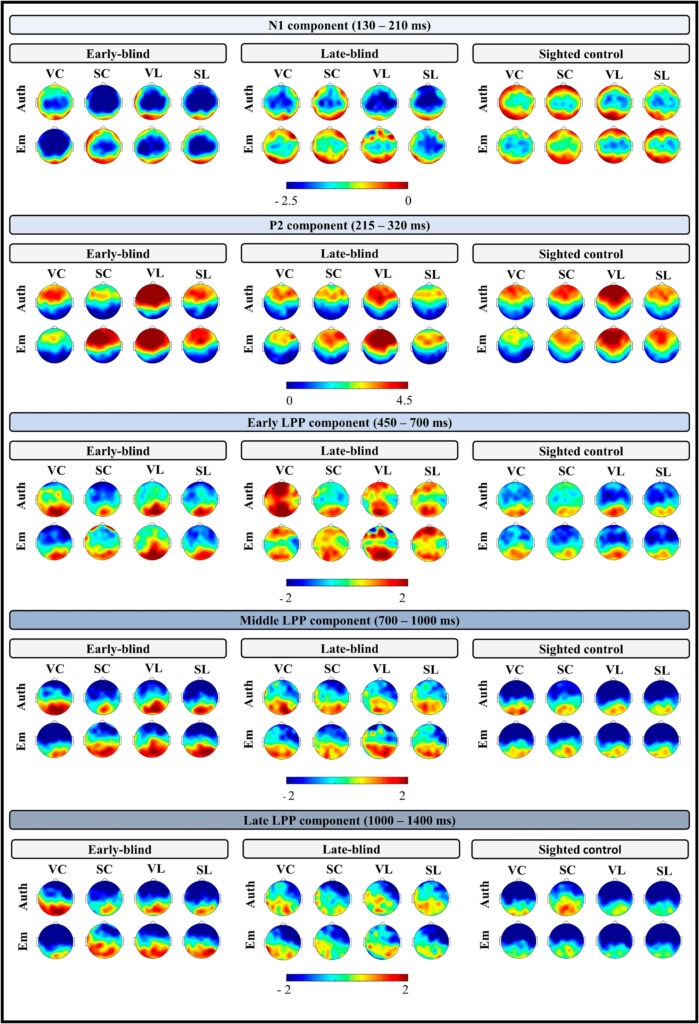
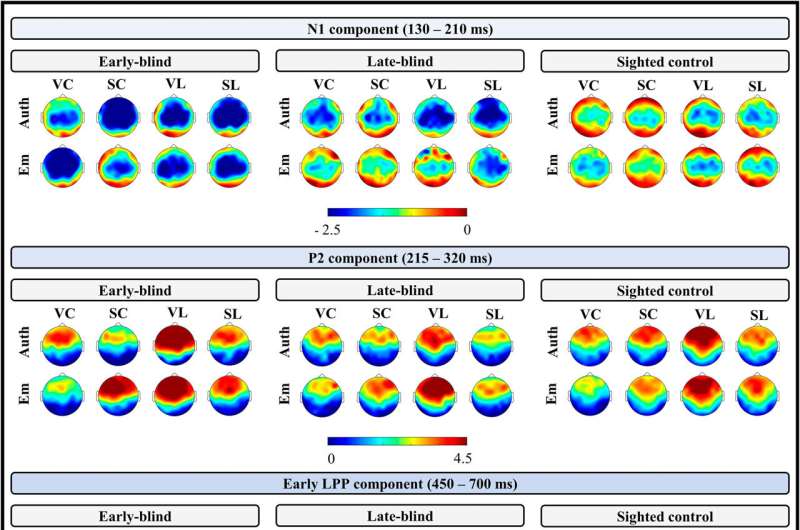
All participants performed two tasks while EEG data was recorded. In one task the participants were instructed to discriminate the emotional authenticity of the stimuli and in the other task to discriminate the emotion (sadness vs. joy). The stimuli consisted of forced or authentic laughter and crying. The ERP analysis centered on three components: N1, P2, and late positive potential (LPP). These ERP components reflect different stages of vocal emotional information processing related to early sensory processing (N1), salience detection (P2), and cognitive evaluation (LPP).
Behaviorally the results revealed that early-blind participants showed intact authenticity perception, in opposite to late-blind participants who performed worse than controls. There were no group differences in the emotion discrimination task.
In brain responses, all groups were sensitive to laughter authenticity at the P2 stage, and to crying authenticity at the early LPP stage. Nevertheless, only early-blind participants were sensitive to crying authenticity at the N1 and middle LPP stages, and to laughter authenticity at the early LPP stage. Furthermore, early-blind and sighted participants were more sensitive than late-blind ones to crying authenticity at the P2 and late LPP stages.
“These findings suggest that prolonged visual deprivation with late-onset impairs the processing of emotional authenticity,” says Tatiana Conde, opposing that “the early onset of visual deprivation seems to potentially lead to benefits in complex auditory abilities.”
More information:
João Sarzedas et al, Blindness influences emotional authenticity perception in voices: Behavioral and ERP evidence, Cortex (2023). DOI: 10.1016/j.cortex.2023.11.005
Provided by
BIAL Foundation
Citation:
How blindness affects the perception of whether an emotion is authentic or posed (2024, March 5)
retrieved 5 March 2024
from https://medicalxpress.com/news/2024-03-affects-perception-emotion-authentic-posed.html
This document is subject to copyright. Apart from any fair dealing for the purpose of private study or research, no
part may be reproduced without the written permission. The content is provided for information purposes only.

Khamrah by Lattafa for Men - 3.4 oz EDP Spray
4% Off
Ghost Sweetheart Eau de Toilette | Pineapple, Jasmine and Sandalwood | Perfume for Women 50 ml
50% Off
Marc Jacobs Dot Eau De Parfum for Women, 100 ml
42% Off
Ted Baker W Eau de Toilette for Her, Fig Leaf, White Peony and Violet Top Notes, Pink Orchid and Raspberry Middle Notes, 75ml
£11.77 (£15.69 / 100 ml) (as of 17/10/2026 06:36 GMT +01:00 - More infoProduct prices and availability are accurate as of the date/time indicated and are subject to change. Any price and availability information displayed on [relevant Amazon Site(s), as applicable] at the time of purchase will apply to the purchase of this product.)
Ted Baker Woman Pink Eau de Toilette Spray Floral Green Feminine Fragrance, Opening Notes are Fresh Peach, Bergamot and Tangerine with Warm Musk, Vanilla and Vetiver Base, 100ml
11% Off
Vera Wang Princess Eau de Toilette - 30 ml

Choco Musk 50ml Eau De Parfum for men and women | Chocolate Musk by Jannat Aromas
17% Off
Christina Aguilera Signature Eau de Parfum (50ml) Floral, Fruity & Exotic Scent, Luxury Fragrance for Women
9% Off
Calvin Klein - Eau De Toilette CKIN2U - Calvin Klein Women, Ladies Perfume, Women's Perfume, Calvin Klein Perfume, Calvin Klein One - 150 ml
5% Off
Jimmy Choo Flash Eau de Parfum, 60 ml (Pack of 1)
3% Off
Fruit of the Loom Men's Heavy T Shirt, White, XL UK
28% Off
ATNKE LED Lighted Beanie Cap,USB Rechargeable Running Hat Ultra Bright 4 LED Waterproof Light Winter Warm Gifts for Men and Women/Pink
17% Off
Men's 1/4 Zip Pullover UK Sale Clearance, Fleece Sweatshirt Casual Jumper Long Sleeve T-shirt Top Stand Collar Sweater Plain Pullover Sports Leisure Workwear Quarter Zip Sweater Lightweight Jumpers
£5.88 (as of 12/11/2025 00:52 GMT +01:00 - More infoProduct prices and availability are accurate as of the date/time indicated and are subject to change. Any price and availability information displayed on [relevant Amazon Site(s), as applicable] at the time of purchase will apply to the purchase of this product.)
Crevice Cleaning Brush, Bathroom Tile Groove Gap Cleaning Brush,Premium Crevice Cleaning Tool Aluminum Support with 15° Angle Magic Brush, Thin Brush for Home Kitchen
19% Off
Wireless Earbuds, Bluetooth 5.3 Headphones in Ear with HiFi Stereo Deep Bass, 4 ENC Noise Cancelling Mic Wireless Earphones 40H Playtime, Bluetooth Earbuds Dual LED Display, IP7 Waterproof, USB-C
42% Off