 [
[

New clues from genetic research may help explain what causes the most common heart defect present at birth. Researchers at KTH Royal Institute of Technology and Karolinska Institutet have identified rare DNA changes during fetal development that can lead to the aortic valve forming with only two cusps instead of three, a condition known as bicuspid aortic valve (BAV).
Publishing in Nature Communications, the researchers identified nearly 30 times more potential genes linked to BAV than previously known. The paper is titled “Rare regulatory mutations disrupt mesenchymal molecular programs driving endocardial cushion formation in bicuspid aortic valve.”
“The study offers a clearer understanding of how the aortic valve is formed, but also highlights the genetic complexity of BAV and its associated aortopathy,” says Hanna Björck, associate professor at the Department of Medicine, Solna, Karolinska Institutet.
People born with BAV often go on to develop complications, such as a narrowing of the valve or enlargement of the aorta. More than half will undergo surgery at some point in their lives.
Identified rare genetic variants
But the underlying causes have long remained unclear. Earlier research showed a small number of cases are caused by changes in genes that contain the instructions for making proteins, the molecules that carry out most of the work in a cell. However, this explained only about 10% of all cases. Most patients had no known genetic cause.
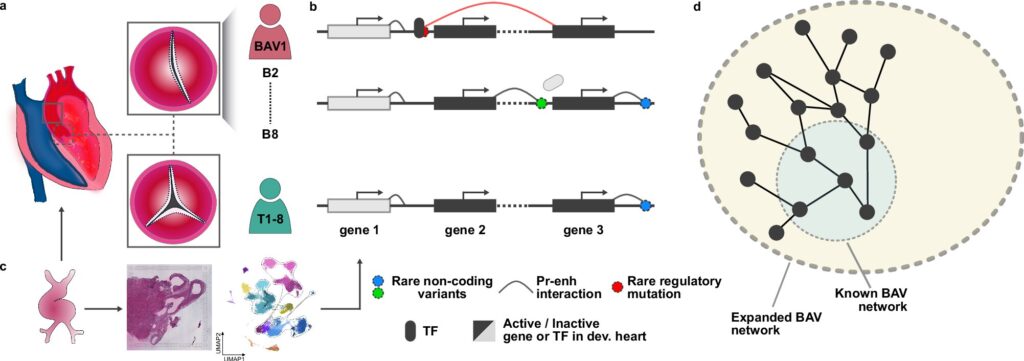
The new study shifted attention to a different part of the DNA—the regulatory regions of the genome that act like switches, turning important genes on or off during early development. The researchers studied vascular tissue from eight people with BAV and eight people with normal valves.
Rather than focus on genes themselves, the researchers used a technique called HiCap, for targeted 3D genome mapping to examine how the DNA is arranged inside the cell and how regulatory regions connect to key developmental genes.
“We found that rare mutations in the regulatory parts of DNA are likely to play a major role in causing BAV,” says Pelin Sahlén, associate professor at KTH Royal Institute of Technology.
Traces of embryonic development
Each patient in the study had different mutations, but many of these mutations disrupted the same important genes that shape the aortic valve in the fetus.
“This suggests that even though the mutations vary, they interfere with the same developmental processes,” says Artemy Zhigulev, postdoctoral researcher at Karolinska Institutet and former Ph.D. student at KTH Royal Institute of Technology.
Researchers say that one of the most surprising discoveries is that adult heart cells retain traces of what went wrong during fetal development. Harmful changes that happened before birth can be detected decades later. The finding indicates adult tissue samples can be used to study problems that originally occurred in the early stages of life.
Publication details
Artemy Zhigulev et al, Rare regulatory mutations disrupt mesenchymal molecular programs driving endocardial cushion formation in bicuspid aortic valve, Nature Communications (2026). DOI: 10.1038/s41467-026-71758-5
Journal information:
Nature Communications
Key medical concepts
Clinical categories
Citation:
Genetic study reveals likely cause of common heart valve defect (2026, April 24)
retrieved 24 April 2026
from https://medicalxpress.com/news/2026-04-genetic-reveals-common-heart-valve.html
This document is subject to copyright. Apart from any fair dealing for the purpose of private study or research, no
part may be reproduced without the written permission. The content is provided for information purposes only.

Khamrah by Lattafa for Men - 3.4 oz EDP Spray
4% Off
Ghost Sweetheart Eau de Toilette | Pineapple, Jasmine and Sandalwood | Perfume for Women 50 ml
50% Off
Marc Jacobs Dot Eau De Parfum for Women, 100 ml
42% Off
Ted Baker W Eau de Toilette for Her, Fig Leaf, White Peony and Violet Top Notes, Pink Orchid and Raspberry Middle Notes, 75ml
£11.77 (£15.69 / 100 ml) (as of 24/06/2026 03:34 GMT +01:00 - More infoProduct prices and availability are accurate as of the date/time indicated and are subject to change. Any price and availability information displayed on [relevant Amazon Site(s), as applicable] at the time of purchase will apply to the purchase of this product.)
Ted Baker Woman Pink Eau de Toilette Spray Floral Green Feminine Fragrance, Opening Notes are Fresh Peach, Bergamot and Tangerine with Warm Musk, Vanilla and Vetiver Base, 100ml
11% Off
Vera Wang Princess Eau de Toilette - 30 ml

Choco Musk 50ml Eau De Parfum for men and women | Chocolate Musk by Jannat Aromas
17% Off
Christina Aguilera Signature Eau de Parfum (50ml) Floral, Fruity & Exotic Scent, Luxury Fragrance for Women
9% Off
Calvin Klein - Eau De Toilette CKIN2U - Calvin Klein Women, Ladies Perfume, Women's Perfume, Calvin Klein Perfume, Calvin Klein One - 150 ml
5% Off
Jimmy Choo Flash Eau de Parfum, 60 ml (Pack of 1)
3% Off
Fruit of the Loom Men's Heavy T Shirt, White, XL UK
28% Off
ATNKE LED Lighted Beanie Cap,USB Rechargeable Running Hat Ultra Bright 4 LED Waterproof Light Winter Warm Gifts for Men and Women/Pink
17% Off
Men's 1/4 Zip Pullover UK Sale Clearance, Fleece Sweatshirt Casual Jumper Long Sleeve T-shirt Top Stand Collar Sweater Plain Pullover Sports Leisure Workwear Quarter Zip Sweater Lightweight Jumpers
£5.88 (as of 12/11/2025 00:52 GMT +01:00 - More infoProduct prices and availability are accurate as of the date/time indicated and are subject to change. Any price and availability information displayed on [relevant Amazon Site(s), as applicable] at the time of purchase will apply to the purchase of this product.)
Crevice Cleaning Brush, Bathroom Tile Groove Gap Cleaning Brush,Premium Crevice Cleaning Tool Aluminum Support with 15° Angle Magic Brush, Thin Brush for Home Kitchen
19% Off
Wireless Earbuds, Bluetooth 5.3 Headphones in Ear with HiFi Stereo Deep Bass, 4 ENC Noise Cancelling Mic Wireless Earphones 40H Playtime, Bluetooth Earbuds Dual LED Display, IP7 Waterproof, USB-C
42% Off