 [
[

A novel study has revealed a link between extreme weather and the risk of cardiovascular disease among middle-aged and older adults in 157 Chinese cities. Based on a city’s climate and location, exposure to extreme heat, cold, and precipitation each increases the risk of heart disease.
The findings of the study in the American Journal of Preventive Medicine, provide evidence for policymakers across different regions to develop targeted strategies protecting vulnerable populations during extreme climate events.
Extreme climate events (ECEs) have intensified globally as climate change accelerates, posing unprecedented threats to public health. China’s rapidly aging population, with 400 million people over 60 years of age projected by 2035, reflects a growing population with increased vulnerability.
Cardiovascular diseases (CVDs), the leading causes of death in China, are particularly prevalent among older adults. Prior studies have linked CVDs to extreme temperatures.
Lead investigator Ya Fang, MD, Ph.D., says, “By integrating macro (city-level) and micro (individual-level) evidence with advanced spatial and causal analysis methods, we have painted a more complete picture of how climate extremes threaten heart health.
“Our study focuses on CVD in middle-aged and older adults—a high-risk age group—and identifies actionable subgroups, thereby providing a basis for adaptive urban-rural planning and clinical interventions, filling critical gaps in climate-health policy.”
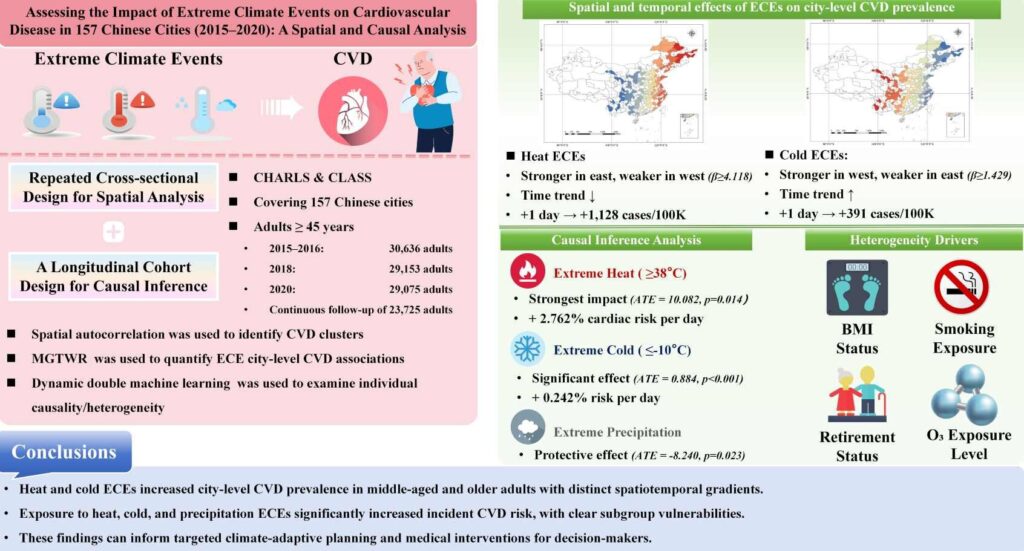
The researchers from the School of Public Health, Xiamen University, China, employed spatial econometric methods to examine the impact of extreme climate events on city-level CVD prevalence among middle-aged and older adults in China using longitudinal data (2015–2020) from the China Health and Retirement Longitudinal Study (CHARLS) and the Chinese Longitudinal Aging Social Survey (CLASS).
They validated the link between individual ECE exposure and CVD risk using a double machine learning approach.
Key results include:
- Extreme heat (above 38ºC) increased city-level CVD prevalence with a weakening east-west impact gradient; each additional heat ECE day was associated with 1,128 more CVD cases per 100,000 people.
- Extreme cold (below -10ºC) increased city-level CVD prevalence with a weakening west-east impact gradient; each additional cold ECE day was associated with 391 more CVD cases per 100,000 people.
- Causal inference analysis revealed that each heat ECE day increased individual CVD risk by 3.044%, cold ECE days by 0.110%, and precipitation ECE days by 1.620%.
Heterogeneity analysis identified high-risk subgroups:
- Heat ECEs affected pre-retirees, smokers, and residents in high ozone (O3) areas (with higher BMI mitigating risk).
- Cold ECEs impacted pre-retirees, individuals with high BMI, and high-O3 populations.
- Precipitation ECEs most strongly affected older adults, rural residents, pre-retirees, and unmarried individuals.
The investigators explain that BMI-related risk depends on temperature intensity. Above 38°C, the physics of heat exchange reverses: heat flows from the environment into the body rather than escaping. In this scenario, body fat acts as a protective physical barrier, blocking external heat and reducing cardiovascular strain.
In contrast, below -10°C, the mild insulation of body fat is overwhelmed by the cardiovascular risks of higher body weight. For those with higher BMI, cold-induced stress—which raises blood pressure and thickens blood viscosity—is significantly amplified, increasing cardiovascular risk despite any insulating effect.
The researchers were surprised by the impact of extreme precipitation—an understudied area. Unlike extreme temperatures, extreme precipitation did not exhibit a continuous, regular spatial pattern at the regional level, yet it showed significant adverse effects on CVD at the individual level.
Co-investigator Liangwen Zhang, Ph.D., notes, “This discrepancy may stem from the fact that the multi-scale geographic analysis emphasizes average regional effects, while the health impacts of extreme precipitation are diluted by differences in individual exposure and regional protective measures, such as urban-rural differences in drainage infrastructure and health care accessibility.
“Unlike the cumulative effects of extreme temperatures, precipitation ECEs are primarily associated with single, short-duration events (heavy short-term rainfall) with scattered spatial distribution. The observed CVD risk may be attributed to abrupt changes in temperature and humidity caused by heavy precipitation.”
The investigators emphasize that further research into extreme precipitation events is needed to elucidate their impact on heart health.
The study highlights the following strategies for policymakers to protect vulnerable populations during extreme climate events:
- Prioritizing climate-vulnerable regions by linking meteorological alerts to health care networks, alerting high-risk groups and pre-positioning resources.
- Offering weight management, air purification support, and simplified health education for high-risk subgroups.
- Establishing alliances to share resources between high-capacity areas and hotspots and prioritizing CVD prevention funding in fast-urbanizing regions.
- Expanding green spaces and upgrading cooling/heating infrastructure.
- Tracking climate and CVD data to dynamically adjust policies.
“Climate change is not just an environmental issue; it is a key factor affecting population health, for which urgent interdisciplinary action is required,” concludes co-investigator Linjiang Wei, Ph.D. “Older adults are more vulnerable due to age-related physiological decline and underlying diseases.”
Publication details
Assessing the Impact of Extreme Climate Events on Cardiovascular Disease in 157 Chinese Cities (2015–2020): A Spatial and Causal Analysis, American Journal of Preventive Medicine (2026). DOI: 10.1016/j.amepre.2026.108280
Journal information:
American Journal of Preventive Medicine
Key medical concepts
Citation:
Extreme climate events increase heart disease risk, new study reveals (2026, April 21)
retrieved 21 April 2026
from https://medicalxpress.com/news/2026-04-extreme-climate-events-heart-disease.html
This document is subject to copyright. Apart from any fair dealing for the purpose of private study or research, no
part may be reproduced without the written permission. The content is provided for information purposes only.

Khamrah by Lattafa for Men - 3.4 oz EDP Spray
4% Off
Ghost Sweetheart Eau de Toilette | Pineapple, Jasmine and Sandalwood | Perfume for Women 50 ml
50% Off
Marc Jacobs Dot Eau De Parfum for Women, 100 ml
42% Off
Ted Baker W Eau de Toilette for Her, Fig Leaf, White Peony and Violet Top Notes, Pink Orchid and Raspberry Middle Notes, 75ml
£11.77 (£15.69 / 100 ml) (as of 08/06/2026 03:30 GMT +01:00 - More infoProduct prices and availability are accurate as of the date/time indicated and are subject to change. Any price and availability information displayed on [relevant Amazon Site(s), as applicable] at the time of purchase will apply to the purchase of this product.)
Ted Baker Woman Pink Eau de Toilette Spray Floral Green Feminine Fragrance, Opening Notes are Fresh Peach, Bergamot and Tangerine with Warm Musk, Vanilla and Vetiver Base, 100ml
11% Off
Vera Wang Princess Eau de Toilette - 30 ml

Choco Musk 50ml Eau De Parfum for men and women | Chocolate Musk by Jannat Aromas
17% Off
Christina Aguilera Signature Eau de Parfum (50ml) Floral, Fruity & Exotic Scent, Luxury Fragrance for Women
9% Off
Calvin Klein - Eau De Toilette CKIN2U - Calvin Klein Women, Ladies Perfume, Women's Perfume, Calvin Klein Perfume, Calvin Klein One - 150 ml
5% Off
Jimmy Choo Flash Eau de Parfum, 60 ml (Pack of 1)
3% Off
Fruit of the Loom Men's Heavy T Shirt, White, XL UK
28% Off
ATNKE LED Lighted Beanie Cap,USB Rechargeable Running Hat Ultra Bright 4 LED Waterproof Light Winter Warm Gifts for Men and Women/Pink
17% Off
Men's 1/4 Zip Pullover UK Sale Clearance, Fleece Sweatshirt Casual Jumper Long Sleeve T-shirt Top Stand Collar Sweater Plain Pullover Sports Leisure Workwear Quarter Zip Sweater Lightweight Jumpers
£5.88 (as of 12/11/2025 00:52 GMT +01:00 - More infoProduct prices and availability are accurate as of the date/time indicated and are subject to change. Any price and availability information displayed on [relevant Amazon Site(s), as applicable] at the time of purchase will apply to the purchase of this product.)
Crevice Cleaning Brush, Bathroom Tile Groove Gap Cleaning Brush,Premium Crevice Cleaning Tool Aluminum Support with 15° Angle Magic Brush, Thin Brush for Home Kitchen
19% Off
Wireless Earbuds, Bluetooth 5.3 Headphones in Ear with HiFi Stereo Deep Bass, 4 ENC Noise Cancelling Mic Wireless Earphones 40H Playtime, Bluetooth Earbuds Dual LED Display, IP7 Waterproof, USB-C
42% Off