 [
[


Researchers led by the Institut Pasteur, Université Paris, have developed a vaccine that elicits anti-Immunoglobulin E antibodies in humanized mice, protects against Immunoglobulin E-mediated anaphylaxis, and shows no detectable adverse reaction over one year of observation.
Allergy and anaphylaxis create major patient discomfort and potentially life-threatening conditions. Immunoglobulin E (IgE) is at the core of anaphylaxis biology, particularly in reactions against foods. Allergens crosslink onto IgE while it is bound to its high-affinity receptor FcεRI on the surface of mast cells and basophils, causing those cells to release substances that then cause allergy symptoms, including anaphylaxis.
Omalizumab, an approved monoclonal antibody therapy, blocks IgE from binding FcεRI, reduces free IgE, and down-regulates FcεRI expression. First approval came for asthma, and more recently, omalizumab received US Food and Drug Administration approval for food allergy.
In a recent study of individuals with food allergies, one-third did not meet the clinical end point for omalizumab. Questions also remain about financial feasibility and adherence, since monoclonal antibody therapies are expensive and injections are required every few weeks, potentially over a lifetime.
An idea first developed in the early 1990s has reentered the conversation. Instead of administering therapeutic antibodies, the host might be prompted to make endogenous, omalizumab-like antibodies by immunizing against IgE.
Antibodies against IgE face important constraints. Antibodies that bind IgE outside the FcεRI-binding domain can still crosslink IgE molecules on the surface of mast cells and basophils and potentially trigger a clinical reaction. Any such approach also needs to overcome immune tolerance and induce antibodies against self-IgE in sufficient titers to block FcεRI binding over the long term.

Designing an IgE locking vaccine
In the study, “A vaccine targeting human IgE induces long-term protection against anaphylaxis in humanized mice,” published in Science Translational Medicine, researchers designed a conjugate vaccine to induce high-avidity antibodies that coerce free IgE into a closed state that cannot bind FcεRI.
Vaccine design drew on the crystal structure of omalizumab binding to IgE. Structural work showed that IgE toggles between open and closed states. FcεRI binding is accessible only in the open state, and omalizumab functions by locking IgE in the closed state so that FcεRI cannot engage.
Using that structural map, the team engineered a target antigen composed of a fragment of IgE with the domains required to bind FcεRI and introduced a point mutation, G335C, that permanently locks this fragment into the closed state.
Researchers attached the mutated IgE fragment to a highly immunogenic but nontoxic mutant of diphtheria toxin to create the vaccine and IgE-humanized mice received IgE-K immunization.
IgE-humanized mice that received the vaccine (IgE-K) produced anti–human IgE antibodies. Serum collected from these vaccinated animals blocked IgE binding to FcεRI in vitro, showing that vaccination generated antibodies capable of interfering with that interaction.
Testing protection
Humanized mice carrying both human IgE and human FcεRI then received the IgE-K vaccine before passive transfer of human IgE specific for the model antigen NP.

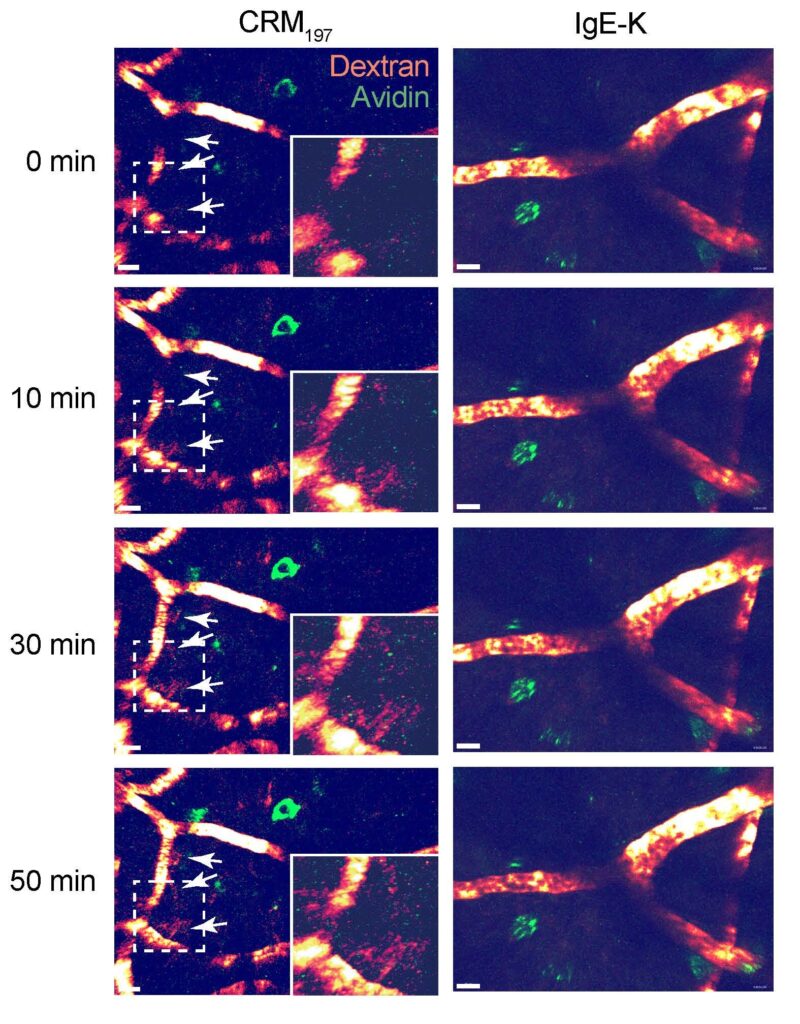
In a local skin reaction test, vaccinated animals showed reduced extravasation and reduced mast-cell degranulation (release of histamines and enzymes) in the skin compared with controls after antigen challenge.
In a systemic model, vaccinated mice did not develop signs of anaphylaxis and showed reduced systemic mast cell activation compared with controls after systemic administration of human IgE and antigen.
Peanut-allergic humanized mice that received IgE-K after sensitization showed greatly reduced signs of anaphylaxis after a high dose of polyclonal anti-IgE.
Taken together, these experiments show that IgE-K vaccination controlled IgE-mediated anaphylaxis in these settings. Findings indicate that IgE-K might be able to overcome tolerance and establish long-term anti-IgE reservoirs in this setting.
Balancing safety and immune defense
IgE-K–vaccinated hIgE-hFcεRI mice had no detectable adverse reaction to IgE-K immunization. Findings may indicate that, for some unknown reason, crosslinking was not meaningfully induced in vivo.
Another possibility is that the progressive increase in anti-IgE that emerged after immunization softly triggered mast cells over time and effectively desensitized them. Any subsequent IgE antibodies would have been blocked from binding FcεRI, leaving the mice unable to respond to later challenges.
Mast cells play pathogenic roles in atopic disease and also participate in protection against parasitic infection. In a nematode infection model that does not require IgE for protection, IgE-K–vaccinated mice and control mice showed similar mast cell numbers, similar mast cell activation, and similar parasite clearance.
Findings indicate that mast cells in vaccinated mice remained functional. A suggested next step is evaluation of IgE-K in a model of multicellular parasitic infection cleared by both IgE and mast cells.
Long-term IgE production may arise from long-lived IgE plasma cells or from IgG+ type 2-polarized memory B cells capable of generating IgE-secreting plasma cells upon allergen exposure. Ligation of the B cell receptor on IgE-secreting plasma cells induces apoptosis, a feature that suggests anti-IgE antibodies generated during IgE-K vaccination could further deplete IgE titers through this mechanism.
Strong suppression of anaphylaxis in the absence of adverse events makes the IgE-K vaccine a very enticing therapeutic candidate if results can translate to humans.
Written for you by our author Justin Jackson, edited by Sadie Harley, and fact-checked and reviewed by Robert Egan—this article is the result of careful human work. We rely on readers like you to keep independent science journalism alive.
If this reporting matters to you,
please consider a donation (especially monthly).
You’ll get an ad-free account as a thank-you.
More information:
Eva Conde et al, A vaccine targeting human IgE induces long-term protection against anaphylaxis in humanized mice, Science Translational Medicine (2025). DOI: 10.1126/scitranslmed.ads0982
© 2025 Science X Network
Citation:
Rethinking long-term allergy treatments: Experimental vaccine protects against anaphylaxis in mice (2025, December 8)
retrieved 8 December 2025
from https://medicalxpress.com/news/2025-12-rethinking-term-allergy-treatments-experimental.html
This document is subject to copyright. Apart from any fair dealing for the purpose of private study or research, no
part may be reproduced without the written permission. The content is provided for information purposes only.

Khamrah by Lattafa for Men - 3.4 oz EDP Spray
4% Off
Ghost Sweetheart Eau de Toilette | Pineapple, Jasmine and Sandalwood | Perfume for Women 50 ml
50% Off
Marc Jacobs Dot Eau De Parfum for Women, 100 ml
42% Off
Ted Baker W Eau de Toilette for Her, Fig Leaf, White Peony and Violet Top Notes, Pink Orchid and Raspberry Middle Notes, 75ml
£11.77 (£15.69 / 100 ml) (as of 13/10/2026 06:34 GMT +01:00 - More infoProduct prices and availability are accurate as of the date/time indicated and are subject to change. Any price and availability information displayed on [relevant Amazon Site(s), as applicable] at the time of purchase will apply to the purchase of this product.)
Ted Baker Woman Pink Eau de Toilette Spray Floral Green Feminine Fragrance, Opening Notes are Fresh Peach, Bergamot and Tangerine with Warm Musk, Vanilla and Vetiver Base, 100ml
11% Off
Vera Wang Princess Eau de Toilette - 30 ml

Choco Musk 50ml Eau De Parfum for men and women | Chocolate Musk by Jannat Aromas
17% Off
Christina Aguilera Signature Eau de Parfum (50ml) Floral, Fruity & Exotic Scent, Luxury Fragrance for Women
9% Off
Calvin Klein - Eau De Toilette CKIN2U - Calvin Klein Women, Ladies Perfume, Women's Perfume, Calvin Klein Perfume, Calvin Klein One - 150 ml
5% Off
Jimmy Choo Flash Eau de Parfum, 60 ml (Pack of 1)
3% Off
Fruit of the Loom Men's Heavy T Shirt, White, XL UK
28% Off
ATNKE LED Lighted Beanie Cap,USB Rechargeable Running Hat Ultra Bright 4 LED Waterproof Light Winter Warm Gifts for Men and Women/Pink
17% Off
Men's 1/4 Zip Pullover UK Sale Clearance, Fleece Sweatshirt Casual Jumper Long Sleeve T-shirt Top Stand Collar Sweater Plain Pullover Sports Leisure Workwear Quarter Zip Sweater Lightweight Jumpers
£5.88 (as of 12/11/2025 00:52 GMT +01:00 - More infoProduct prices and availability are accurate as of the date/time indicated and are subject to change. Any price and availability information displayed on [relevant Amazon Site(s), as applicable] at the time of purchase will apply to the purchase of this product.)
Crevice Cleaning Brush, Bathroom Tile Groove Gap Cleaning Brush,Premium Crevice Cleaning Tool Aluminum Support with 15° Angle Magic Brush, Thin Brush for Home Kitchen
19% Off
Wireless Earbuds, Bluetooth 5.3 Headphones in Ear with HiFi Stereo Deep Bass, 4 ENC Noise Cancelling Mic Wireless Earphones 40H Playtime, Bluetooth Earbuds Dual LED Display, IP7 Waterproof, USB-C
42% Off