 [
[

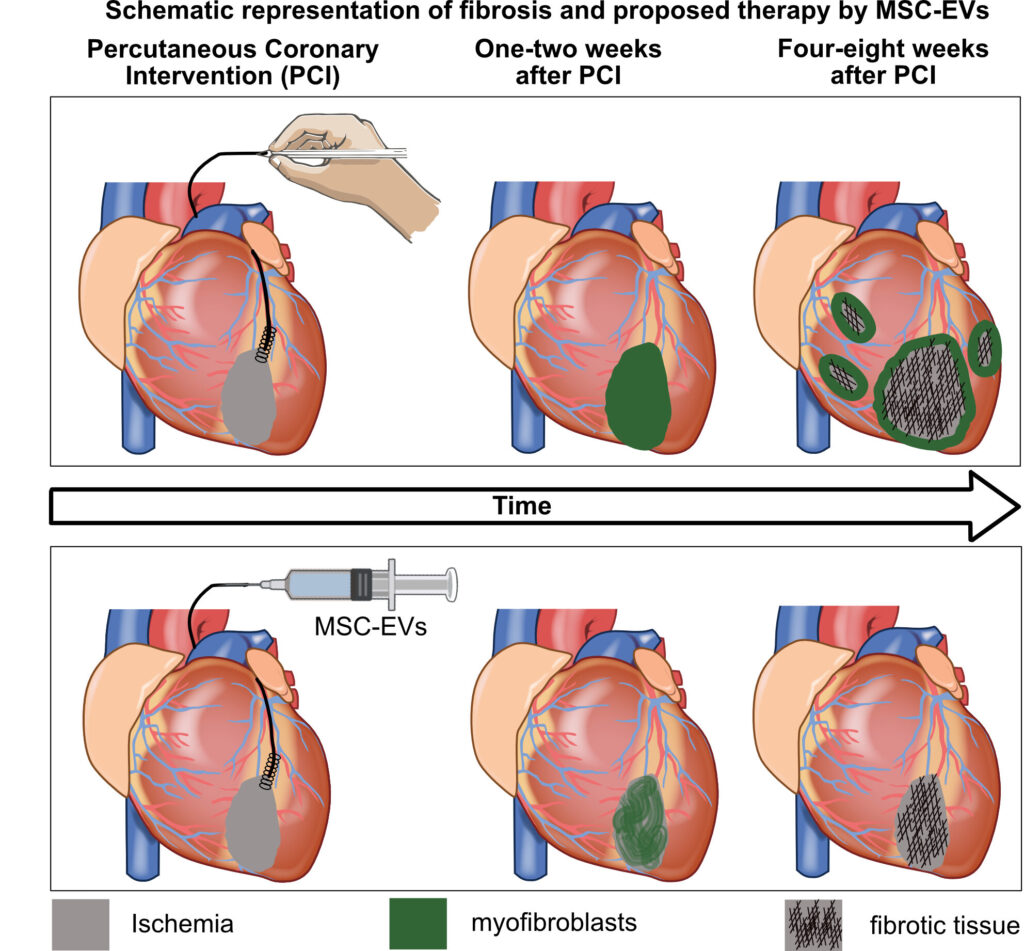
Many people who survive a heart attack will later develop heart failure due to the scarring that occurs as the heart heals. Researchers at Uppsala University are now presenting a new type of biological treatment that is administered directly into the damaged blood vessel and stimulates healing. In the study, they also demonstrate how a new PET (Positron Emission Tomography) method can be used to identify patients with ongoing scarring and, ultimately, enable personalized treatment.
Millions of people around the world suffer a heart attack each year. Although current treatments rapidly restore blood flow to the heart, many patients go on to develop heart failure. A key cause is the inflammation-driven scarring that occurs after the heart attack. There are currently no treatments that specifically target this process.
New biological drug reduces inflammation
In the current study, published in the journal Cell Stem Cell, the researchers present a new therapy that reduces inflammation and subsequent scarring. The treatment has been developed for clinical use in conjunction with balloon angioplasty.
“We’ve developed a completely new type of biological drug that can be described as an anti-inflammatory treatment. It can be administered during balloon angioplasty to dampen inflammation and the scarring process that can otherwise lead to heart failure. The study shows that the treatment is effective in both small and large animal models, and we now hope to proceed with a clinical trial this autumn. We believe the method has great potential to reduce the risk of heart failure after a heart attack and thus also reduce the risk of cardiac death,” says Karl-Henrik Grinnemo, professor and consultant in cardio-thoracic surgery at Uppsala University and Uppsala University Hospital, and the study’s first author.

Utilizing the body’s own process
The biological drug is produced from donated human bone marrow. The researchers cultivate stromal cells from the bone marrow and then harvest the tiny particles known as exosomes that are produced by the cells. Exosomes are small membrane vesicles that transmit signaling molecules between cells. Although they occur naturally in the body, they are produced here in the laboratory so they can be delivered to the damaged coronary artery in much higher concentrations.
The study has shown that the exosomes both reduce the scarring process and preserve heart function over time in a small-animal model and that they have an acute cardioprotective effect in pig trials when administered directly into the coronary arteries.
“The role of the exosomes is to ‘switch’ the activated inflammatory cells in the body away from further stimulating inflammation and toward doing the opposite—dampening inflammation and promoting healing. What we are doing is utilizing the body’s own cells and amplifying a process that already occurs naturally.”
In previous studies on severe inflammatory conditions in the lungs, researchers used stromal cells with associated exosomes to achieve a similar effect. The method developed by the Uppsala researchers uses only the exosomes, which offers many advantages. They are cheaper, can be used for more patients and can easily be frozen, then thawed and used immediately.
-

In mice treated with exosomes (MSC-EV), the signal instead decreased over time, suggesting that the treatment reduces the long-term activation of these cells and thus the continued scarring. Credit: Grinnemo et al.
-

After a heart attack, the activity (PET signal) of the scar-forming cells (myofibroblasts) progressively increased over four weeks in the untreated mice. Credit: Grinnemo et al.
-

Linear regression of the increase and decrease in 68 Ga-ATH001 binding in the infarcted areas over time in MIR-injured mice treated with placebo (red line, positive correlation) or laminin MSC-EVs (blue line, negative correlation), respectively. Scale bars: 1 mm. Credit: Grinnemo et al.
Visualizing the scarring process using PET
The researchers have developed a new PET method to monitor the effects of the treatment. Olof Eriksson, professor of drug development at Uppsala University, has developed a tracer that makes it possible to visualize the active cells driving the scarring process using PET imaging.
“For the first time, we can combine a treatment that targets the scarring process with an imaging technique that makes it possible to monitor how the patient’s heart is responding to the treatment. This paves the way for more personalized treatment after a heart attack,” Grinnemo says.
In an ongoing clinical trial, the researchers observed that some patients still had a high level of scarring two months after their heart attack, while others healed significantly faster.
“Ultimately, we also hope to be able to use PET scans to identify patients in whom the scarring process remains active months after a heart attack. These patients could then receive this treatment at an early stage, which could slow the progression of heart failure. This would be of great benefit to patients.”
May serve as a treatment for other conditions
Survival rates among patients who suffer an ST-elevation myocardial infarction (i.e. a heart attack with complete blockage of a blood vessel) and are treated with balloon angioplasty have remained virtually unchanged since 2008, largely because current therapies cannot target the scarring process that is initiated after balloon angioplasty and leads to heart failure. By targeting this process, the researchers hope to reduce mortality in the long term. Due to its anti-inflammatory effect, the researchers see several potential applications for the treatment, even outside the field of cardiology.
“We see great potential for this treatment in conditions other than heart attacks as well. Stroke is an obvious example, but also acute inflammatory conditions such as acute respiratory distress syndrome. The same principle could also be applied to organ transplants. Transplants cause severe inflammation. If we can reduce this, we could protect the heart, lungs, kidneys and liver, thereby improving the function of these organs after a transplant.”
Publication details
Karl-Henrik Grinnemo et al, Extracellular vesicle secretome from mesenchymal stromal cells prevents post-ischemic heart failure by targeting cardiac fibrosis, Cell Stem Cell (2026). DOI: 10.1016/j.stem.2026.07.003
Journal information:
Cell Stem Cell
Clinical categories


Citation:
Exosome treatment may curb heart scarring after heart attacks (2026, July 30)
retrieved 30 July 2026
from https://medicalxpress.com/news/2026-07-exosome-treatment-curb-heart-scarring.html
This document is subject to copyright. Apart from any fair dealing for the purpose of private study or research, no
part may be reproduced without the written permission. The content is provided for information purposes only.

Khamrah by Lattafa for Men - 3.4 oz EDP Spray
4% Off
Ghost Sweetheart Eau de Toilette | Pineapple, Jasmine and Sandalwood | Perfume for Women 50 ml
50% Off
Marc Jacobs Dot Eau De Parfum for Women, 100 ml
42% Off
Ted Baker W Eau de Toilette for Her, Fig Leaf, White Peony and Violet Top Notes, Pink Orchid and Raspberry Middle Notes, 75ml
£11.77 (£15.69 / 100 ml) (as of 01/08/2026 04:05 GMT +01:00 - More infoProduct prices and availability are accurate as of the date/time indicated and are subject to change. Any price and availability information displayed on [relevant Amazon Site(s), as applicable] at the time of purchase will apply to the purchase of this product.)
Ted Baker Woman Pink Eau de Toilette Spray Floral Green Feminine Fragrance, Opening Notes are Fresh Peach, Bergamot and Tangerine with Warm Musk, Vanilla and Vetiver Base, 100ml
11% Off
Vera Wang Princess Eau de Toilette - 30 ml

Choco Musk 50ml Eau De Parfum for men and women | Chocolate Musk by Jannat Aromas
17% Off
Christina Aguilera Signature Eau de Parfum (50ml) Floral, Fruity & Exotic Scent, Luxury Fragrance for Women
9% Off
Calvin Klein - Eau De Toilette CKIN2U - Calvin Klein Women, Ladies Perfume, Women's Perfume, Calvin Klein Perfume, Calvin Klein One - 150 ml
5% Off
Jimmy Choo Flash Eau de Parfum, 60 ml (Pack of 1)
3% Off
Fruit of the Loom Men's Heavy T Shirt, White, XL UK
28% Off
ATNKE LED Lighted Beanie Cap,USB Rechargeable Running Hat Ultra Bright 4 LED Waterproof Light Winter Warm Gifts for Men and Women/Pink
17% Off
Men's 1/4 Zip Pullover UK Sale Clearance, Fleece Sweatshirt Casual Jumper Long Sleeve T-shirt Top Stand Collar Sweater Plain Pullover Sports Leisure Workwear Quarter Zip Sweater Lightweight Jumpers
£5.88 (as of 12/11/2025 00:52 GMT +01:00 - More infoProduct prices and availability are accurate as of the date/time indicated and are subject to change. Any price and availability information displayed on [relevant Amazon Site(s), as applicable] at the time of purchase will apply to the purchase of this product.)
Crevice Cleaning Brush, Bathroom Tile Groove Gap Cleaning Brush,Premium Crevice Cleaning Tool Aluminum Support with 15° Angle Magic Brush, Thin Brush for Home Kitchen
19% Off
Wireless Earbuds, Bluetooth 5.3 Headphones in Ear with HiFi Stereo Deep Bass, 4 ENC Noise Cancelling Mic Wireless Earphones 40H Playtime, Bluetooth Earbuds Dual LED Display, IP7 Waterproof, USB-C
42% Off