 [
[

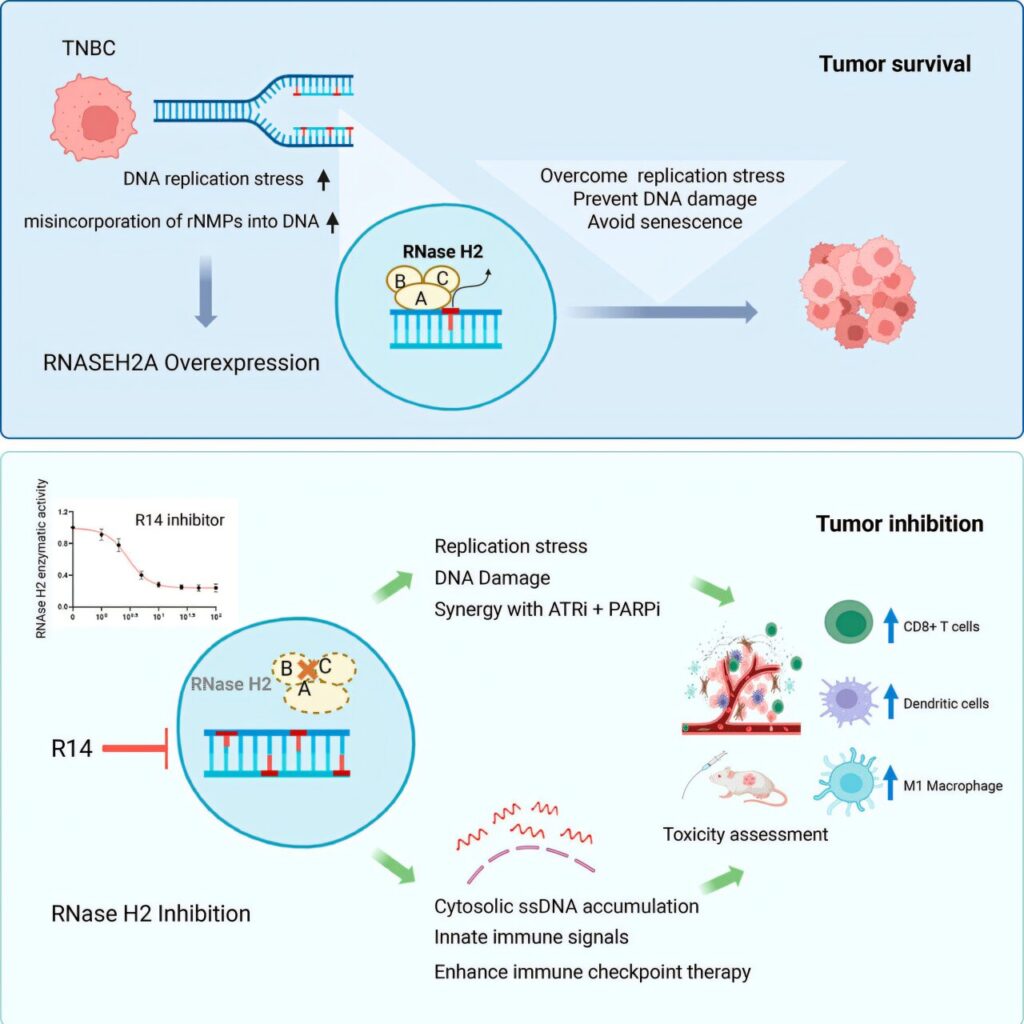
Researchers at The University of Texas MD Anderson Cancer Center have identified a key enzyme—RNase H2—that helps triple-negative breast cancer (TNBC) cells survive high levels of DNA replication stress. Because many breast cancer therapies work by causing replication stress, these results suggest RNase H2 is a promising treatment target.
The study, published in Cell Reports Medicine, was led by Shiaw-Yih Lin, Ph.D., professor of Systems Biology. The findings reveal that RNase H2 directly damages cancer cell DNA while also activating the innate immune system to produce signals that attract T cells to attack the tumor.
“Adding RNase H2 inhibition is a one-two punch that overcomes the adaptive mechanism that triple-negative breast cancer tumors leverage to survive replication stress and continue progressing,” Lin said. “Our findings show that this is a promising therapeutic strategy that lays the groundwork to meaningfully improve patient outcomes for this aggressive and difficult-to-treat subtype of breast cancer.”
How replication stress harms cancer cells
Replication stress is the slowing or stalling of DNA replication when cells copy their DNA. This causes structural DNA damage, such as single-strand DNA accumulation and the embedding of RNA pieces into DNA, leading to cell death.
Many breast cancer therapies work by causing DNA replication stress, but TNBC cells somehow survive this stress and genomic instability, even at high levels, yet it was long unclear how they have adapted to doing so.
RNase H2’s role in tumor survival
Since one of the major sources of replication stress is the accumulation of embedded RNA, the researchers focused on the RNase H2 enzyme, which normally removes stray RNA pieces that get mistakenly built into DNA to prevent DNA damage.
The researchers found that RNase H2 is highly overexpressed in TNBC tumors and correlates with poor survival, suggesting that it may contribute to the adaptive mechanism for handling DNA replication stress.
Blocking RNase H2 to boost immunity
Either genetically silencing RNase H2 or blocking it with drugs increased the amount of DNA replication stress, leading to a strong antitumor response and suppression of TNBC tumor growth in vivo. Moreover, this had an immune-boosting effect, with DNA damage activating the innate immune system to send out signals that recruit T cells to attack the cancer.
While these findings are preclinical, the use of RNase H2 inhibitors—some of which are currently in development—could one day become a strategy to improve outcomes for patients with this difficult-to-treat cancer. The study also showed that blocking RNase H2 boosts the effects of two existing classes of cancer drugs—ATR and PARP inhibitors—pointing to combination strategies that could be tested in future clinical trials.
Publication details
Thai Quynh Anh Nguyen et al, Targeting RNase H2: A dual-mechanism strategy to elevate replication stress, DNA damage, and antitumor immunity in TNBC, Cell Reports Medicine (2026). DOI: 10.1016/j.xcrm.2026.102750
Journal information:
Cell Reports Medicine
Clinical categories
Citation:
Enzyme shields triple-negative breast cancer cells from replication stress (2026, May 4)
retrieved 4 May 2026
from https://medicalxpress.com/news/2026-05-enzyme-shields-triple-negative-breast.html
This document is subject to copyright. Apart from any fair dealing for the purpose of private study or research, no
part may be reproduced without the written permission. The content is provided for information purposes only.

Khamrah by Lattafa for Men - 3.4 oz EDP Spray
4% Off
Ghost Sweetheart Eau de Toilette | Pineapple, Jasmine and Sandalwood | Perfume for Women 50 ml
50% Off
Marc Jacobs Dot Eau De Parfum for Women, 100 ml
42% Off
Ted Baker W Eau de Toilette for Her, Fig Leaf, White Peony and Violet Top Notes, Pink Orchid and Raspberry Middle Notes, 75ml
£11.77 (£15.69 / 100 ml) (as of 13/07/2026 03:57 GMT +01:00 - More infoProduct prices and availability are accurate as of the date/time indicated and are subject to change. Any price and availability information displayed on [relevant Amazon Site(s), as applicable] at the time of purchase will apply to the purchase of this product.)
Ted Baker Woman Pink Eau de Toilette Spray Floral Green Feminine Fragrance, Opening Notes are Fresh Peach, Bergamot and Tangerine with Warm Musk, Vanilla and Vetiver Base, 100ml
11% Off
Vera Wang Princess Eau de Toilette - 30 ml

Choco Musk 50ml Eau De Parfum for men and women | Chocolate Musk by Jannat Aromas
17% Off
Christina Aguilera Signature Eau de Parfum (50ml) Floral, Fruity & Exotic Scent, Luxury Fragrance for Women
9% Off
Calvin Klein - Eau De Toilette CKIN2U - Calvin Klein Women, Ladies Perfume, Women's Perfume, Calvin Klein Perfume, Calvin Klein One - 150 ml
5% Off
Jimmy Choo Flash Eau de Parfum, 60 ml (Pack of 1)
3% Off
Fruit of the Loom Men's Heavy T Shirt, White, XL UK
28% Off
ATNKE LED Lighted Beanie Cap,USB Rechargeable Running Hat Ultra Bright 4 LED Waterproof Light Winter Warm Gifts for Men and Women/Pink
17% Off
Men's 1/4 Zip Pullover UK Sale Clearance, Fleece Sweatshirt Casual Jumper Long Sleeve T-shirt Top Stand Collar Sweater Plain Pullover Sports Leisure Workwear Quarter Zip Sweater Lightweight Jumpers
£5.88 (as of 12/11/2025 00:52 GMT +01:00 - More infoProduct prices and availability are accurate as of the date/time indicated and are subject to change. Any price and availability information displayed on [relevant Amazon Site(s), as applicable] at the time of purchase will apply to the purchase of this product.)
Crevice Cleaning Brush, Bathroom Tile Groove Gap Cleaning Brush,Premium Crevice Cleaning Tool Aluminum Support with 15° Angle Magic Brush, Thin Brush for Home Kitchen
19% Off
Wireless Earbuds, Bluetooth 5.3 Headphones in Ear with HiFi Stereo Deep Bass, 4 ENC Noise Cancelling Mic Wireless Earphones 40H Playtime, Bluetooth Earbuds Dual LED Display, IP7 Waterproof, USB-C
42% Off