Gabija GataveckaiteBBC News NI Dublin Correspondent

 Getty Images
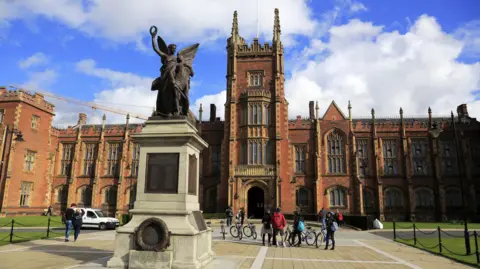
Queen’s University Belfast (QUB) is to take part in a new cross-border collaboration with the Dundalk Institute of Technology (DKIT).
DKIT will get university status and students will be awarded their certs through QUB.
The Irish government hopes to implement the changes for the 2026/2027 academic year.
Institutes of technology (ITs) in Ireland are traditionally more focused on trade and craft professions and offer a wide range of courses which are closer linked to industry than universities.
What is the collaboration?
Students who take courses in DKIT will receive their degree from QUB as part of a new partnership being announced by the Irish government.
This means even though students will study and complete their course at DKIT, they will have a degree from QUB.
The collaboration will make DKIT the “university college” of QUB.
It will also mean the current DKIT name may change to reflect its new university status.
The cross-border collaboration between the two universities was green lighted at a meeting of senior Irish ministers in Dublin on Tuesday.

The proposal was brought to a meeting of Cabinet ministers by Minister for Further and Higher Education James Lawless.
The initiative aims to strengthen cross-border collaboration in higher education, enhance research and innovation, and expand opportunities for students across the island.
Further details of the partnership between the two third level institutions will now be worked out.
In recent years, the Irish government has merged a number of ITs to form technological universities.
“It’s a major step forward in creating the first ever all island university,” Lawless told BBC News NI.
“That will mean we will have a cross-border educational institute. It’s really good news for Dundalk IT. Their qualifications will now become fully fledged Queen’s degrees and a part of the wider Queen’s family of colleges with full university status.”
He said this is “a great boost for the students in the educational community and the business community on the Dublin-Belfast corridor”.
What have student union reps said?
Student union representatives have welcomed the announcement.
President of DKIT Students Union Gerry O’Brien said this will mean education will become more accessible to more students.
Mr O’Brien said this will give “amazing opportunities” for the north-east region.
“For the region where Dundalk is located on the main M1 corridor, and its proximity to the border, it’s massive [news]. It really gives DKIT amazing opportunities for the whole region of the north east and students recognise that.
“It makes it so much more attractive to students to study here and to still be partnered with Queen’s Belfast.
“It makes it so much more accessible to all.”
Bryan O’Mahony, president of AMLE, the union of students in Ireland, said he would like to see more universities working together from both sides of the border.
“We welcome all cross border initiatives,” he said.
“It’s opening up more opportunities, more funding from the EU or the UK, this is opening up so much more opportunities for the students of Ireland.”

Economy Minister Caoimhe Archibald said strengthening academic links will “expand opportunities” for students and researchers.
“By investing in shared knowledge and talent, both institutions are shaping a future where excellence thrives through co-operation,” she said.
BBC News

Khamrah by Lattafa for Men - 3.4 oz EDP Spray
4% Off
Ghost Sweetheart Eau de Toilette | Pineapple, Jasmine and Sandalwood | Perfume for Women 50 ml
50% Off
Marc Jacobs Dot Eau De Parfum for Women, 100 ml
42% Off
Ted Baker W Eau de Toilette for Her, Fig Leaf, White Peony and Violet Top Notes, Pink Orchid and Raspberry Middle Notes, 75ml
£11.77 (£15.69 / 100 ml) (as of 26/07/2026 04:03 GMT +01:00 - More infoProduct prices and availability are accurate as of the date/time indicated and are subject to change. Any price and availability information displayed on [relevant Amazon Site(s), as applicable] at the time of purchase will apply to the purchase of this product.)
Ted Baker Woman Pink Eau de Toilette Spray Floral Green Feminine Fragrance, Opening Notes are Fresh Peach, Bergamot and Tangerine with Warm Musk, Vanilla and Vetiver Base, 100ml
11% Off
Vera Wang Princess Eau de Toilette - 30 ml

Choco Musk 50ml Eau De Parfum for men and women | Chocolate Musk by Jannat Aromas
17% Off
Christina Aguilera Signature Eau de Parfum (50ml) Floral, Fruity & Exotic Scent, Luxury Fragrance for Women
9% Off
Calvin Klein - Eau De Toilette CKIN2U - Calvin Klein Women, Ladies Perfume, Women's Perfume, Calvin Klein Perfume, Calvin Klein One - 150 ml
5% Off
Jimmy Choo Flash Eau de Parfum, 60 ml (Pack of 1)
3% Off
Fruit of the Loom Men's Heavy T Shirt, White, XL UK
28% Off
ATNKE LED Lighted Beanie Cap,USB Rechargeable Running Hat Ultra Bright 4 LED Waterproof Light Winter Warm Gifts for Men and Women/Pink
17% Off
Men's 1/4 Zip Pullover UK Sale Clearance, Fleece Sweatshirt Casual Jumper Long Sleeve T-shirt Top Stand Collar Sweater Plain Pullover Sports Leisure Workwear Quarter Zip Sweater Lightweight Jumpers
£5.88 (as of 12/11/2025 00:52 GMT +01:00 - More infoProduct prices and availability are accurate as of the date/time indicated and are subject to change. Any price and availability information displayed on [relevant Amazon Site(s), as applicable] at the time of purchase will apply to the purchase of this product.)
Crevice Cleaning Brush, Bathroom Tile Groove Gap Cleaning Brush,Premium Crevice Cleaning Tool Aluminum Support with 15° Angle Magic Brush, Thin Brush for Home Kitchen
19% Off
Wireless Earbuds, Bluetooth 5.3 Headphones in Ear with HiFi Stereo Deep Bass, 4 ENC Noise Cancelling Mic Wireless Earphones 40H Playtime, Bluetooth Earbuds Dual LED Display, IP7 Waterproof, USB-C
42% Off