BBC News, Bedfordshire

 MOLA
MOLAAn archaeological dig has revealed a village existed nearly 3,000 years earlier than the medieval period that historians initially thought it dated from.
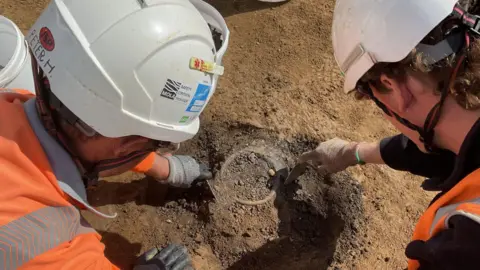
The excavation at Sharnbrook, near Bedford, carried out by the Museum of London Archaeology (Mola) uncovered new evidence that people lived in the area as early as 2,500 BC.
The excavations found two burials, including a cremation which could have dated from the Iron Age, Bronze Age pottery, and remains of an Iron Age and Roman farming settlement.
Paul Smits, managing director of Bellway Northern Home Counties, which has commissioned the dig at one of its housing development sites, said the discoveries offered “a richer understanding of the land and the ways people lived”.
 MOLA
MOLABefore the recent discoveries, historians believed the village was established in the early medieval period (AD 800-900).
One of Mola’s finds included a crouched burial, likely to be of an adult male.
Specialists have said that because the remains were found in a “too small grave” it suggests “the remains had partially decomposed before the burial took place”.
A cremation burial found at the site had remains in a small urn “set upon another layer of burnt bone”.
Mola said: “The cremation also contained small pieces of iron – possibly remains of nails from the funeral pyre.”
Chris Chinnock, its reporting team lead, and human osteologist, said the discovery was “really exciting”.
“While we don’t currently have evidence for other Bronze Age features on our site, the remains of Bronze Age burial mounds were discovered in the 1970s near Radwell, on the opposite bank of the River Great Ouse, so we look forward to exploring Sharnbrook’s Bronze Age connections further during our post-excavation work.”
 MOLA
MOLASince the dig, further studies of the crouched burial are taking place using scientific techniques to discover when and how the individual died.
Mr Smits said: “It is fascinating to discover that a community was living in this area thousands of years earlier than previously thought.”
Redrow Homes is also building in the area – at its Templars Park development.
John Mann, a managing director at Redrow, said: “We look forward to sharing these discoveries with the local community over the coming months and providing an archival legacy for future generations to enjoy.”
BBC News

Khamrah by Lattafa for Men - 3.4 oz EDP Spray
4% Off
Ghost Sweetheart Eau de Toilette | Pineapple, Jasmine and Sandalwood | Perfume for Women 50 ml
50% Off
Marc Jacobs Dot Eau De Parfum for Women, 100 ml
42% Off
Ted Baker W Eau de Toilette for Her, Fig Leaf, White Peony and Violet Top Notes, Pink Orchid and Raspberry Middle Notes, 75ml
£11.77 (£15.69 / 100 ml) (as of 06/09/2026 04:59 GMT +01:00 - More infoProduct prices and availability are accurate as of the date/time indicated and are subject to change. Any price and availability information displayed on [relevant Amazon Site(s), as applicable] at the time of purchase will apply to the purchase of this product.)
Ted Baker Woman Pink Eau de Toilette Spray Floral Green Feminine Fragrance, Opening Notes are Fresh Peach, Bergamot and Tangerine with Warm Musk, Vanilla and Vetiver Base, 100ml
11% Off
Vera Wang Princess Eau de Toilette - 30 ml

Choco Musk 50ml Eau De Parfum for men and women | Chocolate Musk by Jannat Aromas
17% Off
Christina Aguilera Signature Eau de Parfum (50ml) Floral, Fruity & Exotic Scent, Luxury Fragrance for Women
9% Off
Calvin Klein - Eau De Toilette CKIN2U - Calvin Klein Women, Ladies Perfume, Women's Perfume, Calvin Klein Perfume, Calvin Klein One - 150 ml
5% Off
Jimmy Choo Flash Eau de Parfum, 60 ml (Pack of 1)
3% Off
Fruit of the Loom Men's Heavy T Shirt, White, XL UK
28% Off
ATNKE LED Lighted Beanie Cap,USB Rechargeable Running Hat Ultra Bright 4 LED Waterproof Light Winter Warm Gifts for Men and Women/Pink

Men's 1/4 Zip Pullover UK Sale Clearance, Fleece Sweatshirt Casual Jumper Long Sleeve T-shirt Top Stand Collar Sweater Plain Pullover Sports Leisure Workwear Quarter Zip Sweater Lightweight Jumpers
£5.88 (as of 12/11/2025 00:52 GMT +01:00 - More infoProduct prices and availability are accurate as of the date/time indicated and are subject to change. Any price and availability information displayed on [relevant Amazon Site(s), as applicable] at the time of purchase will apply to the purchase of this product.)
Crevice Cleaning Brush, Bathroom Tile Groove Gap Cleaning Brush,Premium Crevice Cleaning Tool Aluminum Support with 15° Angle Magic Brush, Thin Brush for Home Kitchen
19% Off
Wireless Earbuds, Bluetooth 5.3 Headphones in Ear with HiFi Stereo Deep Bass, 4 ENC Noise Cancelling Mic Wireless Earphones 40H Playtime, Bluetooth Earbuds Dual LED Display, IP7 Waterproof, USB-C
42% Off