 [
[


Researchers have long known that diet plays an important role in health later in life, but the biological mechanisms underlying these associations are not yet fully understood. In this study, researchers examined how different dietary patterns were associated with a broad range of blood biomarkers reflecting metabolism, inflammation, vascular health and neurodegenerative processes related to aging.
The study included 1,769 people ages 60 and older who participated in the Swedish National Study on Aging and Care in Kungsholmen (SNAC-K). Participants answered questions about their dietary habits over the previous year, and researchers analyzed 54 blood biomarkers. The research is published in the journal BMC Medicine.
Three dietary patterns
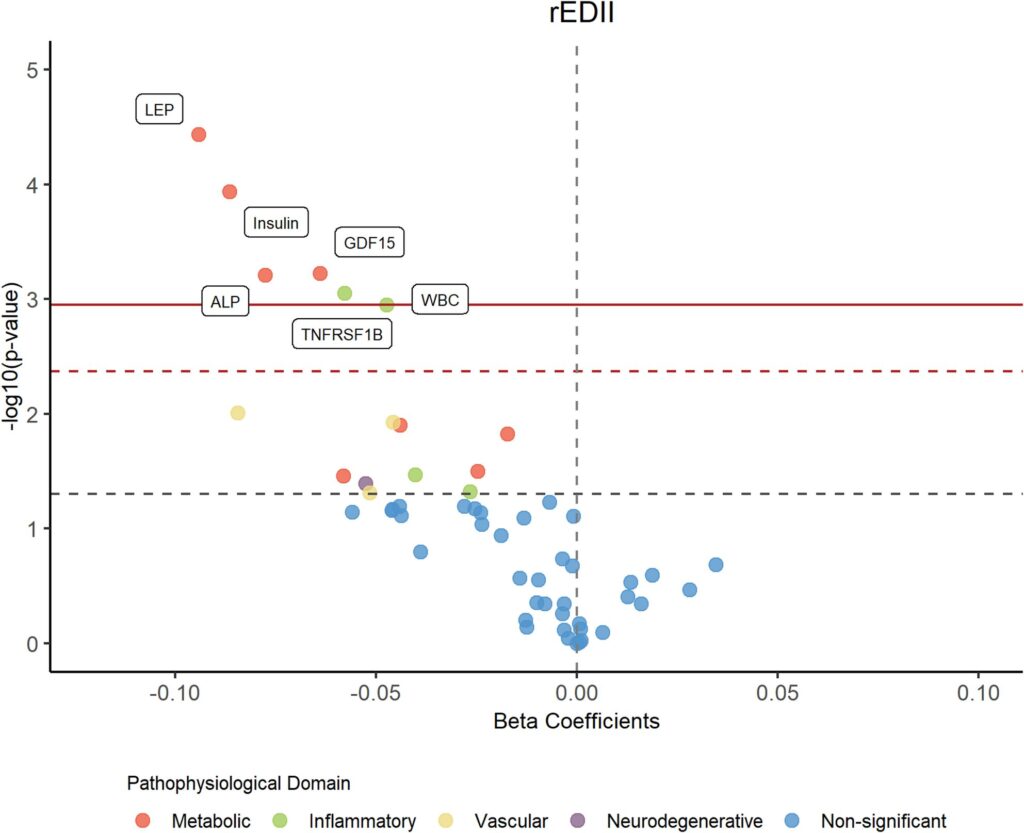
The researchers examined three dietary patterns that have previously been linked to good health: a Mediterranean-style diet, an index of overall dietary quality and a measure of the inflammatory potential of the diet. Greater adherence to these dietary patterns was associated with favorable levels of several biomarkers. These included higher folate levels and lower levels of growth differentiation factor 15, which were observed consistently across all three patterns. Additional associations with biomarkers linked to inflammation, metabolism and neurodegenerative processes were specific to individual dietary patterns.
“Our findings suggest that healthy dietary patterns are associated with several biological processes that are important for how we age. This reinforces the view of diet as a modifiable factor that may contribute to healthy aging,” says Rachel Ann Da Costa, a researcher at the Department of Neurobiology, Care Sciences and Society and first author of the study.
The dietary pattern with lower inflammatory potential showed associations with the greatest number of biomarkers, particularly those linked to inflammation and metabolism. According to the researchers, this may indicate that the inflammatory properties of diet are related to several interconnected biological processes involved in aging.
More studies needed
Because the study examined associations at a single point in time, it cannot establish cause and effect. The researchers also emphasize that participants were mainly older adults from the Stockholm area with relatively high levels of education, which may limit the generalizability of the findings to other populations.
“We now need more longitudinal and intervention studies to investigate whether changes in diet also lead to changes in the biological markers we have studied,” says Adrián Carballo-Casla, a researcher at the same department and last author of the study.
The study was conducted in collaboration among researchers at Karolinska Institutet, Stockholm University, KTH Royal Institute of Technology, Stockholm Gerontology Research Center, Universidad Autónoma de Madrid and CIBERESP in Spain, as well as the University of Ljubljana in Slovenia. The study is based on data from SNAC-K.
Three ways of measuring diet quality
Alternative Mediterranean Diet (AMED)
A dietary pattern based on the traditional Mediterranean diet. Higher scores are awarded for high consumption of vegetables, legumes, fruit, nuts, whole grains and fish. A high proportion of unsaturated fats and moderate alcohol consumption also score positively. Lower consumption of red meat and dairy products likewise contributes to a higher score.
Alternative Healthy Eating Index (AHEI)
A scientifically developed index that measures overall diet quality. Higher scores are awarded for foods like vegetables, fruit, whole grains, legumes, nuts and fish, as well as healthy fats and moderate alcohol consumption. Lower scores are given for high consumption of red and processed meat, sugar-sweetened beverages, trans fats and sodium.
Empirical Dietary Inflammatory Index (EDII)
A measure that estimates how diet influences inflammation in the body. In this study, a reverse version of the index was used, with higher scores corresponding to a diet with lower inflammatory potential. Components like leafy green and dark yellow vegetables, fruit juices, coffee and tea receive higher scores, while higher consumption of red and processed meat, refined grain products and sugar-sweetened beverages results in lower scores.
Publication details
Rachel Ann DaCosta et al, Biological signature of dietary patterns in older adults: findings from a population-based study, BMC Medicine (2026). DOI: 10.1186/s12916-026-05202-2
Journal information:
BMC Medicine
Who’s behind this story?


Citation:
Dietary patterns linked to favorable blood biomarkers relevant to aging (2026, September 27)
retrieved 27 September 2026
from https://medicalxpress.com/news/2026-09-dietary-patterns-linked-favorable-blood.html
This document is subject to copyright. Apart from any fair dealing for the purpose of private study or research, no
part may be reproduced without the written permission. The content is provided for information purposes only.

Khamrah by Lattafa for Men - 3.4 oz EDP Spray
4% Off
Ghost Sweetheart Eau de Toilette | Pineapple, Jasmine and Sandalwood | Perfume for Women 50 ml
50% Off
Marc Jacobs Dot Eau De Parfum for Women, 100 ml
42% Off
Ted Baker W Eau de Toilette for Her, Fig Leaf, White Peony and Violet Top Notes, Pink Orchid and Raspberry Middle Notes, 75ml
£11.77 (£15.69 / 100 ml) (as of 27/09/2026 05:07 GMT +01:00 - More infoProduct prices and availability are accurate as of the date/time indicated and are subject to change. Any price and availability information displayed on [relevant Amazon Site(s), as applicable] at the time of purchase will apply to the purchase of this product.)
Ted Baker Woman Pink Eau de Toilette Spray Floral Green Feminine Fragrance, Opening Notes are Fresh Peach, Bergamot and Tangerine with Warm Musk, Vanilla and Vetiver Base, 100ml
11% Off
Vera Wang Princess Eau de Toilette - 30 ml

Choco Musk 50ml Eau De Parfum for men and women | Chocolate Musk by Jannat Aromas
17% Off
Christina Aguilera Signature Eau de Parfum (50ml) Floral, Fruity & Exotic Scent, Luxury Fragrance for Women
9% Off
Calvin Klein - Eau De Toilette CKIN2U - Calvin Klein Women, Ladies Perfume, Women's Perfume, Calvin Klein Perfume, Calvin Klein One - 150 ml
5% Off
Jimmy Choo Flash Eau de Parfum, 60 ml (Pack of 1)
3% Off
Fruit of the Loom Men's Heavy T Shirt, White, XL UK
28% Off
ATNKE LED Lighted Beanie Cap,USB Rechargeable Running Hat Ultra Bright 4 LED Waterproof Light Winter Warm Gifts for Men and Women/Pink

Men's 1/4 Zip Pullover UK Sale Clearance, Fleece Sweatshirt Casual Jumper Long Sleeve T-shirt Top Stand Collar Sweater Plain Pullover Sports Leisure Workwear Quarter Zip Sweater Lightweight Jumpers
£5.88 (as of 12/11/2025 00:52 GMT +01:00 - More infoProduct prices and availability are accurate as of the date/time indicated and are subject to change. Any price and availability information displayed on [relevant Amazon Site(s), as applicable] at the time of purchase will apply to the purchase of this product.)
Crevice Cleaning Brush, Bathroom Tile Groove Gap Cleaning Brush,Premium Crevice Cleaning Tool Aluminum Support with 15° Angle Magic Brush, Thin Brush for Home Kitchen
19% Off
Wireless Earbuds, Bluetooth 5.3 Headphones in Ear with HiFi Stereo Deep Bass, 4 ENC Noise Cancelling Mic Wireless Earphones 40H Playtime, Bluetooth Earbuds Dual LED Display, IP7 Waterproof, USB-C
42% Off