

An international team of scientists has developed a technology based on artificial intelligence (AI) for the study of minority diseases and has successfully applied it to identify the possible causes of the appearance of what is known as myasthenic-congenital syndromes, a group of rare inherited disorders that limit the ability to move and cause varying degrees of muscle weakness in patients.
The lack of available data on minority—also known as rare—diseases makes research in this area extremely difficult. This work marks a major milestone in the application of AI-based methods, namely multi-layer networks that link and interrelate information from different databases, to address unresolved questions in the study of rare diseases, which affect between 5% and 7% of the population.
The study, published today in the journal Nature Communications, took more than 10 years to complete and involved researchers from 20 scientific institutions in Spain, Canada, Japan, the UK, the Netherlands, Bulgaria and Germany. The team was led by ICREA researcher and Director of the Life Sciences Department at the Barcelona Supercomputing Centre—Centro Nacional de Supercomputación (BSC-CNS), Alfonso Valencia.
“Rare diseases remain an unexplored challenge for biomedical research. The most advanced AI technologies are currently designed to analyze large volumes of data and are not trained for scenarios where the availability of patient data is limited, a key characteristic of rare diseases. This requires large and very long collaborative efforts such as the one we present today,” explains BSC researcher Iker Núñez-Carpintero.
In the study, which involved a cohort of 20 patients from a small population in Bulgaria, the researchers developed a method that uses AI techniques to overcome the limited data available to understand why patients with the same disease and the same mutations suffer very different degrees of severity. The method uses information from large biomedical databases on all kinds of biological processes to explore the relationships between genes in each patient.
“The aim is to identify some kind of functional relationship that can help us to find the missing pieces of the disease puzzle that we haven’t seen because there are not enough patients,” says Núñez-Carpintero.
The role of supercomputing and AI
The development of AI methods based on multi-layer networks and the latest advances in supercomputing have made it possible to find the missing pieces to which the BSC researcher refers, as they allow a much faster analysis of large biomedical data than was possible a decade ago when the study began. This allows researchers to find information that links patients with rare diseases, helping to understand their symptoms and clinical manifestations.
“Recent advances in supercomputing infrastructures, such as the new MareNostrum 5 recently inaugurated at the BSC, represent a tremendous opportunity to develop new strategies for rare disease research. Research into these diseases requires the simultaneous analysis of individual patient data and the general biomedical knowledge accumulated over the last decade. This task demands a strong computational infrastructure, which is only now becoming a reality,” adds Núñez-Carpintero.
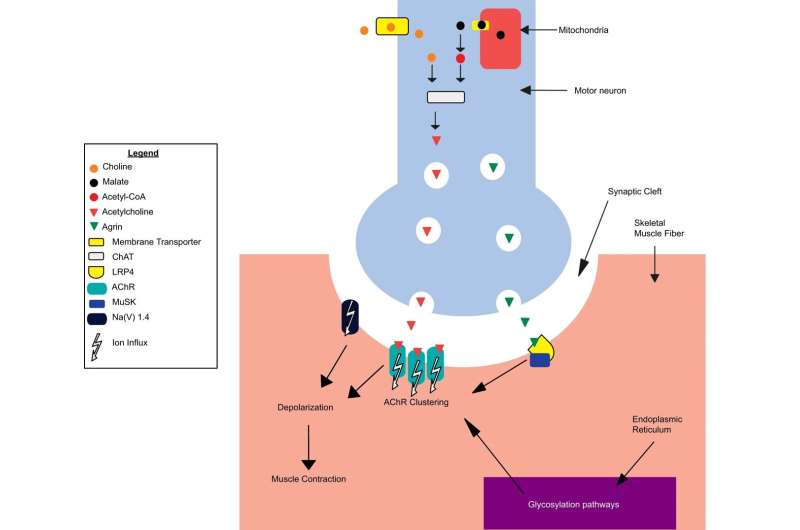
The importance of the research lies in the fact that it opens new avenues for the development of computational applications specifically designed for rare diseases. It also represents a breakthrough in the use of multilayer networks to address fundamental questions about the nature of these diseases. In this case, the results show how different levels of severity of myasthenic congenital syndromes are linked to specific mutations in the correct process of muscle contraction.
The value of drug repositioning in rare diseases
In addition, this study is the first to allow us to understand the possible genetic causes behind the beneficial effects of certain treatments that are effective in some patients with this disease, such as salbutamol, which is commonly used to treat respiratory problems such as asthma. This will allow the development of new drug repositioning strategies, which are essential in the case of rare diseases due to the difficulty of developing specific treatments and the lack of interest from the pharmaceutical industry.
“This is the first study that can genetically explain why some patients with this rare disease respond well to treatments such as salbutamol. This discovery highlights the importance of drug repositioning, a field currently being pursued in biomedical research, and opens up new possibilities for understanding and treating rare diseases using precision medicine methods,” concludes Núñez-Carpintero.
More information:
Iker Núñez-Carpintero et al, Rare disease research workflow using multilayer networks elucidates the molecular determinants of severity in Congenital Myasthenic Syndromes, Nature Communications (2024). DOI: 10.1038/s41467-024-45099-0
Citation:
Developing artificial intelligence technology to improve treatment of rare diseases (2024, February 28)
retrieved 28 February 2024
from https://medicalxpress.com/news/2024-02-artificial-intelligence-technology-treatment-rare.html
This document is subject to copyright. Apart from any fair dealing for the purpose of private study or research, no
part may be reproduced without the written permission. The content is provided for information purposes only.

Khamrah by Lattafa for Men - 3.4 oz EDP Spray
4% Off
Ghost Sweetheart Eau de Toilette | Pineapple, Jasmine and Sandalwood | Perfume for Women 50 ml
50% Off
Marc Jacobs Dot Eau De Parfum for Women, 100 ml
42% Off
Ted Baker W Eau de Toilette for Her, Fig Leaf, White Peony and Violet Top Notes, Pink Orchid and Raspberry Middle Notes, 75ml
£11.77 (£15.69 / 100 ml) (as of 05/10/2026 05:15 GMT +01:00 - More infoProduct prices and availability are accurate as of the date/time indicated and are subject to change. Any price and availability information displayed on [relevant Amazon Site(s), as applicable] at the time of purchase will apply to the purchase of this product.)
Ted Baker Woman Pink Eau de Toilette Spray Floral Green Feminine Fragrance, Opening Notes are Fresh Peach, Bergamot and Tangerine with Warm Musk, Vanilla and Vetiver Base, 100ml
11% Off
Vera Wang Princess Eau de Toilette - 30 ml

Choco Musk 50ml Eau De Parfum for men and women | Chocolate Musk by Jannat Aromas
17% Off
Christina Aguilera Signature Eau de Parfum (50ml) Floral, Fruity & Exotic Scent, Luxury Fragrance for Women
9% Off
Calvin Klein - Eau De Toilette CKIN2U - Calvin Klein Women, Ladies Perfume, Women's Perfume, Calvin Klein Perfume, Calvin Klein One - 150 ml
5% Off
Jimmy Choo Flash Eau de Parfum, 60 ml (Pack of 1)
3% Off
Fruit of the Loom Men's Heavy T Shirt, White, XL UK
28% Off
ATNKE LED Lighted Beanie Cap,USB Rechargeable Running Hat Ultra Bright 4 LED Waterproof Light Winter Warm Gifts for Men and Women/Pink
17% Off
Men's 1/4 Zip Pullover UK Sale Clearance, Fleece Sweatshirt Casual Jumper Long Sleeve T-shirt Top Stand Collar Sweater Plain Pullover Sports Leisure Workwear Quarter Zip Sweater Lightweight Jumpers
£5.88 (as of 12/11/2025 00:52 GMT +01:00 - More infoProduct prices and availability are accurate as of the date/time indicated and are subject to change. Any price and availability information displayed on [relevant Amazon Site(s), as applicable] at the time of purchase will apply to the purchase of this product.)
Crevice Cleaning Brush, Bathroom Tile Groove Gap Cleaning Brush,Premium Crevice Cleaning Tool Aluminum Support with 15° Angle Magic Brush, Thin Brush for Home Kitchen
19% Off
Wireless Earbuds, Bluetooth 5.3 Headphones in Ear with HiFi Stereo Deep Bass, 4 ENC Noise Cancelling Mic Wireless Earphones 40H Playtime, Bluetooth Earbuds Dual LED Display, IP7 Waterproof, USB-C
42% Off