 [


A research team supported by the National Institutes of Health (NIH) has found that electrocardiograms (ECGs) administered during sleep and paired with sleep stage information can be used to determine the risk of future adverse cardiac events. The study, which used a deep learning approach, suggests that using ECGs to predict which patients have a greater risk of poor heart-related outcomes could help guide clinical decision-making. The findings were published in the journal SLEEP.
“This new approach has the potential to identify individuals at risk for cardiovascular disease years before clinical symptoms arise,” said David Goff, M.D., Ph.D., acting director of NIH’s National Heart, Lung, and Blood Institute (NHLBI). “Evaluating whether this information improves traditional risk prediction is an important next step. In the future, proven analytical approaches like this could be integrated into existing diagnostic tests for patients undergoing sleep studies as a screening tool for multiple adverse cardiovascular outcomes.”
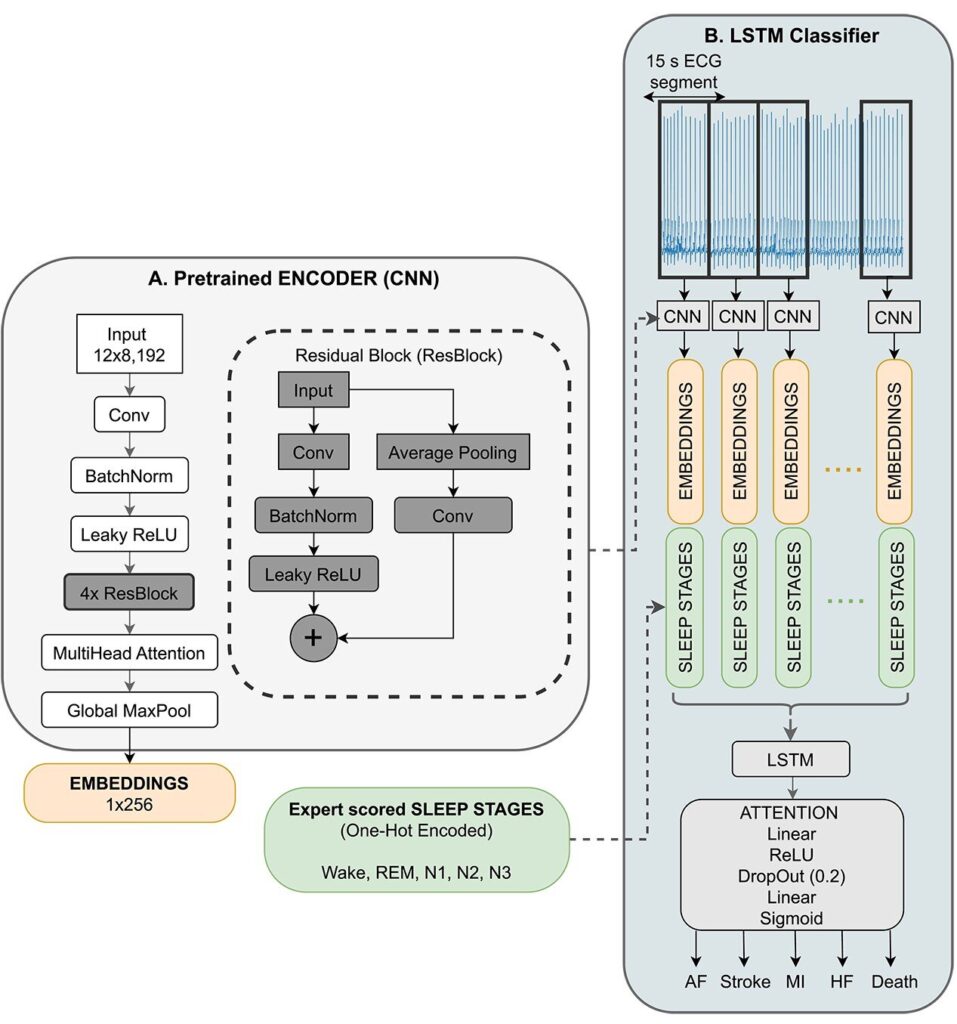
Testing conducted overnight during sleep, known as polysomnography, is the standard method of diagnosing sleep disorders such as insomnia and obstructive sleep apnea, which are recognized as cardiovascular risk factors. ECGs are recorded during these tests but are not often analyzed. The research team in this study wanted to see if these recordings could be used to predict the 10-year risk of cardiovascular outcomes such as atrial fibrillation, stroke, myocardial infarction and heart failure, as well as all-cause mortality.
The researchers applied a deep learning system using single-lead ECGs from sleep studies combined with expert-annotated sleep stage data. The model was fine-tuned on a data set of 15,809 patients at Massachusetts General Hospital in Boston, and performance was assessed on two data sets that included 9,810 patients from Emory University Hospital in Atlanta and 12,576 patients from Beth Israel Deaconess Medical Center in Boston. Outcomes were derived from electronic health records.
The team found that the model was able to sort people into groups with different levels of long-term cardiovascular risk, showing that people with higher scores were at higher risk. The deep learning model also retained its predictive value when adjusted for common cardiovascular risk factors such as age, sex, BMI, diabetes and hypertension, as well as sleep-related characteristics such as sleep apnea severity, arousals and sleep efficiency. The model could predict atrial fibrillation, heart failure and death from any cause.
The scientists believe that additional optimization of the model is needed to predict myocardial infarction and stroke. Overall, they found that predicting cardiovascular outcomes from the ECG channel in sleep studies is a promising approach.
“Importantly, we found that adding the score from our deep learning model improved prediction of cardiac outcomes beyond established risk factors,” said Gari Clifford, D.Phil., study author, chair of the Department of Biomedical Informatics at Emory University School of Medicine and professor of biomedical engineering at Georgia Institute of Technology. “Adding these scores into sleep studies has great potential for improving early detection of cardiovascular disease, determining who is most at risk and being more proactive in patient care.”
In addition, this method uses just one ECG lead, or electrical signal, making data collection easier than with the usual 12-lead setup. Therefore, it offers a simple way to collect useful ECG data in just one night of sleep, making the approach highly accessible through simple, low-cost patches.
Publication details
Zuzana Koscova et al, Prediction of cardiovascular outcomes using electrocardiography from overnight polysomnography, SLEEP (2026). DOI: 10.1093/sleep/zsag229
Journal information:
Sleep
Who’s behind this story?


Citation:
Deep learning model using ECGs during sleep studies can predict cardiovascular outcomes (2026, October 9)
retrieved 9 October 2026
from https://medicalxpress.com/news/2026-10-deep-ecgs-cardiovascular-outcomes.html
This document is subject to copyright. Apart from any fair dealing for the purpose of private study or research, no
part may be reproduced without the written permission. The content is provided for information purposes only.

Khamrah by Lattafa for Men - 3.4 oz EDP Spray
4% Off
Ghost Sweetheart Eau de Toilette | Pineapple, Jasmine and Sandalwood | Perfume for Women 50 ml
50% Off
Marc Jacobs Dot Eau De Parfum for Women, 100 ml
42% Off
Ted Baker W Eau de Toilette for Her, Fig Leaf, White Peony and Violet Top Notes, Pink Orchid and Raspberry Middle Notes, 75ml
£11.77 (£15.69 / 100 ml) (as of 04/11/2026 05:40 GMT +00:00 - More infoProduct prices and availability are accurate as of the date/time indicated and are subject to change. Any price and availability information displayed on [relevant Amazon Site(s), as applicable] at the time of purchase will apply to the purchase of this product.)
Ted Baker Woman Pink Eau de Toilette Spray Floral Green Feminine Fragrance, Opening Notes are Fresh Peach, Bergamot and Tangerine with Warm Musk, Vanilla and Vetiver Base, 100ml
11% Off
Vera Wang Princess Eau de Toilette - 30 ml

Choco Musk 50ml Eau De Parfum for men and women | Chocolate Musk by Jannat Aromas
17% Off
Christina Aguilera Signature Eau de Parfum (50ml) Floral, Fruity & Exotic Scent, Luxury Fragrance for Women
9% Off
Calvin Klein - Eau De Toilette CKIN2U - Calvin Klein Women, Ladies Perfume, Women's Perfume, Calvin Klein Perfume, Calvin Klein One - 150 ml
5% Off
Jimmy Choo Flash Eau de Parfum, 60 ml (Pack of 1)
3% Off
Fruit of the Loom Men's Heavy T Shirt, White, XL UK
28% Off
ATNKE LED Lighted Beanie Cap,USB Rechargeable Running Hat Ultra Bright 4 LED Waterproof Light Winter Warm Gifts for Men and Women/Pink
17% Off
Men's 1/4 Zip Pullover UK Sale Clearance, Fleece Sweatshirt Casual Jumper Long Sleeve T-shirt Top Stand Collar Sweater Plain Pullover Sports Leisure Workwear Quarter Zip Sweater Lightweight Jumpers
£5.88 (as of 11/11/2025 23:52 GMT +00:00 - More infoProduct prices and availability are accurate as of the date/time indicated and are subject to change. Any price and availability information displayed on [relevant Amazon Site(s), as applicable] at the time of purchase will apply to the purchase of this product.)
Crevice Cleaning Brush, Bathroom Tile Groove Gap Cleaning Brush,Premium Crevice Cleaning Tool Aluminum Support with 15° Angle Magic Brush, Thin Brush for Home Kitchen
19% Off
Wireless Earbuds, Bluetooth 5.3 Headphones in Ear with HiFi Stereo Deep Bass, 4 ENC Noise Cancelling Mic Wireless Earphones 40H Playtime, Bluetooth Earbuds Dual LED Display, IP7 Waterproof, USB-C
42% Off