 BBC
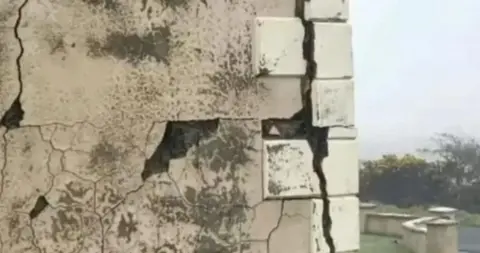
BBCLiving in a crumbling home affected by defective concrete blocks in the Republic of Ireland has had a major impact on homeowners’ mental health, including increased suicidal thoughts, according to new research.
The Ulster University study examined the experience of almost 400 adults living in affected homes across Ireland.
The homeowners reported suffering from depression, post traumatic stress disorder and suicidal thoughts similar to those who live through earthquakes, floods or who are displaced.
Joy Beard, whose home was demolished in in September, said she has been “extremely depressed” because of the crisis.
 The Bigger Picture Project
Thousands of homes in the Republic of Ireland have crumbled in recent years because of defective bricks. BBC News NI has contacted the Department of Housing in Dublin for comment.
The study found 30% of respondents had experienced severe depression after finding out that their homes had been built with defective concrete.
That is nearly three times higher than the general population, researchers said.
More than 25% had experienced severe anxiety, four times higher than the general Irish population while rates of post traumatic stress disorder were twice as high.
Researchers also found 35.5% of respondents had reported suicidal thoughts following the detection of defective blocks in their homes.
“It is clear that more needs to be done by the Irish government to provide mental health support and ensure the defective concrete grant scheme will allow families to free themselves from the primary causes of their distress,” researcher Oisin Keenan said.
 Oisin Keenan
The study is the first to examine the mental health impact on people living in an affected home.
“This study is significant because we now have the first clear and robust scientific evidence from a representative sample that shows the profound level of distress that families are living with,” said Mr Keenan.
He said it showed the need for the Irish government to introduce “immediate mental health support”.
They say the study shows a “severely high prevalence of mental health conditions among people affected by Ireland’s defective concrete crisis”.
‘A humanitarian disaster’
In the Republic of Ireland, about 6,000 homes affected by mica and another mineral – pyrite – have been identified, mostly in counties Mayo and Donegal.
The minerals absorb water, which can cause walls to crack and crumble.
The government’s redress scheme – which was first announced in November 2021 – is currently capped at €420,000, at a total cost to the exchequer of €2.2 billion.
Last year four councillors representing affected homeowners were elected in County Donegal.
The 100% Redress Party was formed at the end of 2023 and is demanding better compensation for the many people whose homes are crumbling because they were built with defective blocks

Joy Beard is one of their councillors and one of the many people who have suffered from depression as a result of what they have gone through.
Her own home, near Buncrana, was built with defective blocks and was finally demolished last September.
She said the Ulster University report made for grim reading but reflected life for people caught up in the scandal.
“This is a humanitarian disaster,” she said, “and people have been living with it for 14 years.
“This is comparable to a natural disaster such as an earthquake.
“People have lost their homes, many are in financial ruin and the consequences of this for so many people have been devastating.
“I have been extremely depressed myself as a direct result of this and had to get help. There are many, many people like me.”
‘Deeply concerning’
A total of 393 adults whose homes are built by defective blocks took part in the study.
Dr Karen Kirby from UU’s school of psychology described the findings as “deeply concerning”.
“Living in defective homes has created chronic fear and uncertainty, which significantly increases mental health risks, particularly for those displaced or financially trapped.
“Those living in potentially dangerous properties are experiencing prolonged safety fears, which become chronic over time.”
BBC News

Khamrah by Lattafa for Men - 3.4 oz EDP Spray
4% Off
Ghost Sweetheart Eau de Toilette | Pineapple, Jasmine and Sandalwood | Perfume for Women 50 ml
50% Off
Marc Jacobs Dot Eau De Parfum for Women, 100 ml
42% Off
Ted Baker W Eau de Toilette for Her, Fig Leaf, White Peony and Violet Top Notes, Pink Orchid and Raspberry Middle Notes, 75ml
£11.77 (£15.69 / 100 ml) (as of 03/09/2026 04:57 GMT +01:00 - More infoProduct prices and availability are accurate as of the date/time indicated and are subject to change. Any price and availability information displayed on [relevant Amazon Site(s), as applicable] at the time of purchase will apply to the purchase of this product.)
Ted Baker Woman Pink Eau de Toilette Spray Floral Green Feminine Fragrance, Opening Notes are Fresh Peach, Bergamot and Tangerine with Warm Musk, Vanilla and Vetiver Base, 100ml
11% Off
Vera Wang Princess Eau de Toilette - 30 ml

Choco Musk 50ml Eau De Parfum for men and women | Chocolate Musk by Jannat Aromas
17% Off
Christina Aguilera Signature Eau de Parfum (50ml) Floral, Fruity & Exotic Scent, Luxury Fragrance for Women
9% Off
Calvin Klein - Eau De Toilette CKIN2U - Calvin Klein Women, Ladies Perfume, Women's Perfume, Calvin Klein Perfume, Calvin Klein One - 150 ml
5% Off
Jimmy Choo Flash Eau de Parfum, 60 ml (Pack of 1)
3% Off
Fruit of the Loom Men's Heavy T Shirt, White, XL UK
28% Off
ATNKE LED Lighted Beanie Cap,USB Rechargeable Running Hat Ultra Bright 4 LED Waterproof Light Winter Warm Gifts for Men and Women/Pink
17% Off
Men's 1/4 Zip Pullover UK Sale Clearance, Fleece Sweatshirt Casual Jumper Long Sleeve T-shirt Top Stand Collar Sweater Plain Pullover Sports Leisure Workwear Quarter Zip Sweater Lightweight Jumpers
£5.88 (as of 12/11/2025 00:52 GMT +01:00 - More infoProduct prices and availability are accurate as of the date/time indicated and are subject to change. Any price and availability information displayed on [relevant Amazon Site(s), as applicable] at the time of purchase will apply to the purchase of this product.)
Crevice Cleaning Brush, Bathroom Tile Groove Gap Cleaning Brush,Premium Crevice Cleaning Tool Aluminum Support with 15° Angle Magic Brush, Thin Brush for Home Kitchen
19% Off
Wireless Earbuds, Bluetooth 5.3 Headphones in Ear with HiFi Stereo Deep Bass, 4 ENC Noise Cancelling Mic Wireless Earphones 40H Playtime, Bluetooth Earbuds Dual LED Display, IP7 Waterproof, USB-C
42% Off