Skygazers in the UK have the best chance this week to see a comet which will not make another close approach to Earth for another 1,300 years, astronomers have said.
Comet Lemmon should be easy to see with binoculars during the evening after sunset – but experts said it may also be possible to see it with the naked eye depending on the weather and if “you’ve got a very dark sky”.
The comet, which orbits the sun, was first detected in January and has been monitored by astronomers during the year.
It came closest to the Earth on Tuesday when it was 56 million miles (90 million km) away, but is still expected to offer people the chance of “something to go and enjoy” into the opening days of November.
Another comet, Swan, came to within 24 million miles (39 million km) of Earth on Tuesday, but it is easier to view from the southern hemisphere with a telescope.
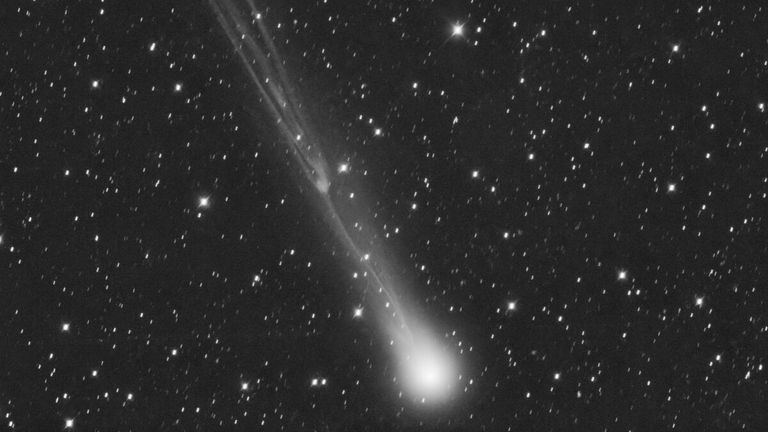
Comet Lemmon will not be visible for another 1,300 years. Pic: Virtual Telescope Project
It comes as one of the most reliable meteor showers is set to peak this week when debris left by Halley’s Comet will streak across the night sky.
The Orionid meteor shower presents a dramatic light show for UK astronomers, producing up to 20 meteors every hour until the early morning.
Read more:
Here’s how to see the Orionid shower
Find out the weather for your area
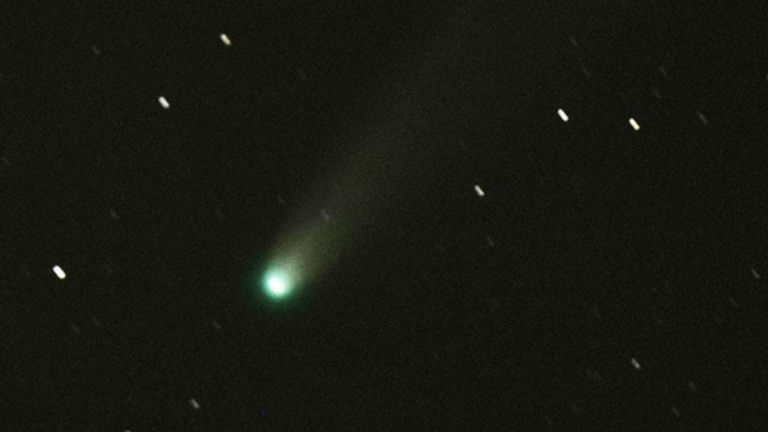
Lemmon streaks through the sky above Kansas. Pic: AP
Best time to see Comet Lemmon
People in the UK are being advised that 8pm is around the best time to see Lemmon, which last made its closest approach to Earth around 1,300 years ago.
By looking at a clear western sky around an hour after sunset, the comet – a greenish cosmic snowball – will appear relatively high and will brighten as it gets nearer to the sun in the coming weeks.
Dr Robert Massey, deputy executive director of the Royal Astronomical Society, said it may be a “little tough” to see with the naked eye, but it should be “reasonably bright” and easy to spot with binoculars.
“Comet Lemmon is pretty much at its best visibility right now,” he said.
“The best place to look is in the evening sky. As the sky darkens the comet will first of all be moving, over a matter of days, past the bright star Arcturus, and then further round towards the southwest.
“It will stand out as a fairly bright, fuzzy object.
“The fact that you can see it easily with binoculars makes it fairly unusual, and I think for that reason alone it’s something to go and enjoy, particularly if you’ve never seen a comet before.”
This month also brought the chance to see the harvest moon – the first of three consecutive supermoons due to appear before the end of 2025.
Supermoons appear larger and fuller than usual because the moon is at a point in its orbit which is nearer to Earth.
The next supermoon will rise on 5 November and is set to be “the biggest one of all”.
Source link

Khamrah by Lattafa for Men - 3.4 oz EDP Spray
4% Off
Ghost Sweetheart Eau de Toilette | Pineapple, Jasmine and Sandalwood | Perfume for Women 50 ml
50% Off
Marc Jacobs Dot Eau De Parfum for Women, 100 ml
42% Off
Ted Baker W Eau de Toilette for Her, Fig Leaf, White Peony and Violet Top Notes, Pink Orchid and Raspberry Middle Notes, 75ml
£11.77 (£15.69 / 100 ml) (as of 04/08/2026 04:06 GMT +01:00 - More infoProduct prices and availability are accurate as of the date/time indicated and are subject to change. Any price and availability information displayed on [relevant Amazon Site(s), as applicable] at the time of purchase will apply to the purchase of this product.)
Ted Baker Woman Pink Eau de Toilette Spray Floral Green Feminine Fragrance, Opening Notes are Fresh Peach, Bergamot and Tangerine with Warm Musk, Vanilla and Vetiver Base, 100ml
11% Off
Vera Wang Princess Eau de Toilette - 30 ml

Choco Musk 50ml Eau De Parfum for men and women | Chocolate Musk by Jannat Aromas
17% Off
Christina Aguilera Signature Eau de Parfum (50ml) Floral, Fruity & Exotic Scent, Luxury Fragrance for Women
9% Off
Calvin Klein - Eau De Toilette CKIN2U - Calvin Klein Women, Ladies Perfume, Women's Perfume, Calvin Klein Perfume, Calvin Klein One - 150 ml
5% Off
Jimmy Choo Flash Eau de Parfum, 60 ml (Pack of 1)
3% Off
Fruit of the Loom Men's Heavy T Shirt, White, XL UK
28% Off
ATNKE LED Lighted Beanie Cap,USB Rechargeable Running Hat Ultra Bright 4 LED Waterproof Light Winter Warm Gifts for Men and Women/Pink

Men's 1/4 Zip Pullover UK Sale Clearance, Fleece Sweatshirt Casual Jumper Long Sleeve T-shirt Top Stand Collar Sweater Plain Pullover Sports Leisure Workwear Quarter Zip Sweater Lightweight Jumpers
£5.88 (as of 12/11/2025 00:52 GMT +01:00 - More infoProduct prices and availability are accurate as of the date/time indicated and are subject to change. Any price and availability information displayed on [relevant Amazon Site(s), as applicable] at the time of purchase will apply to the purchase of this product.)
Crevice Cleaning Brush, Bathroom Tile Groove Gap Cleaning Brush,Premium Crevice Cleaning Tool Aluminum Support with 15° Angle Magic Brush, Thin Brush for Home Kitchen
19% Off
Wireless Earbuds, Bluetooth 5.3 Headphones in Ear with HiFi Stereo Deep Bass, 4 ENC Noise Cancelling Mic Wireless Earphones 40H Playtime, Bluetooth Earbuds Dual LED Display, IP7 Waterproof, USB-C
42% Off