Business reporter

 Getty Images
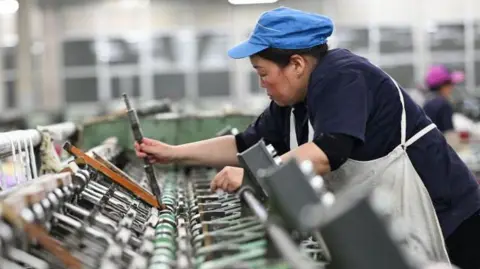
China’s leaders are expected to unveil a large stimulus plan at a key annual meeting to revive the country’s lagging economy, which is now facing a trade war with the United States.
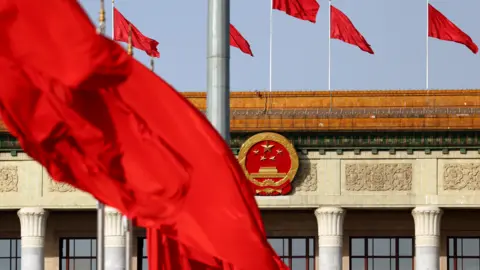
Thousands of delegates are attending the National People’s Congress (NPC), a rubber-stamp parliament, which will announce decisions that have already been made behind closed doors.
But the week-long gathering is watched closely by observers for clues on Beijing’s policy changes – and this year is more significant than most.
President Xi Jinping had already been battling persistently low consumption, a property crisis and unemployment, before Donald Trump’s new 10% levy on Chinese imports came into effect on Tuesday.
This follows the 10% tariff imposed in early February, taking the total US levy to 20%. And it hits what has been a rare bright spot for the Chinese economy: exports.
Beijing hit back almost immediately on Tuesday, just as it did last month. It announced retailatory action that included 10%-15% tariffs on certain agriculture imports from the US – this is key because China is the biggest market for these goods, such as American corn, wheat and soybeans.
Still, at this week’s meeting, known as Two Sessions, the spotlight will be on how to spur growth in the wake of these tariffs.
Party leaders are expected to announce 5% as the growth target for 2025, like in previous years. And it may come with a pledge to pump trillions of Chinese yuan – or hundreds of billions of dollars – into the system.
Beijing was able to meet the 5% target last year, but growth was driven by strong exports, which resulted in a nearly trillion-dollar record trade surplus.
Repeating that is going to be much harder this year. “If the tariffs linger, Chinese exports to the US could drop by a quarter to a third,” says Harry Murphy Cruise, head of China economics at Moody’s Analytics.
Beijing is going to have to rely more than ever on domestic spending to achieve 5% growth – but that has been one of its biggest challenges.
The spending crunch
Analysts say expanding domestic demand, which was the third objective at last year’s meeting, could now move to the top of the priority list.
Beijing has already rolled out schemes to encourage its people to spend more, including allowing them to trade in and replace consumer goods like kitchen appliances, cars, phones and electronic devices.
 Getty Images
But it’s widely expected that there will be a slew of new programmes to boost spending. Whether they will be enough to boost consumption is the key question.
Harsh pandemic-era restrictions along with a prolonged real estate crisis and a government crackdown on tech and finance have fuelled pessimism among Chinese people. And a weak social safety net means savings have become especially crucial in case of unexpected out-of-pocket expenses.
But China’s leadership is optimistic. CPCC spokesman Liu Jieyi told reporters ahead of the session that while the economy was facing challenges such as low demand, it was “important to recognise that China’s economic fundamentals are stable, there are many advantages, resilience is strong, and potential is significant”.
‘High quality’ development
Investment in what President Xi calls “high-quality development”, which covers high-tech industries from renewables to artificial intelligence, is also expected to be a major focus.
The world’s second-largest economy, China has long vied to become a world leader in tech, partly to reduce its reliance on the West.
State media has already touted recent examples like DeepSeek and Unitree Robotics, both of which have caught global attention, as examples of China’s “technological progress”.
The success of Deepseek in particular saw an AI-driven stock rally, with analysts noting renewed interest in China among foreign investors.
A commentary in the state-run Xinhua newspaper said “China’s new energy industries and overall green transition, driven by its cutting-edge technologies, will continue to be important growth drivers”.
But the new US levies – which come on top of tariffs from Trumps first term – could stymie these plans, not least because they could dampen investor sentiment.
“The chaos that tariffs leave in their wake is kryptonite for investment,” Mr Murphy Cruise says. “Tariffs are set to deliver a one-two punch to China’s economy, landing blows to both exports and investment.”
BBC News

Khamrah by Lattafa for Men - 3.4 oz EDP Spray
4% Off
Ghost Sweetheart Eau de Toilette | Pineapple, Jasmine and Sandalwood | Perfume for Women 50 ml
50% Off
Marc Jacobs Dot Eau De Parfum for Women, 100 ml
42% Off
Ted Baker W Eau de Toilette for Her, Fig Leaf, White Peony and Violet Top Notes, Pink Orchid and Raspberry Middle Notes, 75ml
£11.77 (£15.69 / 100 ml) (as of 19/06/2026 03:33 GMT +01:00 - More infoProduct prices and availability are accurate as of the date/time indicated and are subject to change. Any price and availability information displayed on [relevant Amazon Site(s), as applicable] at the time of purchase will apply to the purchase of this product.)
Ted Baker Woman Pink Eau de Toilette Spray Floral Green Feminine Fragrance, Opening Notes are Fresh Peach, Bergamot and Tangerine with Warm Musk, Vanilla and Vetiver Base, 100ml
11% Off
Vera Wang Princess Eau de Toilette - 30 ml

Choco Musk 50ml Eau De Parfum for men and women | Chocolate Musk by Jannat Aromas
17% Off
Christina Aguilera Signature Eau de Parfum (50ml) Floral, Fruity & Exotic Scent, Luxury Fragrance for Women
9% Off
Calvin Klein - Eau De Toilette CKIN2U - Calvin Klein Women, Ladies Perfume, Women's Perfume, Calvin Klein Perfume, Calvin Klein One - 150 ml
5% Off
Jimmy Choo Flash Eau de Parfum, 60 ml (Pack of 1)
3% Off
Fruit of the Loom Men's Heavy T Shirt, White, XL UK
28% Off
ATNKE LED Lighted Beanie Cap,USB Rechargeable Running Hat Ultra Bright 4 LED Waterproof Light Winter Warm Gifts for Men and Women/Pink
17% Off
Men's 1/4 Zip Pullover UK Sale Clearance, Fleece Sweatshirt Casual Jumper Long Sleeve T-shirt Top Stand Collar Sweater Plain Pullover Sports Leisure Workwear Quarter Zip Sweater Lightweight Jumpers
£5.88 (as of 12/11/2025 00:52 GMT +01:00 - More infoProduct prices and availability are accurate as of the date/time indicated and are subject to change. Any price and availability information displayed on [relevant Amazon Site(s), as applicable] at the time of purchase will apply to the purchase of this product.)
Crevice Cleaning Brush, Bathroom Tile Groove Gap Cleaning Brush,Premium Crevice Cleaning Tool Aluminum Support with 15° Angle Magic Brush, Thin Brush for Home Kitchen
19% Off
Wireless Earbuds, Bluetooth 5.3 Headphones in Ear with HiFi Stereo Deep Bass, 4 ENC Noise Cancelling Mic Wireless Earphones 40H Playtime, Bluetooth Earbuds Dual LED Display, IP7 Waterproof, USB-C
42% Off