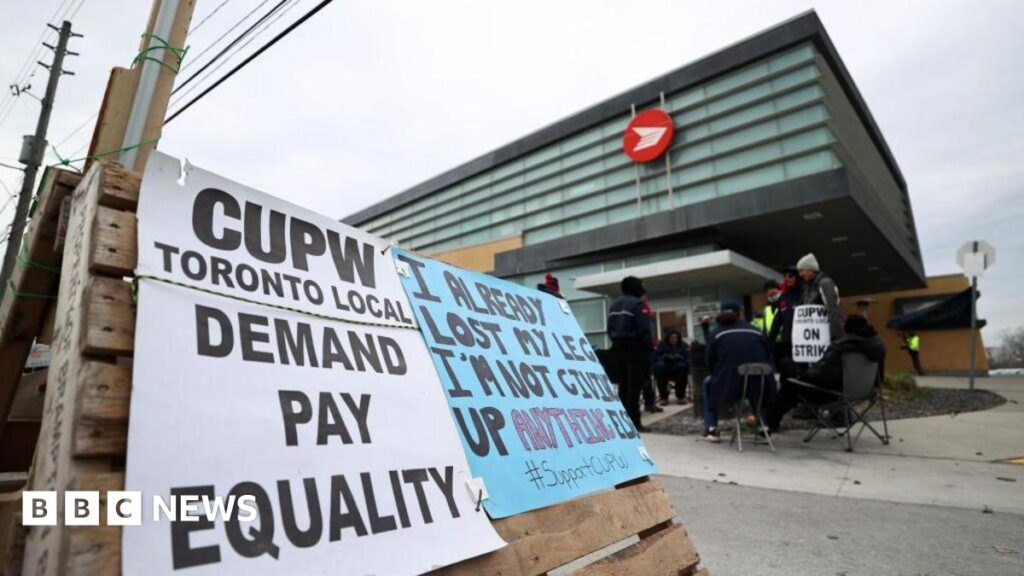

In a statement on Friday, the CUPW called the move an “assault on our constitutionally protected right to collectively bargain and to strike”.
Meanwhile, Canada Post said in a statement that it looks forward to welcoming its employees back to work and resuming its services.
The Crown corporation added that it remains committed to reaching a negotiated agreement with the union, but said it wants to do so while “also meeting the postal needs of Canadians.”
The Canadian Industrial Relations Board is expected to rule on Minister MacKinnon’s request next week.
The strike has impacted businesses during one of the biggest shopping periods of the year. With deliveries halted, inventory has sat in warehouses across the country while shipping costs have increased.
Lorne James, an Ontario business owner, told the BBC last week that he fears the strike is “going to wipe out a good number of businesses” due to steep financial losses.
In Canada’s northern communities – where Canada Post is the sole mail delivery provider – the strike has had a profound impact on those who rely on the postal service for the delivery of essentials, like medicine and cheque payments.
Service Canada has also reportedly withheld the delivery of 85,000 passports and other important documents while the strike is ongoing.
Announcing the order on Friday, Minister MacKinnon said “Canadians are rightly fed up” with the strike. He added that it is not a decision he takes lightly, “but in this situation, it is the right one.”
The order would ask striking employees to go back to work under their existing collective agreement until 22 May, by which then the minister hopes a new agreement will be in place.
The union has been trying to negotiate a wage increase of 19% over the next four years – higher than the 11.5% increase initially proposed by Canada Post. They are also negotiating issues around benefits, sick leave, job conditions and security.
“Our demands are reasonable: fair wages, safe working conditions, the right to retire with dignity and the expansion of services at the public post office,” the union has said.
CUPW national president Jan Simpson has since accused Canada Post of dragging its feet so the federal government can intervene. Meanwhile, Canada Post accused the union of increasing their demands instead of reaching a compromise.
When the strike began, Canada Post warned that its services would continue to be disrupted even if an agreement is reached due to backlogs in deliveries.
It added that it has already felt a financial impact, with customers switching to private competitors or stopping use of its services altogether as the strike is ongoing.
The last Canada post began in October 2018 and ended after more than a month when the federal government mandated that employees go back to work through legislation.
That job action cost Canada Post around C$135m ($96.7m; £76.27m).
Source link

Khamrah by Lattafa for Men - 3.4 oz EDP Spray
4% Off
Ghost Sweetheart Eau de Toilette | Pineapple, Jasmine and Sandalwood | Perfume for Women 50 ml
50% Off
Marc Jacobs Dot Eau De Parfum for Women, 100 ml
42% Off
Ted Baker W Eau de Toilette for Her, Fig Leaf, White Peony and Violet Top Notes, Pink Orchid and Raspberry Middle Notes, 75ml
£11.77 (£15.69 / 100 ml) (as of 12/10/2026 06:34 GMT +01:00 - More infoProduct prices and availability are accurate as of the date/time indicated and are subject to change. Any price and availability information displayed on [relevant Amazon Site(s), as applicable] at the time of purchase will apply to the purchase of this product.)
Ted Baker Woman Pink Eau de Toilette Spray Floral Green Feminine Fragrance, Opening Notes are Fresh Peach, Bergamot and Tangerine with Warm Musk, Vanilla and Vetiver Base, 100ml
11% Off
Vera Wang Princess Eau de Toilette - 30 ml

Choco Musk 50ml Eau De Parfum for men and women | Chocolate Musk by Jannat Aromas
17% Off
Christina Aguilera Signature Eau de Parfum (50ml) Floral, Fruity & Exotic Scent, Luxury Fragrance for Women
9% Off
Calvin Klein - Eau De Toilette CKIN2U - Calvin Klein Women, Ladies Perfume, Women's Perfume, Calvin Klein Perfume, Calvin Klein One - 150 ml
5% Off
Jimmy Choo Flash Eau de Parfum, 60 ml (Pack of 1)
3% Off
Fruit of the Loom Men's Heavy T Shirt, White, XL UK
28% Off
ATNKE LED Lighted Beanie Cap,USB Rechargeable Running Hat Ultra Bright 4 LED Waterproof Light Winter Warm Gifts for Men and Women/Pink
17% Off
Men's 1/4 Zip Pullover UK Sale Clearance, Fleece Sweatshirt Casual Jumper Long Sleeve T-shirt Top Stand Collar Sweater Plain Pullover Sports Leisure Workwear Quarter Zip Sweater Lightweight Jumpers
£5.88 (as of 12/11/2025 00:52 GMT +01:00 - More infoProduct prices and availability are accurate as of the date/time indicated and are subject to change. Any price and availability information displayed on [relevant Amazon Site(s), as applicable] at the time of purchase will apply to the purchase of this product.)
Crevice Cleaning Brush, Bathroom Tile Groove Gap Cleaning Brush,Premium Crevice Cleaning Tool Aluminum Support with 15° Angle Magic Brush, Thin Brush for Home Kitchen
19% Off
Wireless Earbuds, Bluetooth 5.3 Headphones in Ear with HiFi Stereo Deep Bass, 4 ENC Noise Cancelling Mic Wireless Earphones 40H Playtime, Bluetooth Earbuds Dual LED Display, IP7 Waterproof, USB-C
42% Off