
 [
[


From the weather to sports to the performance of the stock market, predictions are a regular feature of our lives. Most of these sectors rely on past data and models that can give us a decent sense of what to expect in the future.
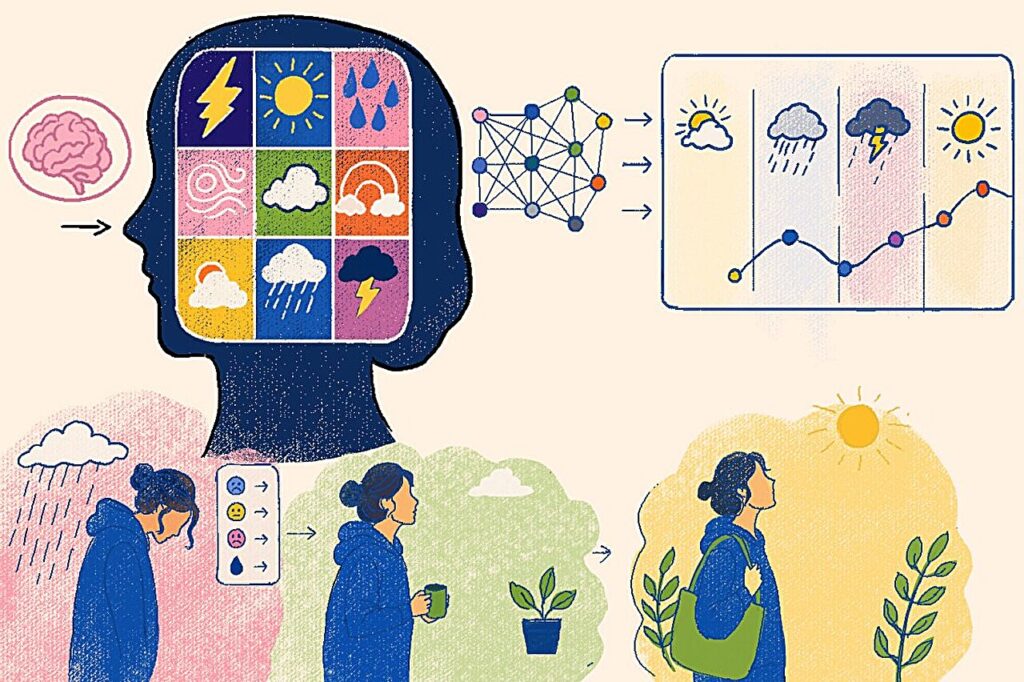
And as complex as meteorology and economics are, one researcher wants to bring a possibly more complicated topic into the world of predictions: human emotions. Specifically, Joshua Curtiss, a Northeastern assistant professor of applied psychology and mental health researcher, is investigating how a person’s emotions can be predicted using machine-learning models.
Being able to predict someone’s emotions in this way could provide insight into how they experience mental health disorders such as anxiety and depression, according to Curtiss. With that insight, providers could offer proactive and tailored mental health support.
Two models had the lowest error in predicting the four emotions, Curtiss reported. For contentedness and cheerfulness, it was a model that forecasts based on past performance that seemed to be most accurate. For sadness and anxiousness, it was the ensemble model that produced a sort of composite of the individual models’ results to make a prediction, according to Curtiss.
Oftentimes, the treatment or intervention for these disorders, which can include therapy or medication, are a one-size-fits-all approach, said Curtiss, who leads the Computational Clinical Psychology Lab. He argues that what works for one person may not be effective for another because humans are so diverse.
“Maybe there are better ways we could help personalize mental health and better understand the individual,” he said.
The pilot study, which Curtiss gave a brief overview of during the Institute for Cognitive and Brain Health’s Institute Day, focused on 34 people who had an official emotional disorder diagnosis. These participants were asked to report on a seven-point scale their emotion in that moment: contentedness, cheerfulness, sadness and anxiousness. The questions were posed five times a day over a two-week period.
The responses were then fed into a half dozen individual machine-learning models to see if the model could identify patterns and predict the participant’s future emotions. The individual models ranged from using the average score of a person’s reported emotion and correlating that to an emotion on the seven-point scale to using a neural network, which mimics the brain in how it processes data, to find other patterns. These models were compared to a baseline of the average response across all study participants.
The accuracy of these models was tested by comparing the predicted value of a person’s emotions to the actual recorded value. Preliminarily, Curtiss found that the individual models were more accurate than the group-level benchmark in predicting a person’s emotions about one day in the future.
Moreover, the research suggests that while one type of prediction model may work for one person, emotional disorder or emotion, it could be inaccurate for another—which drives home the need for individualization.
While this research is still in the early “proof of concept” stages before it can be regularly implemented in the world, Curtiss said that with more validation, forecasting machine learning could have implications for more personalized interventions.
It could be as simple as offering someone a heads up to prepare how they might feel at a point in the future. It could also mean empowering someone with the knowledge to begin to engage in a certain habit or dissuade another, based on their emotions, “to give some bandwidth and wiggle room to preempt or offset some of the things we think could be happening in your future,” Curtiss said.
“Better prediction really means better care,” said Don Robinaugh, an assistant professor who is also in Northeastern’s Applied Psychology department but was not involved in the study.
“People are just enormously complex, and the challenges that people face, while they can seem very similar on the outside, things like depression and anxiety often have very unique and person-specific factors that are driving those areas of distress,” Robinaugh said.
Curtiss’ work “really embraces that complex reality” in a way “that appreciates how unique we are and how there may be different factors driving any given individual’s distress, and then we need models that are really tailored to the individual if we’re going to better predict where their mental health is going and how we can potentially best support them.”
The lab is now working on expanding the research to more people, different populations and for longer time periods. They’re also looking at what value, if any, data from smartphones or wearable technology—determining if someone is active or sitting at home, for example—can add to someone’s subjective emotional report.
The research is not without its challenges, however. One is how far in the future these predictions can be made because of both internal—one’s personality, thoughts, feelings and preferences—and external factors that can affect a person’s mental health.
“I have no way of predicting whether someone will receive health news from a doctor two months from now. I have no way of knowing whether someone will experience frustrating news about their job or their career three weeks from now, for instance,” he said.
“The main thing is trying to find a good balance. It might be too much to say, “Let’s develop a perfect model that predicts how you’re going to feel on a Tuesday a year from now,'” he said. But more realistically, Curtiss said being able to make these predictions just one or two weeks out could be helpful.
It’s why Curtiss equates this to the weather. These predictions are a best guess, but may not be 100% accurate.
“Even if I did have perfect information, it’s really challenging to predict these things because, almost like the butterfly effect, little individual differences in a person’s mood or affect one day can lead to more chaotic, unpredictable behavior later on,” Curtiss said.
He added, “No matter how good of a job we think we’re doing, we can still get things wrong. So, we need to make sure that we’re being very responsible about this.”
Robinaugh also noted the challenges with predicting emotions, but was hopeful about the research, calling the potential “enormous” and “game-changing.”
“There’s a long way to go, but this is, I think, a really exciting and promising direction, and I think the more that we can help people understand that these ideas are out there, the more we can try to help continue to build this work,” he said.
Clinical categories


This story is republished courtesy of Northeastern Global News news.northeastern.edu.
Citation:
Can AI help predict how you might be feeling in the future? (2026, May 21)
retrieved 22 May 2026
from https://medicalxpress.com/news/2026-05-ai-future.html
This document is subject to copyright. Apart from any fair dealing for the purpose of private study or research, no
part may be reproduced without the written permission. The content is provided for information purposes only.

Khamrah by Lattafa for Men - 3.4 oz EDP Spray
4% Off
Ghost Sweetheart Eau de Toilette | Pineapple, Jasmine and Sandalwood | Perfume for Women 50 ml
50% Off
Marc Jacobs Dot Eau De Parfum for Women, 100 ml
42% Off
Ted Baker W Eau de Toilette for Her, Fig Leaf, White Peony and Violet Top Notes, Pink Orchid and Raspberry Middle Notes, 75ml
£11.77 (£15.69 / 100 ml) (as of 13/10/2026 06:34 GMT +01:00 - More infoProduct prices and availability are accurate as of the date/time indicated and are subject to change. Any price and availability information displayed on [relevant Amazon Site(s), as applicable] at the time of purchase will apply to the purchase of this product.)
Ted Baker Woman Pink Eau de Toilette Spray Floral Green Feminine Fragrance, Opening Notes are Fresh Peach, Bergamot and Tangerine with Warm Musk, Vanilla and Vetiver Base, 100ml
11% Off
Vera Wang Princess Eau de Toilette - 30 ml

Choco Musk 50ml Eau De Parfum for men and women | Chocolate Musk by Jannat Aromas
17% Off
Christina Aguilera Signature Eau de Parfum (50ml) Floral, Fruity & Exotic Scent, Luxury Fragrance for Women
9% Off
Calvin Klein - Eau De Toilette CKIN2U - Calvin Klein Women, Ladies Perfume, Women's Perfume, Calvin Klein Perfume, Calvin Klein One - 150 ml
5% Off
Jimmy Choo Flash Eau de Parfum, 60 ml (Pack of 1)
3% Off
Fruit of the Loom Men's Heavy T Shirt, White, XL UK
28% Off
ATNKE LED Lighted Beanie Cap,USB Rechargeable Running Hat Ultra Bright 4 LED Waterproof Light Winter Warm Gifts for Men and Women/Pink
17% Off
Men's 1/4 Zip Pullover UK Sale Clearance, Fleece Sweatshirt Casual Jumper Long Sleeve T-shirt Top Stand Collar Sweater Plain Pullover Sports Leisure Workwear Quarter Zip Sweater Lightweight Jumpers
£5.88 (as of 12/11/2025 00:52 GMT +01:00 - More infoProduct prices and availability are accurate as of the date/time indicated and are subject to change. Any price and availability information displayed on [relevant Amazon Site(s), as applicable] at the time of purchase will apply to the purchase of this product.)
Crevice Cleaning Brush, Bathroom Tile Groove Gap Cleaning Brush,Premium Crevice Cleaning Tool Aluminum Support with 15° Angle Magic Brush, Thin Brush for Home Kitchen
19% Off
Wireless Earbuds, Bluetooth 5.3 Headphones in Ear with HiFi Stereo Deep Bass, 4 ENC Noise Cancelling Mic Wireless Earphones 40H Playtime, Bluetooth Earbuds Dual LED Display, IP7 Waterproof, USB-C
42% Off