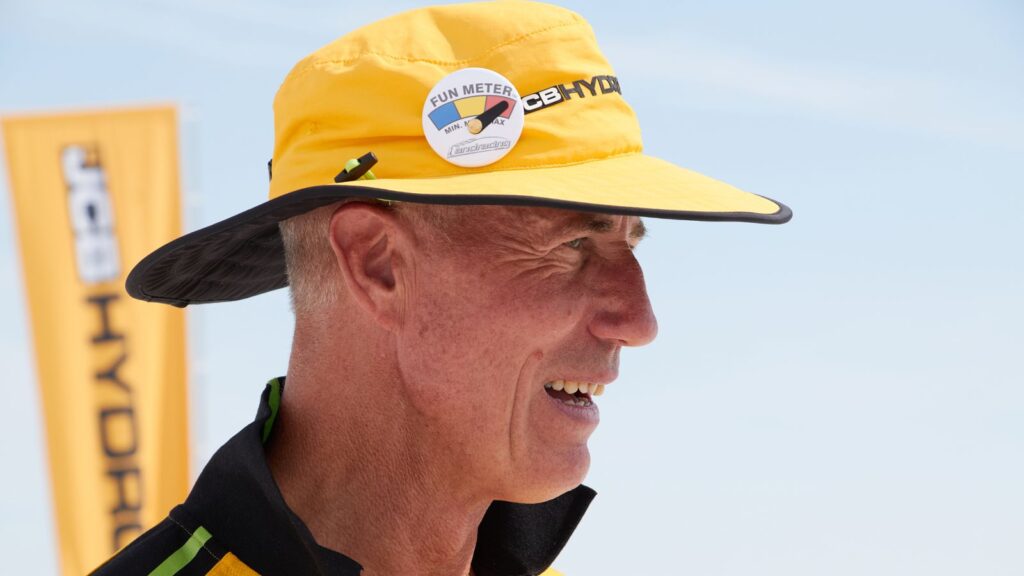
A British driver, who remains the only person to break the sound barrier in a car, has set another world record, this time in a hydrogen-powered vehicle.
Andy Green, a 64-year-old retired Royal Air Force pilot, reached a speed of 406.32mph – measured as an average from two runs – on Utah‘s famous Bonneville Salt Flats in a car powered by two hydrogen internal combustion engines with a combined 1,600 horsepower.
In doing so, he set the record for that vehicle category, according to the Federation Internationale de l’Automobile, the international governing body of motor sports.
The 32ft (9.75m) Hydromax car, engineered by British manufacturer JCB, used engines adapted from those used in the company’s machinery, mixing pressurised hydrogen gas with air and igniting it to create bursts of power.
The new record easily surpassed the previous hydrogen combustion world record of 185.5mph.

The vehicle driven by Mr Green. Pic: AP Photo/Hannah Schoenbaum
‘The fuel of the future’
After the runs, Mr Green said it was “magic” to be able showcase the technology, hailing hydrogen as “the fuel of the future”.
Mr Green’s latest feat, witnessed by JCB staff members and reporters watching through cameras and binoculars, did not come close to toppling the overall land-speed record, which he set with jet power in 1997, breaking the sound barrier at a speed of 763.035mph.
It did, however, beat the land-speed record for a diesel-powered car – 350.092mph – which he set at the Bonneville Salt Flats in 2006.

Mr Green and the JCB team celebrate. Pic: AP Photo/Hannah Schoenbaum
Mr Green said that the temperature inside the car on Tuesday was “probably a little hotter” than in the jet-powered vehicle from 1997, with temperatures routinely exceeding 50C (122F).
But he insisted he had become accustomed to such heat having “been training four months for that, both training in the gym and actually just getting used to it with hot baths”.
Read more from Sky News:
Olympic swimmer faces speeding trial
Man shot dead near Clapham pub
‘Best racing surface in the world’
The Bonneville Salt Flats, a remnant of a prehistoric lake bed, are situated about 100 miles (160km) west of Salt Lake City and sit atop a shallow aquifer – an underground layer of water-bearing rock, gravel, sand, or silt – that cools the tyres.
The low-friction surface and dry desert air are conducive to speed and have attracted drivers since the first race there in 1914.
Mr Green, who described the flats as “the best racing surface in the world”, added: “It looks like snow, and it behaves a bit like packed snow – it is surprisingly slippery.”
Source link

Khamrah by Lattafa for Men - 3.4 oz EDP Spray
4% Off
Ghost Sweetheart Eau de Toilette | Pineapple, Jasmine and Sandalwood | Perfume for Women 50 ml
50% Off
Marc Jacobs Dot Eau De Parfum for Women, 100 ml
42% Off
Ted Baker W Eau de Toilette for Her, Fig Leaf, White Peony and Violet Top Notes, Pink Orchid and Raspberry Middle Notes, 75ml
£11.77 (£15.69 / 100 ml) (as of 11/08/2026 04:10 GMT +01:00 - More infoProduct prices and availability are accurate as of the date/time indicated and are subject to change. Any price and availability information displayed on [relevant Amazon Site(s), as applicable] at the time of purchase will apply to the purchase of this product.)
Ted Baker Woman Pink Eau de Toilette Spray Floral Green Feminine Fragrance, Opening Notes are Fresh Peach, Bergamot and Tangerine with Warm Musk, Vanilla and Vetiver Base, 100ml
11% Off
Vera Wang Princess Eau de Toilette - 30 ml

Choco Musk 50ml Eau De Parfum for men and women | Chocolate Musk by Jannat Aromas
17% Off
Christina Aguilera Signature Eau de Parfum (50ml) Floral, Fruity & Exotic Scent, Luxury Fragrance for Women
9% Off
Calvin Klein - Eau De Toilette CKIN2U - Calvin Klein Women, Ladies Perfume, Women's Perfume, Calvin Klein Perfume, Calvin Klein One - 150 ml
5% Off
Jimmy Choo Flash Eau de Parfum, 60 ml (Pack of 1)
3% Off
Fruit of the Loom Men's Heavy T Shirt, White, XL UK
28% Off
ATNKE LED Lighted Beanie Cap,USB Rechargeable Running Hat Ultra Bright 4 LED Waterproof Light Winter Warm Gifts for Men and Women/Pink

Men's 1/4 Zip Pullover UK Sale Clearance, Fleece Sweatshirt Casual Jumper Long Sleeve T-shirt Top Stand Collar Sweater Plain Pullover Sports Leisure Workwear Quarter Zip Sweater Lightweight Jumpers
£5.88 (as of 12/11/2025 00:52 GMT +01:00 - More infoProduct prices and availability are accurate as of the date/time indicated and are subject to change. Any price and availability information displayed on [relevant Amazon Site(s), as applicable] at the time of purchase will apply to the purchase of this product.)
Crevice Cleaning Brush, Bathroom Tile Groove Gap Cleaning Brush,Premium Crevice Cleaning Tool Aluminum Support with 15° Angle Magic Brush, Thin Brush for Home Kitchen
19% Off
Wireless Earbuds, Bluetooth 5.3 Headphones in Ear with HiFi Stereo Deep Bass, 4 ENC Noise Cancelling Mic Wireless Earphones 40H Playtime, Bluetooth Earbuds Dual LED Display, IP7 Waterproof, USB-C
42% Off