 [
[

The brain’s immune cells are increasingly recognized as key players in Alzheimer’s disease, but exactly how they change as the disease develops has remained unclear. A new study published in Nature Genetics provides the most comprehensive map to date of these cells, identifying a protective subtype of brain immune cells that expands as Alzheimer’s disease progresses and uncovering the molecular pathway that enables these cells to help defend the brain. The findings offer new insights that could inform future Alzheimer’s therapies.
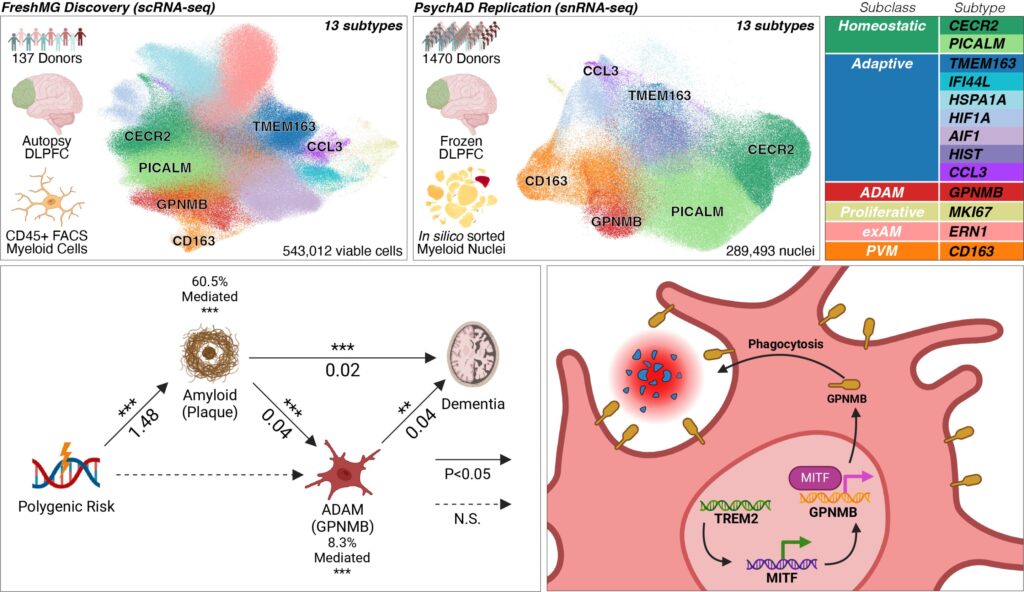
Researchers from the Icahn School of Medicine at Mount Sinai, led by Donghoon Lee, assistant professor of genetics and genomic sciences and psychiatry, and Panos Roussos, Mount Sinai professor of translational psychiatry, analyzed more than 830,000 myeloid-origin immune cells of the brain—including microglia, the brain’s resident immune cells, and perivascular macrophages, cells crucial for modulating the brain’s immune response—from the prefrontal cortex of 1,607 donors spanning the lifespan and representing a wide range of Alzheimer’s disease pathology. By profiling brain tissue at an unprecedented scale, the team identified six subclasses comprising 13 distinct subtypes of myeloid cells and characterized how these populations change during aging and disease progression.
The researchers identified a disease-associated subtype of microglia that becomes increasingly abundant as Alzheimer’s disease advances. Rather than contributing to damage, these cells appear to play a protective role by increasing their ability to engulf and clear harmful material from the brain. The study further identified a molecular pathway involving the proteins TREM2, MITF and GPNMB that is required to maintain this protective microglial state. Experiments in both human tissue and mouse models demonstrated that the beneficial effects of these cells depend on TREM2 signaling.
Beyond identifying this protective microglial population, the study provides the most detailed reference to date of how the brain’s immune cells change across the lifespan and throughout Alzheimer’s disease. The findings help explain why genetic variants in immune-related genes such as TREM2 and APOE increase Alzheimer’s risk and provide a roadmap for developing therapies that strengthen the brain’s natural immune defenses rather than focusing solely on amyloid plaques.
“Our study provides the clearest picture yet of how the brain’s immune cells adapt during aging and Alzheimer’s disease,” said Lee, assistant professor of genetics and genomic sciences and psychiatry at the Icahn School of Medicine at Mount Sinai and first and corresponding author of the paper. “By identifying the specific immune cells that appear to protect the brain—and the molecular signals they rely on—we have uncovered potential new targets for therapies aimed at slowing Alzheimer’s disease progression.”
Publication details
Plasticity of human microglia and brain perivascular macrophages in aging and Alzheimer’s disease, Nature Genetics (2026). DOI: 10.1038/s41588-026-02716-6
Journal information:
Nature Genetics
Clinical categories


Citation:
Brain immune cell map explains how defenses shift during Alzheimer’s progression (2026, August 11)
retrieved 11 August 2026
from https://medicalxpress.com/news/2026-08-brain-immune-cell-defenses-shift.html
This document is subject to copyright. Apart from any fair dealing for the purpose of private study or research, no
part may be reproduced without the written permission. The content is provided for information purposes only.

Khamrah by Lattafa for Men - 3.4 oz EDP Spray
4% Off
Ghost Sweetheart Eau de Toilette | Pineapple, Jasmine and Sandalwood | Perfume for Women 50 ml
50% Off
Marc Jacobs Dot Eau De Parfum for Women, 100 ml
42% Off
Ted Baker W Eau de Toilette for Her, Fig Leaf, White Peony and Violet Top Notes, Pink Orchid and Raspberry Middle Notes, 75ml
£11.77 (£15.69 / 100 ml) (as of 16/08/2026 04:12 GMT +01:00 - More infoProduct prices and availability are accurate as of the date/time indicated and are subject to change. Any price and availability information displayed on [relevant Amazon Site(s), as applicable] at the time of purchase will apply to the purchase of this product.)
Ted Baker Woman Pink Eau de Toilette Spray Floral Green Feminine Fragrance, Opening Notes are Fresh Peach, Bergamot and Tangerine with Warm Musk, Vanilla and Vetiver Base, 100ml
11% Off
Vera Wang Princess Eau de Toilette - 30 ml

Choco Musk 50ml Eau De Parfum for men and women | Chocolate Musk by Jannat Aromas
17% Off
Christina Aguilera Signature Eau de Parfum (50ml) Floral, Fruity & Exotic Scent, Luxury Fragrance for Women
9% Off
Calvin Klein - Eau De Toilette CKIN2U - Calvin Klein Women, Ladies Perfume, Women's Perfume, Calvin Klein Perfume, Calvin Klein One - 150 ml
5% Off
Jimmy Choo Flash Eau de Parfum, 60 ml (Pack of 1)
3% Off
Fruit of the Loom Men's Heavy T Shirt, White, XL UK
28% Off
ATNKE LED Lighted Beanie Cap,USB Rechargeable Running Hat Ultra Bright 4 LED Waterproof Light Winter Warm Gifts for Men and Women/Pink
17% Off
Men's 1/4 Zip Pullover UK Sale Clearance, Fleece Sweatshirt Casual Jumper Long Sleeve T-shirt Top Stand Collar Sweater Plain Pullover Sports Leisure Workwear Quarter Zip Sweater Lightweight Jumpers
£5.88 (as of 12/11/2025 00:52 GMT +01:00 - More infoProduct prices and availability are accurate as of the date/time indicated and are subject to change. Any price and availability information displayed on [relevant Amazon Site(s), as applicable] at the time of purchase will apply to the purchase of this product.)
Crevice Cleaning Brush, Bathroom Tile Groove Gap Cleaning Brush,Premium Crevice Cleaning Tool Aluminum Support with 15° Angle Magic Brush, Thin Brush for Home Kitchen
19% Off
Wireless Earbuds, Bluetooth 5.3 Headphones in Ear with HiFi Stereo Deep Bass, 4 ENC Noise Cancelling Mic Wireless Earphones 40H Playtime, Bluetooth Earbuds Dual LED Display, IP7 Waterproof, USB-C
42% Off