 [
[

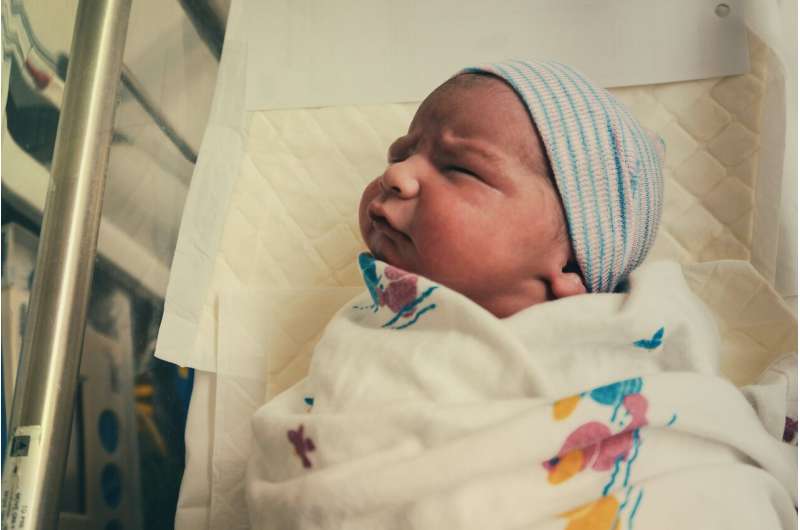
The very first thing many babies encounter when they’re born is their mother’s poop. If they’re born vaginally, head down, with the face against their mother’s rectum, the pressure can expel fecal material just as they are born. This early exposure is not only normal but likely to be beneficial.
Microbes from their mother acquired during birth, and especially from the mother’s poop, help shape a baby’s developing gut and immune system, setting the stage for lifelong health.
Birth is a microbial event
Birth is the moment when babies are exposed to and colonized by live bacteria. As they move through the birth canal, they are coated in the mother’s vaginal bacteria.
Historically, we believed the dominant bacterium in the birth canal—Lactobacillus—was the first and most important microbe to seed the baby’s gut. Lactobacillus is easy to grow in the lab, extensively studied and widely recognized as a “good” bacterium.
But although babies encounter Lactobacillus during birth, it does not remain in their gut for long.
Instead, the microbes that form the foundation of a newborn’s gut microbiome come mainly from the mother’s gut, not her vagina.
This raises an obvious question: How do babies acquire their mother’s gut bacteria?
The answer lies in the mechanics of birth.
It’s a tight squeeze
The ideal delivery position in a vaginal birth is known as “occiput anterior.” This is when the baby’s head is face down, facing the mother’s back, with their chin tucked down. So the baby’s head presses against the mother’s rectum as it descends, expelling fecal material just as the baby is born.
The truth is that the first thing a baby sees on entering this world is their mother’s intestinal contents. Far from being an accident, this appears to be an evolved mechanism that ensures the baby receives the microbes best suited to colonize their gut.
But we want to be clear. Deliberately smearing poop on your newborn’s face is dangerous and can lead to a life-threatening infection.
That’s because the amount and source of bacteria, and the way these are delivered, won’t match what happens naturally. Also, newborns’ immature immune systems make them especially vulnerable to infection.
Then there’s breast milk
Nature has refined this process even further through breast milk. This is because breast milk not only has all the nutrients a baby needs but also contains molecules known as “human milk oligosaccharides.” These are the third most abundant solid in breast milk, yet babies cannot digest them.
So what are they doing there?
These oligosaccharides are food for specific beneficial bacteria, especially Bifidobacterium. This is one of the key microbes transferred from mother to baby at birth.
These bacteria use these oligosaccharides to grow, protect the baby’s gut from harmful microbes, support immune development and help the immune system learn when to respond and when to stay calm.
But this system can be disrupted
This coordinated system—birth exposure, maternal gut microbes and breast milk—has evolved to optimize babies’ survival.
But medical practices can disrupt it. Antibiotics, while lifesaving, alter the mother’s microbiome. Cesarean delivery bypasses exposure to the key vaginal and intestinal microbes.
Babies born by cesarean or exposed to antibiotics during pregnancy have different early microbiomes and may face increased risks of certain childhood conditions, such as asthma and atopic dermatitis.
These medical interventions are essential when needed and should never be avoided out of fear of disrupting the microbiome. The health and safety of mother and baby always come first.
However, understanding how these interventions affect how babies acquire beneficial bacteria helps us identify ways to support babies when this natural exposure is interrupted.
How can we use this?
One area where this knowledge has had a profound impact is the care of babies born before 33 weeks.
These preterm babies undergo numerous medical procedures and often miss out on normal microbial exposure. They are also at high risk of serious conditions such as necrotizing enterocolitis, when parts of the bowel die.
Giving these babies probiotics containing Bifidobacterium significantly reduces the incidence and severity of necrotizing enterocolitis.
This makes sense. Bifidobacterium is a key early-life microbe, perfectly adapted to thrive on human milk oligosaccharides in breast milk, and may even be transferred through breast milk itself.
In a nutshell
In essence, birth is not just a physical event; it is a microbial one. Nature has orchestrated a system where the mother passes on the microbes and nutrients her baby needs to thrive.
While medicine today sometimes alters this process, our growing understanding of the microbiome allows us to support babies in new and effective ways.
Key medical concepts


This article is republished from The Conversation under a Creative Commons license. Read the original article.
Citation:
Birth exposes babies to maternal gut bacteria that help build early microbiomes (2026, July 24)
retrieved 24 July 2026
from https://medicalxpress.com/news/2026-07-birth-exposes-babies-maternal-gut.html
This document is subject to copyright. Apart from any fair dealing for the purpose of private study or research, no
part may be reproduced without the written permission. The content is provided for information purposes only.

Khamrah by Lattafa for Men - 3.4 oz EDP Spray
4% Off
Ghost Sweetheart Eau de Toilette | Pineapple, Jasmine and Sandalwood | Perfume for Women 50 ml
50% Off
Marc Jacobs Dot Eau De Parfum for Women, 100 ml
42% Off
Ted Baker W Eau de Toilette for Her, Fig Leaf, White Peony and Violet Top Notes, Pink Orchid and Raspberry Middle Notes, 75ml
£11.77 (£15.69 / 100 ml) (as of 21/10/2026 06:36 GMT +01:00 - More infoProduct prices and availability are accurate as of the date/time indicated and are subject to change. Any price and availability information displayed on [relevant Amazon Site(s), as applicable] at the time of purchase will apply to the purchase of this product.)
Ted Baker Woman Pink Eau de Toilette Spray Floral Green Feminine Fragrance, Opening Notes are Fresh Peach, Bergamot and Tangerine with Warm Musk, Vanilla and Vetiver Base, 100ml
11% Off
Vera Wang Princess Eau de Toilette - 30 ml

Choco Musk 50ml Eau De Parfum for men and women | Chocolate Musk by Jannat Aromas
17% Off
Christina Aguilera Signature Eau de Parfum (50ml) Floral, Fruity & Exotic Scent, Luxury Fragrance for Women
9% Off
Calvin Klein - Eau De Toilette CKIN2U - Calvin Klein Women, Ladies Perfume, Women's Perfume, Calvin Klein Perfume, Calvin Klein One - 150 ml
5% Off
Jimmy Choo Flash Eau de Parfum, 60 ml (Pack of 1)
3% Off
Fruit of the Loom Men's Heavy T Shirt, White, XL UK
28% Off
ATNKE LED Lighted Beanie Cap,USB Rechargeable Running Hat Ultra Bright 4 LED Waterproof Light Winter Warm Gifts for Men and Women/Pink
17% Off
Men's 1/4 Zip Pullover UK Sale Clearance, Fleece Sweatshirt Casual Jumper Long Sleeve T-shirt Top Stand Collar Sweater Plain Pullover Sports Leisure Workwear Quarter Zip Sweater Lightweight Jumpers
£5.88 (as of 12/11/2025 00:52 GMT +01:00 - More infoProduct prices and availability are accurate as of the date/time indicated and are subject to change. Any price and availability information displayed on [relevant Amazon Site(s), as applicable] at the time of purchase will apply to the purchase of this product.)
Crevice Cleaning Brush, Bathroom Tile Groove Gap Cleaning Brush,Premium Crevice Cleaning Tool Aluminum Support with 15° Angle Magic Brush, Thin Brush for Home Kitchen
19% Off
Wireless Earbuds, Bluetooth 5.3 Headphones in Ear with HiFi Stereo Deep Bass, 4 ENC Noise Cancelling Mic Wireless Earphones 40H Playtime, Bluetooth Earbuds Dual LED Display, IP7 Waterproof, USB-C
42% Off