Angus CochraneBBC Scotland News

 PA Media
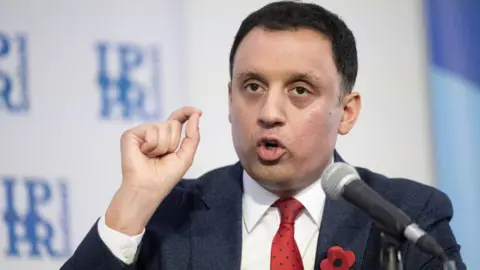
Scottish Labour leader Anas Sarwar has refused to be drawn on speculation that Chancellor Rachel Reeves will raise UK income tax.
While an increase would not apply in Scotland – which has distinct bands and rates – it would lead to a cut in the Holyrood budget under devolved funding arrangements, known as the fiscal framework.
Scottish Finance Secretary Shona Robison has warned that she may “have to revisit” a promise not to raise income tax as a result.
Sarwar declined to explain how he would plug the budget gap if he became first minister following the Holyrood election in May.
The Scottish Labour leader, speaking at an event launching a report on economic growth in Scotland, repeatedly said he would not speculate about what was going to be in the chancellor’s Autumn Budget, which will be announced on 26 November.
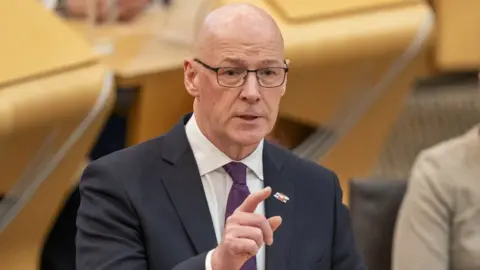
He highlighted that First Minister John Swinney had previously called on the UK government to increase income tax south of the border.
Sarwar described Swinney as “economically illiterate” and the “strongest advocate” for UK income tax rises.
“He’s been arguing that for two years and he’s the man that negotiated the fiscal framework,” Sarwar told BBC Scotland News.
The Scottish Labour leader said that if he became first minister he wanted to “reduce the tax burden on our country and go hell for leather for growth”.
He said he would achieve that through measures like city mayors, more co-operation with Westminster and speeding up the planning system.
Budget ‘black hole’
It has been speculated that the chancellor might raise the basic rate of income tax in England, Wales and Northern Ireland by 2p, coupled with an equal cut in National Insurance.
That would have a neutral impact on most working people who pay both taxes, but would mean groups such as pensioners or landlords would pay more.
Swinney warned that the UK government would potentially raise taxes to “fill a black hole of their own making”.
He predicted a hike would end up “punishing” Scotland’s public finances and services.
“That’s not what we’ve been calling for,” the first minister told BBC Scotland News.
“What we’ve been calling for is taxation to be used to invest in our public services.”
He added that economic growth was “at the heart” of his government’s policy programme.
Scottish Conservative finance spokesman Craig Hoy said: “Economic growth is essential to pay for public services, but it will be impossible to achieve until we ditch the high-tax agenda of Labour and the SNP.”
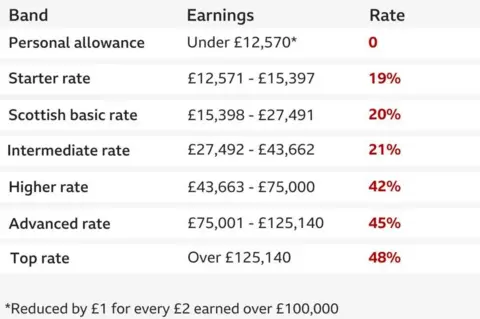
The Scottish government says its income tax system, which has seven bands to the UK’s four, is fairer and more progressive than Westminster’s.
People living in Scotland earning below about £30,300 pay slightly less income tax than they would elsewhere in the UK, with a maximum saving of about £28.
Above that threshold they pay increasingly more as earnings increase.
Someone on £50,000 in Scotland pays £1,528 more than they would in the rest of the UK. That rises to £5,207 for someone on £125,000.
However, economist Sir Anton Muscatelli – who was commissioned by Scottish Labour to write the economic growth report – found that Scotland’s higher marginal income tax rates “could be a major disincentive in attracting high value jobs”.
A former economic adviser to the Scottish government, he suggested that Holyrood ministers should aim to reduce “distortion” between the Scottish and UK income tax systems.
 PA Media
In its 2024 manifesto, Labour pledged not to hike income tax, VAT or National Insurance.
However, in a pre-Budget speech last week, Reeves said she would make “necessary choices” after the world had “thrown more challenges our way”.
While a UK income tax hike would not directly affect people in Scotland – because Holyrood ministers have used devolved powers to create a distinct system – it would lead to an automatic deduction from the Scottish Budget.
That is because under the fiscal framework the UK government is able to deduct funds from the block grant that it estimates it would have received if tax-raising powers were not devolved to Holyrood.
A rise in UK income tax would lead to an increase in the amount the Treasury would have levied in Scotland if its income tax rates applied north of the border.
That in turn would lead to a bigger deduction from the block grant, known as a block grant adjustment (BGA).
The Fraser of Allander Institute, an independent economic research unit at the University of Strathclyde, has estimated that a 2p increase in the basic rate of UK income tax would lead to a cut of about £1bn in Scotland’s block grant in each of the next three financial years.
Unless the UK government increases spending in other areas, which would increase Scotland’s block grant, Holyrood ministers would either have to raise taxes or make spending cuts to plug the gap.
Changes to National Insurance, which is not devolved, would apply directly in Scotland, and would not affect the BGA.
The Treasury has said it will not comment on speculation about the Budget, but insisted the chancellor was focused on providing economic stability and growth.
A spokesperson also said Scotland had received a record settlement in 2024-25.
The Scottish government is now due to reveal its tax and spending plans until 13 January.
BBC News

Khamrah by Lattafa for Men - 3.4 oz EDP Spray
4% Off
Ghost Sweetheart Eau de Toilette | Pineapple, Jasmine and Sandalwood | Perfume for Women 50 ml
50% Off
Marc Jacobs Dot Eau De Parfum for Women, 100 ml
42% Off
Ted Baker W Eau de Toilette for Her, Fig Leaf, White Peony and Violet Top Notes, Pink Orchid and Raspberry Middle Notes, 75ml
£11.77 (£15.69 / 100 ml) (as of 10/09/2026 05:01 GMT +01:00 - More infoProduct prices and availability are accurate as of the date/time indicated and are subject to change. Any price and availability information displayed on [relevant Amazon Site(s), as applicable] at the time of purchase will apply to the purchase of this product.)
Ted Baker Woman Pink Eau de Toilette Spray Floral Green Feminine Fragrance, Opening Notes are Fresh Peach, Bergamot and Tangerine with Warm Musk, Vanilla and Vetiver Base, 100ml
11% Off
Vera Wang Princess Eau de Toilette - 30 ml

Choco Musk 50ml Eau De Parfum for men and women | Chocolate Musk by Jannat Aromas
17% Off
Christina Aguilera Signature Eau de Parfum (50ml) Floral, Fruity & Exotic Scent, Luxury Fragrance for Women
9% Off
Calvin Klein - Eau De Toilette CKIN2U - Calvin Klein Women, Ladies Perfume, Women's Perfume, Calvin Klein Perfume, Calvin Klein One - 150 ml
5% Off
Jimmy Choo Flash Eau de Parfum, 60 ml (Pack of 1)
3% Off
Fruit of the Loom Men's Heavy T Shirt, White, XL UK
28% Off
ATNKE LED Lighted Beanie Cap,USB Rechargeable Running Hat Ultra Bright 4 LED Waterproof Light Winter Warm Gifts for Men and Women/Pink
17% Off
Men's 1/4 Zip Pullover UK Sale Clearance, Fleece Sweatshirt Casual Jumper Long Sleeve T-shirt Top Stand Collar Sweater Plain Pullover Sports Leisure Workwear Quarter Zip Sweater Lightweight Jumpers
£5.88 (as of 12/11/2025 00:52 GMT +01:00 - More infoProduct prices and availability are accurate as of the date/time indicated and are subject to change. Any price and availability information displayed on [relevant Amazon Site(s), as applicable] at the time of purchase will apply to the purchase of this product.)
Crevice Cleaning Brush, Bathroom Tile Groove Gap Cleaning Brush,Premium Crevice Cleaning Tool Aluminum Support with 15° Angle Magic Brush, Thin Brush for Home Kitchen
19% Off
Wireless Earbuds, Bluetooth 5.3 Headphones in Ear with HiFi Stereo Deep Bass, 4 ENC Noise Cancelling Mic Wireless Earphones 40H Playtime, Bluetooth Earbuds Dual LED Display, IP7 Waterproof, USB-C
42% Off