 [
[

Researchers at the Technion Faculty of Biomedical Engineering have achieved a breakthrough in the early detection of heart failure. They developed DeepHHF, an artificial intelligence model that identifies patients at high risk of developing heart failure years before the onset of clinical disease, enabling preventive interventions that could spare patients significant suffering and potentially save lives.
The study, published in npj Digital Medicine, was led by Prof. Joachim Behar and Ph.D. student Eran Zvuloni of the Technion, in collaboration with researchers and physicians from Rambam Health Care Campus, Shaare Zedek Medical Center, the Hebrew University of Jerusalem and Leumit Health Services.
A common and costly condition
Heart failure affects approximately 64 million people worldwide and is especially common among adults older than 65, affecting roughly 12% of this population in developed countries. The condition significantly reduces quality of life, causing symptoms such as fatigue, shortness of breath, edema and exercise intolerance, and can ultimately lead to death. As a result, there is a growing emphasis on early diagnosis, which makes it possible to initiate preventive treatments that can improve outcomes and save lives.
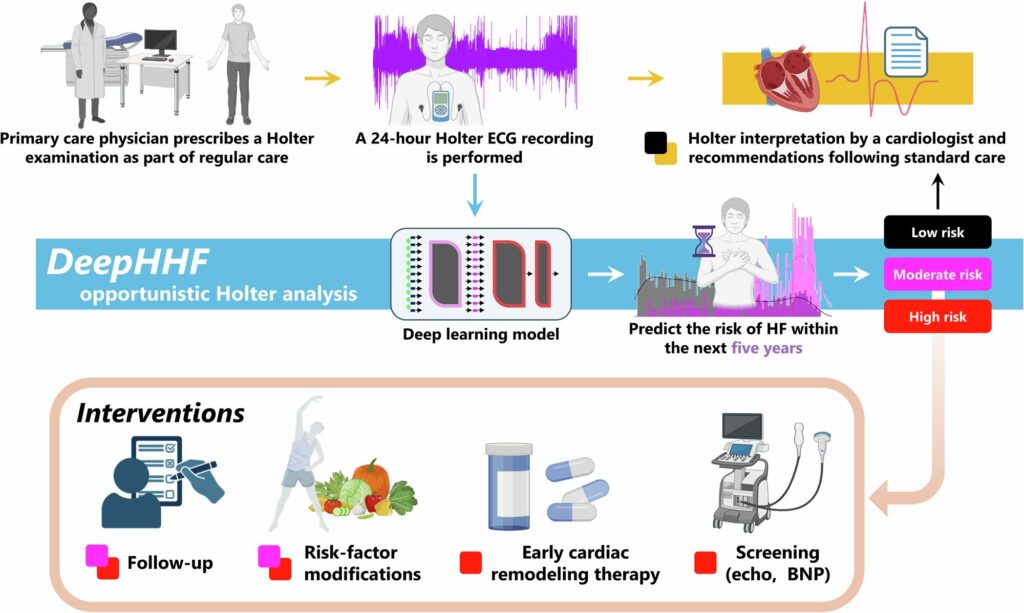
The Technion-developed model, DeepHHF, was trained on approximately 70,000 Holter examinations performed at Leumit Health Services. It analyzes standard 24-hour ambulatory electrocardiogram (Holter ECG) recordings obtained during routine home monitoring and identifies patients at elevated risk of heart failure. The model detects subtle abnormalities in ECG recordings that are often imperceptible to the human eye, generating an early warning that can precede the onset of heart failure by several years.
Five-year warning from routine ECGs
According to the study’s senior author, Prof. Behar, “To the best of our knowledge, no existing model can predict the risk of heart failure up to five years in advance using raw Holter ECG recordings. By relying on standard, non-invasive diagnostic tools, our model provides clinically valuable information that enables early identification of high-risk patients and timely preventive interventions, with the potential to reduce hospitalizations, suffering and mortality.”
Collaborating researchers and physicians, including Dr. Ronit Almog from the Technion and Rambam Health Care Campus, Michael Glikson from Shaare Zedek Medical Center, Shany Brimer Biton from the Technion, Dr. Ilan Green and Izhar Laufer from Leumit Health Services, and Offer Amir from Hadassah Medical Center, also participated in the research.
Publication details
Eran Zvuloni et al, Modeling day-long ECG signals to predict heart failure risk with explainable AI, npj Digital Medicine (2026). DOI: 10.1038/s41746-026-02835-8
Journal information:
npj Digital Medicine
Key medical concepts
Clinical categories


Citation:
AI flags heart failure risk five years early from routine ECG recordings (2026, July 15)
retrieved 15 July 2026
from https://medicalxpress.com/news/2026-07-ai-flags-heart-failure-years.html
This document is subject to copyright. Apart from any fair dealing for the purpose of private study or research, no
part may be reproduced without the written permission. The content is provided for information purposes only.

Khamrah by Lattafa for Men - 3.4 oz EDP Spray
4% Off
Ghost Sweetheart Eau de Toilette | Pineapple, Jasmine and Sandalwood | Perfume for Women 50 ml
50% Off
Marc Jacobs Dot Eau De Parfum for Women, 100 ml
42% Off
Ted Baker W Eau de Toilette for Her, Fig Leaf, White Peony and Violet Top Notes, Pink Orchid and Raspberry Middle Notes, 75ml
£11.77 (£15.69 / 100 ml) (as of 07/08/2026 04:07 GMT +01:00 - More infoProduct prices and availability are accurate as of the date/time indicated and are subject to change. Any price and availability information displayed on [relevant Amazon Site(s), as applicable] at the time of purchase will apply to the purchase of this product.)
Ted Baker Woman Pink Eau de Toilette Spray Floral Green Feminine Fragrance, Opening Notes are Fresh Peach, Bergamot and Tangerine with Warm Musk, Vanilla and Vetiver Base, 100ml
11% Off
Vera Wang Princess Eau de Toilette - 30 ml

Choco Musk 50ml Eau De Parfum for men and women | Chocolate Musk by Jannat Aromas
17% Off
Christina Aguilera Signature Eau de Parfum (50ml) Floral, Fruity & Exotic Scent, Luxury Fragrance for Women
9% Off
Calvin Klein - Eau De Toilette CKIN2U - Calvin Klein Women, Ladies Perfume, Women's Perfume, Calvin Klein Perfume, Calvin Klein One - 150 ml
5% Off
Jimmy Choo Flash Eau de Parfum, 60 ml (Pack of 1)
3% Off
Fruit of the Loom Men's Heavy T Shirt, White, XL UK
28% Off
ATNKE LED Lighted Beanie Cap,USB Rechargeable Running Hat Ultra Bright 4 LED Waterproof Light Winter Warm Gifts for Men and Women/Pink
17% Off
Men's 1/4 Zip Pullover UK Sale Clearance, Fleece Sweatshirt Casual Jumper Long Sleeve T-shirt Top Stand Collar Sweater Plain Pullover Sports Leisure Workwear Quarter Zip Sweater Lightweight Jumpers
£5.88 (as of 12/11/2025 00:52 GMT +01:00 - More infoProduct prices and availability are accurate as of the date/time indicated and are subject to change. Any price and availability information displayed on [relevant Amazon Site(s), as applicable] at the time of purchase will apply to the purchase of this product.)
Crevice Cleaning Brush, Bathroom Tile Groove Gap Cleaning Brush,Premium Crevice Cleaning Tool Aluminum Support with 15° Angle Magic Brush, Thin Brush for Home Kitchen
19% Off
Wireless Earbuds, Bluetooth 5.3 Headphones in Ear with HiFi Stereo Deep Bass, 4 ENC Noise Cancelling Mic Wireless Earphones 40H Playtime, Bluetooth Earbuds Dual LED Display, IP7 Waterproof, USB-C
42% Off