A McGill University-led research team working in collaboration with a French team (CNRS, INSERM and Sorbonne university) believes it has identified both the neurological mechanism underlying anorexia nervosa as well as a possible cure.
The international team’s findings, published this week in Nature Communications, have the potential to improve the lives of millions of people around the world, mostly women, who suffer from the common eating disorder, which has the highest mortality rate of any psychiatric disease.
Working with mice, the researchers discovered that a deficit in the acetylcholine, a neurotransmitter in an area of the brain called the striatum, which is associated with the reward system, can lead to excessive habit formation and precipitate the compulsive self-starvation seen in people who suffer from anorexia nervosa.
McGill Psychiatry professor Dr. Salah El Mestikawy, the senior author on the paper and a researcher at the Douglas Research Centre, said the research team decided to see whether using donepezil, a medication which is known to increase the presence of acetylcholine in the brain, could have an effect on these compulsive self-destructive behaviors.
“We found that it fully reversed the anorexia-like behavior in mice, and we believe that it could potentially offer the first mechanism-based treatment of anorexia nervosa. In fact, we are already seeing its effects on some patients with the disease.”
Improving health of anorexia patients treated with donepezil
Ongoing independent studies in Toronto and Montreal, led by Dr. Leora Pinhas, an independent psychiatrist, are showing positive results for 10 patients with severe anorexia nervosa who are being treated with low doses of donepezil. Three of the patients are in full remission and the other seven patients show a marked improvement in the disease.
Further double-blind clinical trials, comparing the results of those taking a placebo with those taking the medication, are due to take place this year at Columbia University, Denver University, and the Hôpital Sainte-Anne in Paris.
Dr. El Mestikawy cautions, however, that between clinical trials and government approval it may take several years before a new drug can be used to treat anorexic patients.
Possible effects on other diseases involving compulsive behaviors
El Mestikawy said donepezil is a drug with many gastrointestinal and muscular side effects. As a result, the McGill researchers are working with the French team, led by Stéphanie Daumas and Nicolas Pietrancosta at Sorbonne Université, who co-authored the study, to develop a novel compound with fewer problems.
“We also suspect that other compulsive pathologies such as obsessive-compulsive disorders (OCD) and addictions can also be improved by donepezil, so we are actively looking for collaboration with other psychiatrists around the world to explore the possibilities,” said El Mestikawy.
More information:
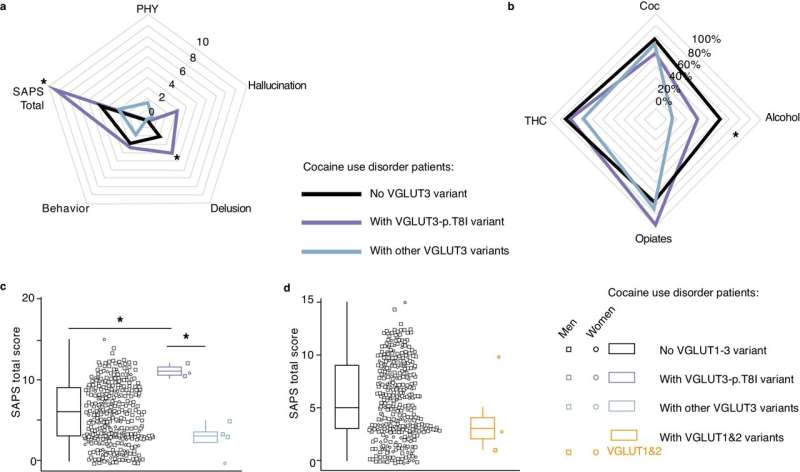
Mathieu Favier et al, The human VGLUT3-pT8I mutation elicits uneven striatal DA signaling, food or drug maladaptive consumption in male mice, Nature Communications (2024). DOI: 10.1038/s41467-024-49371-1
Citation:
A research team may have discovered the neurological mechanism underlying a common eating disorder (2024, July 8)
retrieved 8 July 2024
from https://medicalxpress.com/news/2024-07-team-neurological-mechanism-underlying-common.html
This document is subject to copyright. Apart from any fair dealing for the purpose of private study or research, no
part may be reproduced without the written permission. The content is provided for information purposes only.

Khamrah by Lattafa for Men - 3.4 oz EDP Spray
4% Off
Ghost Sweetheart Eau de Toilette | Pineapple, Jasmine and Sandalwood | Perfume for Women 50 ml
50% Off
Marc Jacobs Dot Eau De Parfum for Women, 100 ml
42% Off
Ted Baker W Eau de Toilette for Her, Fig Leaf, White Peony and Violet Top Notes, Pink Orchid and Raspberry Middle Notes, 75ml
£11.77 (£15.69 / 100 ml) (as of 21/08/2026 04:39 GMT +01:00 - More infoProduct prices and availability are accurate as of the date/time indicated and are subject to change. Any price and availability information displayed on [relevant Amazon Site(s), as applicable] at the time of purchase will apply to the purchase of this product.)
Ted Baker Woman Pink Eau de Toilette Spray Floral Green Feminine Fragrance, Opening Notes are Fresh Peach, Bergamot and Tangerine with Warm Musk, Vanilla and Vetiver Base, 100ml
11% Off
Vera Wang Princess Eau de Toilette - 30 ml

Choco Musk 50ml Eau De Parfum for men and women | Chocolate Musk by Jannat Aromas
17% Off
Christina Aguilera Signature Eau de Parfum (50ml) Floral, Fruity & Exotic Scent, Luxury Fragrance for Women
9% Off
Calvin Klein - Eau De Toilette CKIN2U - Calvin Klein Women, Ladies Perfume, Women's Perfume, Calvin Klein Perfume, Calvin Klein One - 150 ml
5% Off
Jimmy Choo Flash Eau de Parfum, 60 ml (Pack of 1)
3% Off
Fruit of the Loom Men's Heavy T Shirt, White, XL UK
28% Off
ATNKE LED Lighted Beanie Cap,USB Rechargeable Running Hat Ultra Bright 4 LED Waterproof Light Winter Warm Gifts for Men and Women/Pink
17% Off
Men's 1/4 Zip Pullover UK Sale Clearance, Fleece Sweatshirt Casual Jumper Long Sleeve T-shirt Top Stand Collar Sweater Plain Pullover Sports Leisure Workwear Quarter Zip Sweater Lightweight Jumpers
£5.88 (as of 12/11/2025 00:52 GMT +01:00 - More infoProduct prices and availability are accurate as of the date/time indicated and are subject to change. Any price and availability information displayed on [relevant Amazon Site(s), as applicable] at the time of purchase will apply to the purchase of this product.)
Crevice Cleaning Brush, Bathroom Tile Groove Gap Cleaning Brush,Premium Crevice Cleaning Tool Aluminum Support with 15° Angle Magic Brush, Thin Brush for Home Kitchen
19% Off
Wireless Earbuds, Bluetooth 5.3 Headphones in Ear with HiFi Stereo Deep Bass, 4 ENC Noise Cancelling Mic Wireless Earphones 40H Playtime, Bluetooth Earbuds Dual LED Display, IP7 Waterproof, USB-C
42% Off