Environmental and public health agencies often don’t warn people about smoke-choked air until it’s already swept in, a new study from the University of Oregon suggests.
The study, published on Feb. 5 in the journal BMC Public Health, provides recommendations for how public institutions can more effectively communicate wildfire smoke and its risks to provide people ample time to prepare.
Looking at the Pacific Northwest in particular, researchers from the School of Journalism and Communication examined the frequency and content of federal, state and local agencies’ health communications on X, formerly known as Twitter.
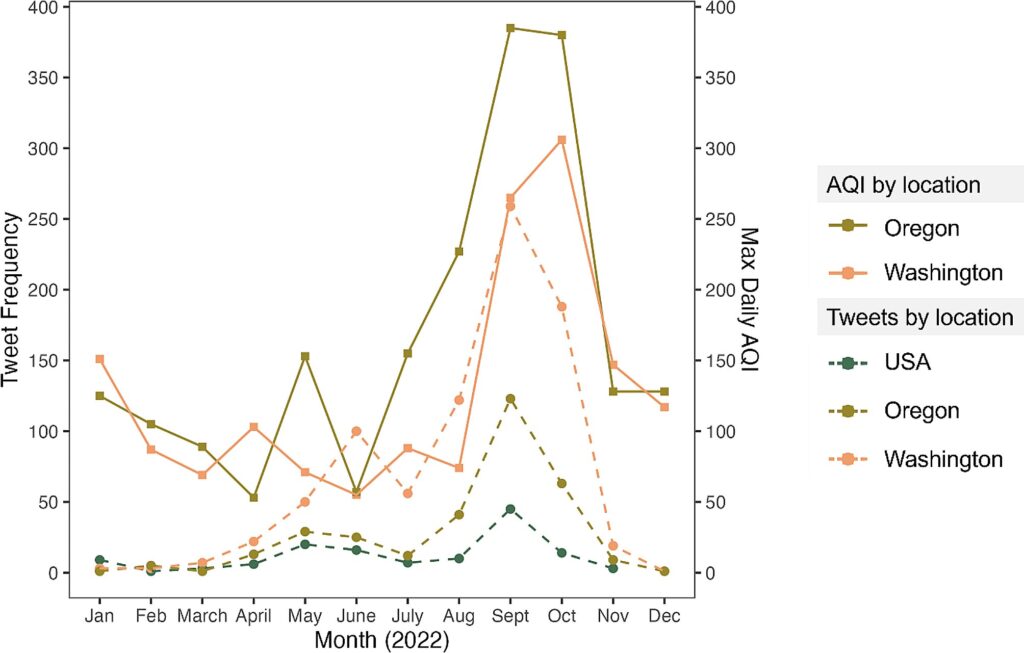
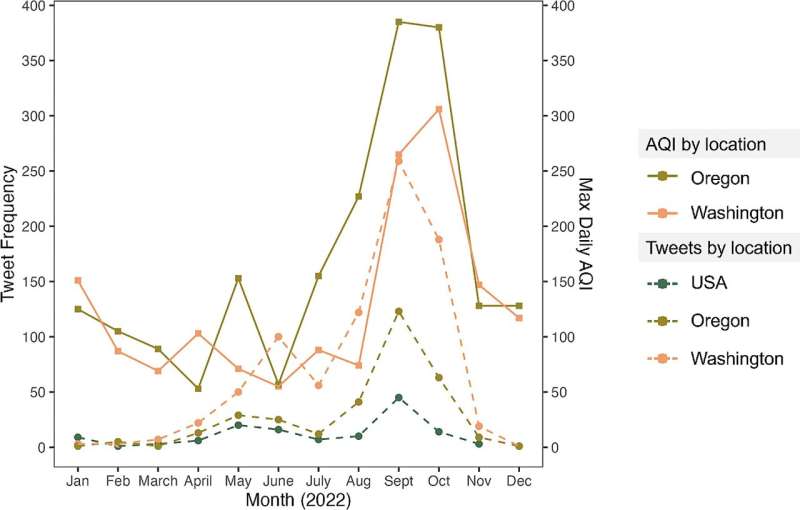
In an analysis led by Catherine Slavik, a postdoctoral researcher in the school’s Center for Science Communication Research, she found that public health messages were primarily reactive: More than half of wildfire-related tweets authored by 32 institutional accounts in 2022 were posted during peak smoke levels, when the risk of exposure was highest.
“On the one side, these institutions are doing a great job of highlighting the risks when the risks are present,” Slavik said. “But going forward, hopefully more of these conversations on smoke will be had before it’s potentially already in the air and too late to prepare.”
Slavik and her colleague Daniel Chapman, a postdoctoral researcher in the Center for Science Communication Research and collaborator with the UO’s Center for Wildfire Smoke Research and Practice, also found that most tweets discussed the hazards but not the actions to mitigate them. Only 1 in 7 of the total 1,287 analyzed tweets instructed and encouraged preparatory actions, such as wearing respirators, staying indoors and using at-home air purifiers.
“We want to see more emphasis on the actions people can take to help deal with wildfire smoke,” Chapman said. “It’s good to be aware, but in the absence of knowing what to do, awareness can only take you so far.”
Moreover, only 213 of the total tweets used air quality index labels to report how clean or polluted the air was. Even fewer—64 tweets—described risks with numeric information, such as the percentage likelihood of a fire spreading or the number of acres burning. Previous research, however, has indicated people prefer and are more motivated by numeric information, Chapman said.
In response, the researchers created a list of best practices for government agencies in Oregon and Washington to consider when communicating wildfires and smoke events:
- Communicate the severity, risk, likelihood and mitigation of a hazard.
- Describe risks with numeric information and air quality index levels.
- Engage with communities to foster community-building and resilience.
- Implement proactive communications by discussing wildfire and smoke risks during off-seasons.
Local organizations, like fire departments, are often highly trusted in a community, so messages by regional communicators that incorporate the suggestions may be particularly persuasive, researchers said.
“Any institution that has a clear role in its community has a real opportunity to communicate risk and responses effectively,” Chapman said
Journalists also play a key role in telling an accurate and timely story of fire. Hollie Smith, an associate professor of science and environmental communication in the School of Journalism and Communication and a researcher at the Center for Wildfire Smoke Research and Practice, recently co-authored a guide for Oregon reporters covering wildfires. The project, done in partnership with Oregon State University’s Extension Fire Program, provides tips on how to safely approach fire sites and where to obtain credible information.
Smith, associate director of the Center for Science Communication Research, noted the oftentimes negative language associated with fire in the media. Fire, however, has both ecological and cultural significance. The conversation on what fire means to people needs to be more nuanced, she said.
“It’s helpful to recognize that we will be living with fire,” she said. “So what does that look like today? What did it look like historically? What are the social and economic dimensions of wildfire? These are all important pieces of the conversation.”
The researchers at the Center for Science Communication Research are now looking at how to best present information to specific audiences, such as parents on the West Coast, to motivate proactive protective behaviors. Researchers at the Center for Wildfire Smoke Research and Practice are also looking into the barriers communication professionals might face when trying to communicate public health risks.
“There are now three seasons in Oregon: rainy, sunny and smoky,” said Ellen Peters, director of the Center for Science Communication Research. “Smoke is such an important and relatively new risk that we face as Oregonians, and we need to understand what the state and federal agencies are doing to communicate it and how they could do better for our communities.”
More information:
Catherine E. Slavik et al, Clearing the air: evaluating institutions’ social media health messaging on wildfire and smoke risks in the US Pacific Northwest, BMC Public Health (2024). DOI: 10.1186/s12889-024-17907-1
Citation:
Wildfire smoke warnings need to be issued sooner, study finds (2024, March 15)
retrieved 16 March 2024
from https://medicalxpress.com/news/2024-03-wildfire-issued-sooner.html
This document is subject to copyright. Apart from any fair dealing for the purpose of private study or research, no
part may be reproduced without the written permission. The content is provided for information purposes only.

Khamrah by Lattafa for Men - 3.4 oz EDP Spray
4% Off
Ghost Sweetheart Eau de Toilette | Pineapple, Jasmine and Sandalwood | Perfume for Women 50 ml
50% Off
Marc Jacobs Dot Eau De Parfum for Women, 100 ml
42% Off
Ted Baker W Eau de Toilette for Her, Fig Leaf, White Peony and Violet Top Notes, Pink Orchid and Raspberry Middle Notes, 75ml
£11.77 (£15.69 / 100 ml) (as of 18/07/2026 03:59 GMT +01:00 - More infoProduct prices and availability are accurate as of the date/time indicated and are subject to change. Any price and availability information displayed on [relevant Amazon Site(s), as applicable] at the time of purchase will apply to the purchase of this product.)
Ted Baker Woman Pink Eau de Toilette Spray Floral Green Feminine Fragrance, Opening Notes are Fresh Peach, Bergamot and Tangerine with Warm Musk, Vanilla and Vetiver Base, 100ml
11% Off
Vera Wang Princess Eau de Toilette - 30 ml

Choco Musk 50ml Eau De Parfum for men and women | Chocolate Musk by Jannat Aromas
17% Off
Christina Aguilera Signature Eau de Parfum (50ml) Floral, Fruity & Exotic Scent, Luxury Fragrance for Women
9% Off
Calvin Klein - Eau De Toilette CKIN2U - Calvin Klein Women, Ladies Perfume, Women's Perfume, Calvin Klein Perfume, Calvin Klein One - 150 ml
5% Off
Jimmy Choo Flash Eau de Parfum, 60 ml (Pack of 1)
3% Off
Fruit of the Loom Men's Heavy T Shirt, White, XL UK
28% Off
ATNKE LED Lighted Beanie Cap,USB Rechargeable Running Hat Ultra Bright 4 LED Waterproof Light Winter Warm Gifts for Men and Women/Pink
17% Off
Men's 1/4 Zip Pullover UK Sale Clearance, Fleece Sweatshirt Casual Jumper Long Sleeve T-shirt Top Stand Collar Sweater Plain Pullover Sports Leisure Workwear Quarter Zip Sweater Lightweight Jumpers
£5.88 (as of 12/11/2025 00:52 GMT +01:00 - More infoProduct prices and availability are accurate as of the date/time indicated and are subject to change. Any price and availability information displayed on [relevant Amazon Site(s), as applicable] at the time of purchase will apply to the purchase of this product.)
Crevice Cleaning Brush, Bathroom Tile Groove Gap Cleaning Brush,Premium Crevice Cleaning Tool Aluminum Support with 15° Angle Magic Brush, Thin Brush for Home Kitchen
19% Off
Wireless Earbuds, Bluetooth 5.3 Headphones in Ear with HiFi Stereo Deep Bass, 4 ENC Noise Cancelling Mic Wireless Earphones 40H Playtime, Bluetooth Earbuds Dual LED Display, IP7 Waterproof, USB-C
42% Off