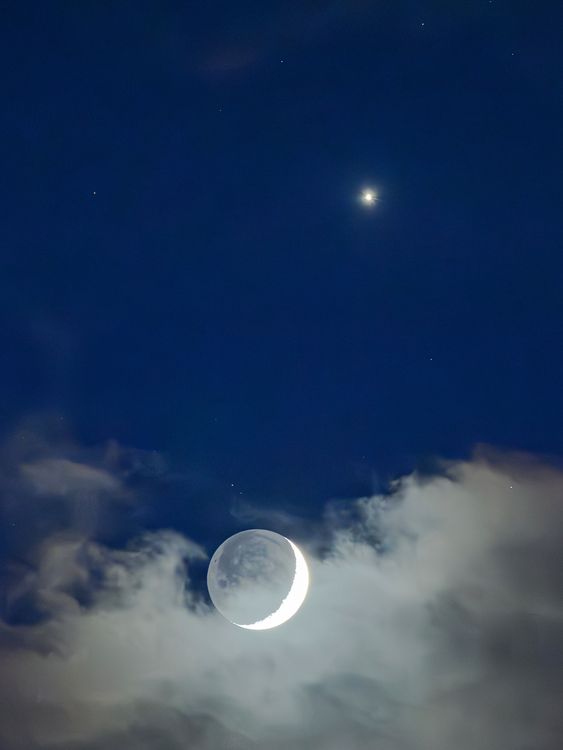
Stargazers spied an unusual sight on Friday night, as Venus appeared beside a crescent moon.
The planet could be seen with the naked eye in locations lucky enough to have clear skies and incredible pictures show it seemingly shining.
Venus is often called the Morning or Evening Star, as it can easily be mistaken for a bright star.
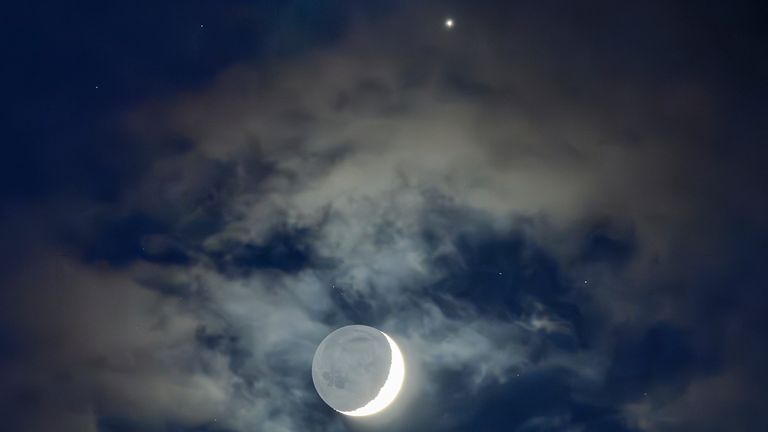
The view from Sieversdorf, Germany. Pic: AP

The Moon and Venus straddle a cross on top of Quebec Baptist Church in Ellaville, Georgia. Pic: Reuters
January looks set to be a good month for stargazers and astronomers, as numerous celestial phenomena will be visible across the coming weeks.
The Quadrantid meteor shower is at its peak this weekend and visible until 12 January.

Venus – seen here from Georgia, USA – didn’t appear as bright when viewed from the States. Pic: Reuters
On 16 January, there’s a strong chance you’ll be able to see Mars as the red planet will be in “opposition”, meaning Earth will be directly between it and the sun.
Just under a week later, on 21 January, you could see five planets – Saturn, Venus, Uranus, Jupiter and Mars – in the night sky after 9pm, according to the Royal Observatory Greenwich.
More from Sky News:
NASA spacecraft survives approach to the sun
Stranded astronauts send message from space
Four of the planets should be visible to the naked eye, but seeing Uranus will require a telescope or very dark skies.
Anyone hoping to spot celestial phenomena is advised to find a stargazing spot away from light pollution and to allow at least 15 minutes for your eyes to adjust to the darkness.
Source link

Khamrah by Lattafa for Men - 3.4 oz EDP Spray
4% Off
Ghost Sweetheart Eau de Toilette | Pineapple, Jasmine and Sandalwood | Perfume for Women 50 ml
50% Off
Marc Jacobs Dot Eau De Parfum for Women, 100 ml
42% Off
Ted Baker W Eau de Toilette for Her, Fig Leaf, White Peony and Violet Top Notes, Pink Orchid and Raspberry Middle Notes, 75ml
£11.77 (£15.69 / 100 ml) (as of 03/09/2026 04:57 GMT +01:00 - More infoProduct prices and availability are accurate as of the date/time indicated and are subject to change. Any price and availability information displayed on [relevant Amazon Site(s), as applicable] at the time of purchase will apply to the purchase of this product.)
Ted Baker Woman Pink Eau de Toilette Spray Floral Green Feminine Fragrance, Opening Notes are Fresh Peach, Bergamot and Tangerine with Warm Musk, Vanilla and Vetiver Base, 100ml
11% Off
Vera Wang Princess Eau de Toilette - 30 ml

Choco Musk 50ml Eau De Parfum for men and women | Chocolate Musk by Jannat Aromas
17% Off
Christina Aguilera Signature Eau de Parfum (50ml) Floral, Fruity & Exotic Scent, Luxury Fragrance for Women
9% Off
Calvin Klein - Eau De Toilette CKIN2U - Calvin Klein Women, Ladies Perfume, Women's Perfume, Calvin Klein Perfume, Calvin Klein One - 150 ml
5% Off
Jimmy Choo Flash Eau de Parfum, 60 ml (Pack of 1)
3% Off
Fruit of the Loom Men's Heavy T Shirt, White, XL UK
28% Off
ATNKE LED Lighted Beanie Cap,USB Rechargeable Running Hat Ultra Bright 4 LED Waterproof Light Winter Warm Gifts for Men and Women/Pink

Men's 1/4 Zip Pullover UK Sale Clearance, Fleece Sweatshirt Casual Jumper Long Sleeve T-shirt Top Stand Collar Sweater Plain Pullover Sports Leisure Workwear Quarter Zip Sweater Lightweight Jumpers
£5.88 (as of 12/11/2025 00:52 GMT +01:00 - More infoProduct prices and availability are accurate as of the date/time indicated and are subject to change. Any price and availability information displayed on [relevant Amazon Site(s), as applicable] at the time of purchase will apply to the purchase of this product.)
Crevice Cleaning Brush, Bathroom Tile Groove Gap Cleaning Brush,Premium Crevice Cleaning Tool Aluminum Support with 15° Angle Magic Brush, Thin Brush for Home Kitchen
19% Off
Wireless Earbuds, Bluetooth 5.3 Headphones in Ear with HiFi Stereo Deep Bass, 4 ENC Noise Cancelling Mic Wireless Earphones 40H Playtime, Bluetooth Earbuds Dual LED Display, IP7 Waterproof, USB-C
42% Off