

Abu Bakar Yasinand
Naomi de Souza,BBC Newsbeat

 PFA
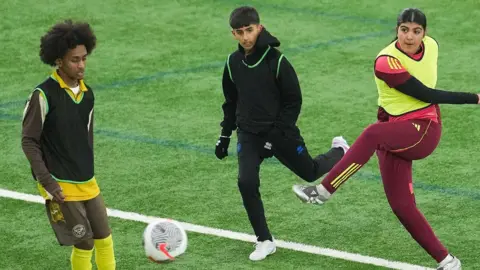
PFAThe number of South Asian men playing professional football in England has almost doubled since the 2021-22 season, when the Football Association (FA) launched a strategy to boost participation in the game.
But the numbers don’t tell the whole story.
While there were 28 professional South Asian players in England last season – compared with 16 five years ago – they represent just over 1% of those competing at an elite level.
But the interest is there – the FA reports that within England more South Asian people are playing, coaching and refereeing across all levels of the game.
Within South Asian communities, more than 11% of adult males and more than 15% of adult females are participating in football, it says.
There is no shortage of talent – but why are so few players struggling to break through to the top?
Players tells BBC Newsbeat tired myths, cultural expectations and lack of infrastructure are some of the reasons why.
‘We’ve experienced this for decades’
 Natine Williams
“It’s good more conversations are happening, but it’s something that a lot of us have been experiencing for decades,” says journalist and presenter Marva Kreel.
Marva, who is of part South-Asian heritage, has been involved in girls’ and women’s football since childhood and once played for Tottenham as a youth.
“When I looked around, the players that were playing on the pitch didn’t represent my local area,” she tells Newsbeat.
“They didn’t represent who I was going to school with, it was a very white space.”
Marva says physical barriers, such as distant training grounds, stopped some of her friends from progressing to higher levels.
“You couldn’t get to training. You couldn’t get to your games in the same way that boys could and that my boy mates could, because we didn’t have coaches laid on for us,” she says.
Marva says certain assumptions can count out promising South Asian talent.
“A lot of this comes down to shared problems that we have in the South Asian community of how South Asian boys and how South Asian girls might be stereotyped amongst football,” she says.
‘Told we would never make it’
 Professional Footballers’ Association
It’s a situation Riz Rehman experienced himself.
“We were told that we would never make it because you’ve got the wrong diet, you’re playing towards education, not sport,” he recalls.
Riz’s brother, Zesh, was the first British South Asian to play in the Premier League.
He had hopes of forging a similar career but had to stop playing due to injury.
Now a coach, he worked with the Professional Footballers’ Association (PFA) to set up the Asian Inclusion Mentoring Scheme (AIMS), which supports Asian footballers at all levels by setting them up with mentors putting on workshops.
“AIMS will give support to any player on the elite pathway,” says the 43-year-old, referring to the phases aspiring pros must go through.
Riz says he wants to give others the chances and understanding that he and his brother missed out on.
“We obviously defeated those odds and we wanted to give every single player on the elite pathway a helping hand so that it is possible they can make it in the game as well,” he says.
The FA says Loughborough University is carrying out an independent evaluation of AIMS to help it understand the programme’s impact and shape its future.
‘Mentoring has massive impact’
 Getty Images
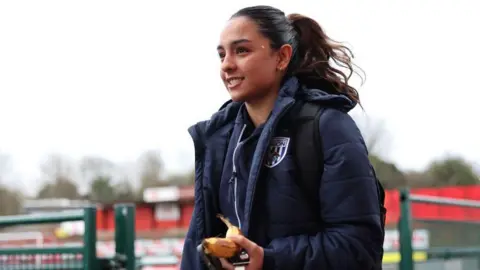
Malvind Singh Benning, who plays for League Two side Shrewsbury Town, took part in the AIMS programme and is now a mentor.
He recalls seeing only two players of South Asian heritage as he came up in his career.
“I’m 32 now so passing on real-life experience in the professional games to these young lads will be massive,” he says.
The PFA reports “steady progress” in getting more South Asian players into clubs but there is a way to go – particularly for women.
Mariam Mahmood, who plays for Wrexham, says representation also hinges on role models.
“When people see other people’s success stories and more publicity on people that are getting success in football, I think it will motivate other players and different people to also get involved and think: ‘Oh, if they can do it, I can do it’,” says the 21-year-old.
Mariam says she was “lucky” to cut her teeth in an inclusive academy but believes better representation starts at grassroots level, which feeds into the talent pool for bigger clubs.
“The important thing is to get [South Asians] playing football, develop them until they’re 16, 17, so they can sign professional contracts and get into that pool of people.”

Source link

Khamrah by Lattafa for Men - 3.4 oz EDP Spray
4% Off
Ghost Sweetheart Eau de Toilette | Pineapple, Jasmine and Sandalwood | Perfume for Women 50 ml
50% Off
Marc Jacobs Dot Eau De Parfum for Women, 100 ml
42% Off
Ted Baker W Eau de Toilette for Her, Fig Leaf, White Peony and Violet Top Notes, Pink Orchid and Raspberry Middle Notes, 75ml
£11.77 (£15.69 / 100 ml) (as of 24/01/2026 01:18 GMT +00:00 - More infoProduct prices and availability are accurate as of the date/time indicated and are subject to change. Any price and availability information displayed on [relevant Amazon Site(s), as applicable] at the time of purchase will apply to the purchase of this product.)
Ted Baker Woman Pink Eau de Toilette Spray Floral Green Feminine Fragrance, Opening Notes are Fresh Peach, Bergamot and Tangerine with Warm Musk, Vanilla and Vetiver Base, 100ml
11% Off
Vera Wang Princess Eau de Toilette - 30 ml

Choco Musk 50ml Eau De Parfum for men and women | Chocolate Musk by Jannat Aromas
17% Off
Christina Aguilera Signature Eau de Parfum (50ml) Floral, Fruity & Exotic Scent, Luxury Fragrance for Women
9% Off
Calvin Klein - Eau De Toilette CKIN2U - Calvin Klein Women, Ladies Perfume, Women's Perfume, Calvin Klein Perfume, Calvin Klein One - 150 ml
5% Off
Jimmy Choo Flash Eau de Parfum, 60 ml (Pack of 1)
3% Off
Fruit of the Loom Men's Heavy T Shirt, White, XL UK
28% Off
ATNKE LED Lighted Beanie Cap,USB Rechargeable Running Hat Ultra Bright 4 LED Waterproof Light Winter Warm Gifts for Men and Women/Pink
17% Off
Men's 1/4 Zip Pullover UK Sale Clearance, Fleece Sweatshirt Casual Jumper Long Sleeve T-shirt Top Stand Collar Sweater Plain Pullover Sports Leisure Workwear Quarter Zip Sweater Lightweight Jumpers
£5.88 (as of 11/11/2025 23:52 GMT +00:00 - More infoProduct prices and availability are accurate as of the date/time indicated and are subject to change. Any price and availability information displayed on [relevant Amazon Site(s), as applicable] at the time of purchase will apply to the purchase of this product.)
Crevice Cleaning Brush, Bathroom Tile Groove Gap Cleaning Brush,Premium Crevice Cleaning Tool Aluminum Support with 15° Angle Magic Brush, Thin Brush for Home Kitchen
19% Off
Wireless Earbuds, Bluetooth 5.3 Headphones in Ear with HiFi Stereo Deep Bass, 4 ENC Noise Cancelling Mic Wireless Earphones 40H Playtime, Bluetooth Earbuds Dual LED Display, IP7 Waterproof, USB-C
42% Off


