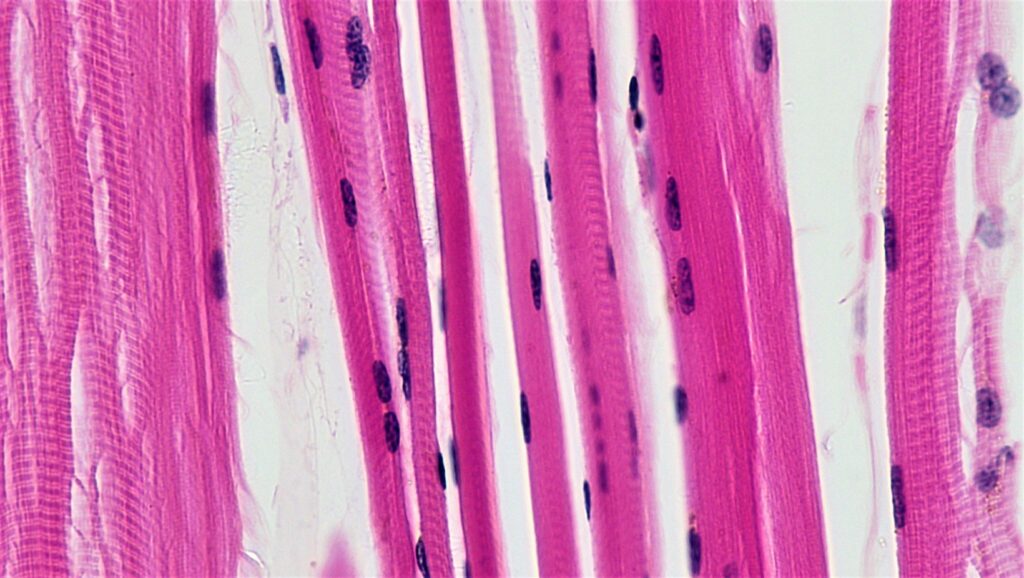
How muscle changes with aging and tries to fight its effects is now better understood at the cellular and molecular level with the first comprehensive atlas of aging muscles in humans.
Researchers from the Wellcome Sanger Institute and their collaborators at Sun Yat-sen University, China applied single-cell technologies and advanced imaging to analyze human skeletal muscle samples from 17 individuals across the adult lifespan. By comparing the results, they shed new light on the many complex processes underlying age-related muscle changes.
The atlas, published April 15 in Nature Aging, uncovers new cell populations that may explain why some muscle fibers age faster than others. It also identifies compensatory mechanisms the muscles employ to combat aging.
The findings offer avenues for future therapies and interventions to improve muscle health and quality of life as we age.
This study is part of the international Human Cell Atlas initiative to map every cell type in the human body, to transform understanding of health and disease.
As we age, our muscles progressively weaken. This can affect our ability to perform everyday activities like standing up and walking. For some people, muscle loss worsens, leading to falls, immobility, a loss of autonomy and a condition called sarcopenia. The reasons why our muscles weaken over time have remained poorly understood.
In this new study, scientists from the Wellcome Sanger Institute and Sun Yat-sen University, China used both single-cell and single-nucleus sequencing techniques along with advanced imaging to analyze human muscle samples from 17 individuals aged 20 to 75.
The team discovered that genes controlling ribosomes, responsible for producing proteins, were less active in muscle stem cells from aged samples. This impairs the cells’ ability to repair and regenerate muscle fibers as we age. Further, non-muscle cell populations within these skeletal muscle samples produced more of a pro-inflammatory molecule called CCL2, attracting immune cells to the muscle and exacerbating age-related muscle deterioration.
Age-related loss of a specific fast-twitch muscle fiber subtype, key for explosive muscle performance, was also observed. However, they discovered for the first time several compensatory mechanisms from the muscles appearing to make up for the loss. These included a shift in slow-twitch muscle fibers to express genes characteristic of the lost fast-twitch subtype, and increased regeneration of remaining fast-twitch fiber subtypes.
The team also identified specialized nuclei populations within the muscle fibers that help rebuild the connections between nerves and muscles that decline with age. Knockout experiments in lab-grown human muscle cells by the team confirmed the importance of these nuclei in maintaining muscle function.
Veronika Kedlian, first author of the study from the Wellcome Sanger Institute, said, “Our unbiased, multifaceted approach to studying muscle aging, combining different types of sequencing, imaging and investigation reveals previously unknown cellular mechanisms of aging and highlights areas for further study.”
Professor Hongbo Zhang, senior author of the study from Sun Yat-sen University, Guangzhou, China, said, “In China, the UK and other countries, we have aging populations, but our understanding of the aging process itself is limited. We now have a detailed view into how muscles strive to maintain function for as long as possible, despite the effects of aging.”
Dr. Sarah Teichmann, senior author of the study from the Wellcome Sanger Institute, and co-founder of the Human Cell Atlas, said, “Through the Human Cell Atlas, we are learning about the body in unprecedented detail, from the earliest stages of human development through to old age.
“With these new insights into healthy skeletal muscle aging, researchers all over the world can now explore ways to combat inflammation, boost muscle regeneration, preserve nerve connectivity, and more. Discoveries from research like this have huge potential for developing therapeutic strategies that promote healthier aging for future generations.”
More information:
Human skeletal muscle aging atlas, Nature Aging (2024). DOI: 10.1038/s43587-024-00613-3
Citation:
Human muscle map reveals how we try to fight effects of aging at cellular and molecular levels (2024, April 15)
retrieved 15 April 2024
from https://medicalxpress.com/news/2024-04-human-muscle-reveals-effects-aging.html
This document is subject to copyright. Apart from any fair dealing for the purpose of private study or research, no
part may be reproduced without the written permission. The content is provided for information purposes only.

Khamrah by Lattafa for Men - 3.4 oz EDP Spray
4% Off
Ghost Sweetheart Eau de Toilette | Pineapple, Jasmine and Sandalwood | Perfume for Women 50 ml
50% Off
Marc Jacobs Dot Eau De Parfum for Women, 100 ml
42% Off
Ted Baker W Eau de Toilette for Her, Fig Leaf, White Peony and Violet Top Notes, Pink Orchid and Raspberry Middle Notes, 75ml
£11.77 (£15.69 / 100 ml) (as of 06/06/2026 03:29 GMT +01:00 - More infoProduct prices and availability are accurate as of the date/time indicated and are subject to change. Any price and availability information displayed on [relevant Amazon Site(s), as applicable] at the time of purchase will apply to the purchase of this product.)
Ted Baker Woman Pink Eau de Toilette Spray Floral Green Feminine Fragrance, Opening Notes are Fresh Peach, Bergamot and Tangerine with Warm Musk, Vanilla and Vetiver Base, 100ml
11% Off
Vera Wang Princess Eau de Toilette - 30 ml

Choco Musk 50ml Eau De Parfum for men and women | Chocolate Musk by Jannat Aromas
17% Off
Christina Aguilera Signature Eau de Parfum (50ml) Floral, Fruity & Exotic Scent, Luxury Fragrance for Women
9% Off
Calvin Klein - Eau De Toilette CKIN2U - Calvin Klein Women, Ladies Perfume, Women's Perfume, Calvin Klein Perfume, Calvin Klein One - 150 ml
5% Off
Jimmy Choo Flash Eau de Parfum, 60 ml (Pack of 1)
3% Off
Fruit of the Loom Men's Heavy T Shirt, White, XL UK
28% Off
ATNKE LED Lighted Beanie Cap,USB Rechargeable Running Hat Ultra Bright 4 LED Waterproof Light Winter Warm Gifts for Men and Women/Pink
17% Off
Men's 1/4 Zip Pullover UK Sale Clearance, Fleece Sweatshirt Casual Jumper Long Sleeve T-shirt Top Stand Collar Sweater Plain Pullover Sports Leisure Workwear Quarter Zip Sweater Lightweight Jumpers
£5.88 (as of 12/11/2025 00:52 GMT +01:00 - More infoProduct prices and availability are accurate as of the date/time indicated and are subject to change. Any price and availability information displayed on [relevant Amazon Site(s), as applicable] at the time of purchase will apply to the purchase of this product.)
Crevice Cleaning Brush, Bathroom Tile Groove Gap Cleaning Brush,Premium Crevice Cleaning Tool Aluminum Support with 15° Angle Magic Brush, Thin Brush for Home Kitchen
19% Off
Wireless Earbuds, Bluetooth 5.3 Headphones in Ear with HiFi Stereo Deep Bass, 4 ENC Noise Cancelling Mic Wireless Earphones 40H Playtime, Bluetooth Earbuds Dual LED Display, IP7 Waterproof, USB-C
42% Off