 [
[

While people explore the environment around them, their eyes constantly move between different objects, faces and other specific segments of a visual scene. This dynamic process allows them to prioritize visual information relevant to a task at hand or that they find more interesting, ignoring details or items in their surroundings that they deem less important.
Short pauses on a specific part of a visual scene are known as fixations. Past studies have shown that different people can exhibit distinct fixation patterns. For instance, some people might spend more time looking at faces, while others might pause longer on written words or specific types of objects.
Researchers at Justus-Liebig University Giessen and the Center for Mind, Brain and Behavior recently carried out a study aimed at better understanding the relationship between what people tend to gaze at most and how their brains represent visual information. Their findings, published in Nature Human Behaviour, suggest that where people naturally direct their gaze reflects how their individual brains encode different types of visual stimuli.
“Individuals reliably differ in how they look at complex visual scenes, with the most prominent variation in their propensity to fixate on faces and text,” Diana Kollenda, Elaheh Akbari and their colleagues wrote in their paper. “We tested the hypothesis that these differences in gaze are linked to representational properties of the individual visual system in 61 adults.”

Tracking people’s gaze tendencies
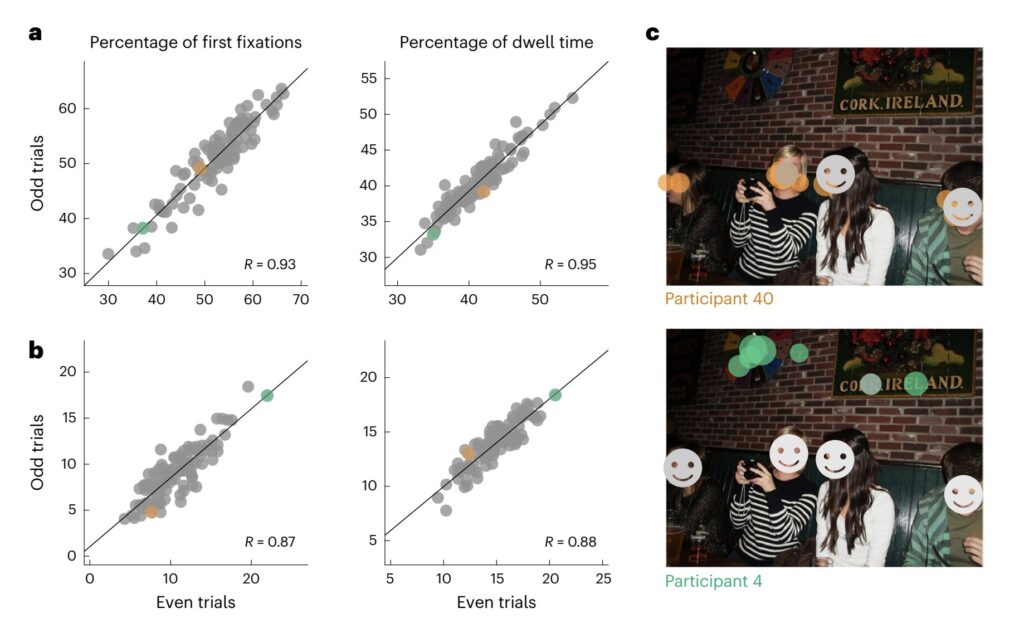
To explore the link between people’s fixation patterns and how their brains represent visual information, the researchers recruited 61 adults and asked them to complete a basic visual task. This task required them to observe complex natural scenes.
While the study participants looked at these scenes, the researchers tracked their gaze using eye-tracking technology. During a separate experiment, they also used an imaging technique called functional magnetic resonance imaging (fMRI) to collect scans of the participants’ brains while they were shown images of faces, words or other visual stimuli.
“Eye-tracking captured each observer’s characteristic gaze tendencies during naturalistic scene viewing, and independent fMRI recorded category-selective responses to faces, words and other stimuli when participants were instructed to fixate centrally,” wrote Kollenda and her colleagues. “We find that the propensity to fixate faces or text goes along with enhanced distinctiveness and enlarged functional regions of corresponding categorical representations in the ventral stream. These, in turn, predicted performance on reading and face-recognition tasks.”
Individual differences in the encoding of different stimuli
Kollenda and her colleagues found that participants exhibited different fixation patterns, with some spontaneously gazing more at faces and others at words. These distinct fixation patterns were associated with differences in the size and distinctiveness of specific brain regions.
Regions known to play a role in processing faces appeared to be larger and more distinctive in the brains of people who looked more frequently at faces. On the other hand, those who naturally tended to gaze more at text appeared to have larger functional regions specialized in processing written words.
Interestingly, the researchers also found that participants who looked more at faces performed significantly better on face-recognition tasks. In contrast, those who fixated more on text achieved better results on reading tasks.
“Thus, active vision appears linked to the precision of category-selective encoding and corresponding neural resources in the individual brain,” wrote the authors.
This recent study suggests that distinct fixation patterns are often accompanied by differences in the encoding of specific visual stimuli. If the team’s findings are validated in further studies, they could eventually help improve understanding of the underpinnings of individual differences in reading, face perception, visual processing and learning.
Written for you by our author Ingrid Fadelli, edited by Gaby Clark, and fact-checked and reviewed by Andrew Zinin—this article is the result of careful human work. We rely on readers like you to keep independent science journalism alive.
If this reporting matters to you, please consider a donation (especially monthly). You’ll get an ad-free account as a thank-you.
Publication details
Diana Kollenda et al, Active vision is linked to category selectivity in the individual brain, Nature Human Behaviour (2026). DOI: 10.1038/s41562-026-02494-5.
Journal information:
Nature Human Behaviour
Key medical concepts
Clinical categories


© 2026 Science X Network
Citation:
What people look at most reflects their brains’ specialization (2026, July 17)
retrieved 17 July 2026
from https://medicalxpress.com/news/2026-07-people-brains-specialization.html
This document is subject to copyright. Apart from any fair dealing for the purpose of private study or research, no
part may be reproduced without the written permission. The content is provided for information purposes only.

Khamrah by Lattafa for Men - 3.4 oz EDP Spray
4% Off
Ghost Sweetheart Eau de Toilette | Pineapple, Jasmine and Sandalwood | Perfume for Women 50 ml
50% Off
Marc Jacobs Dot Eau De Parfum for Women, 100 ml
42% Off
Ted Baker W Eau de Toilette for Her, Fig Leaf, White Peony and Violet Top Notes, Pink Orchid and Raspberry Middle Notes, 75ml
£11.77 (£15.69 / 100 ml) (as of 19/07/2026 04:00 GMT +01:00 - More infoProduct prices and availability are accurate as of the date/time indicated and are subject to change. Any price and availability information displayed on [relevant Amazon Site(s), as applicable] at the time of purchase will apply to the purchase of this product.)
Ted Baker Woman Pink Eau de Toilette Spray Floral Green Feminine Fragrance, Opening Notes are Fresh Peach, Bergamot and Tangerine with Warm Musk, Vanilla and Vetiver Base, 100ml
11% Off
Vera Wang Princess Eau de Toilette - 30 ml

Choco Musk 50ml Eau De Parfum for men and women | Chocolate Musk by Jannat Aromas
17% Off
Christina Aguilera Signature Eau de Parfum (50ml) Floral, Fruity & Exotic Scent, Luxury Fragrance for Women
9% Off
Calvin Klein - Eau De Toilette CKIN2U - Calvin Klein Women, Ladies Perfume, Women's Perfume, Calvin Klein Perfume, Calvin Klein One - 150 ml
5% Off
Jimmy Choo Flash Eau de Parfum, 60 ml (Pack of 1)
3% Off
Fruit of the Loom Men's Heavy T Shirt, White, XL UK
28% Off
ATNKE LED Lighted Beanie Cap,USB Rechargeable Running Hat Ultra Bright 4 LED Waterproof Light Winter Warm Gifts for Men and Women/Pink
17% Off
Men's 1/4 Zip Pullover UK Sale Clearance, Fleece Sweatshirt Casual Jumper Long Sleeve T-shirt Top Stand Collar Sweater Plain Pullover Sports Leisure Workwear Quarter Zip Sweater Lightweight Jumpers
£5.88 (as of 12/11/2025 00:52 GMT +01:00 - More infoProduct prices and availability are accurate as of the date/time indicated and are subject to change. Any price and availability information displayed on [relevant Amazon Site(s), as applicable] at the time of purchase will apply to the purchase of this product.)
Crevice Cleaning Brush, Bathroom Tile Groove Gap Cleaning Brush,Premium Crevice Cleaning Tool Aluminum Support with 15° Angle Magic Brush, Thin Brush for Home Kitchen
19% Off
Wireless Earbuds, Bluetooth 5.3 Headphones in Ear with HiFi Stereo Deep Bass, 4 ENC Noise Cancelling Mic Wireless Earphones 40H Playtime, Bluetooth Earbuds Dual LED Display, IP7 Waterproof, USB-C
42% Off