 [
[

Engineers have developed a new way to monitor how tiny lab-grown human heart tissues beat—by effectively “listening” to the ripples they create. The team has created a wireless, noninvasive sensing platform that can biomechanically measure how strongly the miniature heart tissues, known as cardiac organoids, beat in real time. The research could help accelerate drug development, improve disease modeling and reduce reliance on animal testing, offering a more human-relevant way to study how the heart works.
Cardiac organoids are 3D clusters of human heart cells grown in a laboratory that are used to evaluate the safety and efficacy of new drugs prior to clinical trials, as well as study disease. While they don’t replicate the full structure of a human heart, they mimic key behaviors, especially how heart muscles contract when drugs are administered.
They are increasingly seen as a powerful alternative to animal models, which often fail to fully capture how human biology works.
Current ways of monitoring whether these cardiac organoids are working properly often rely on optical imaging, essentially filming the organoids under microscopes and analyzing the footage. This process is time-consuming, difficult to scale and can disrupt the delicate environment the tissues need to survive.
Some techniques also require physically attaching or constraining the tissue, which can alter how it behaves.
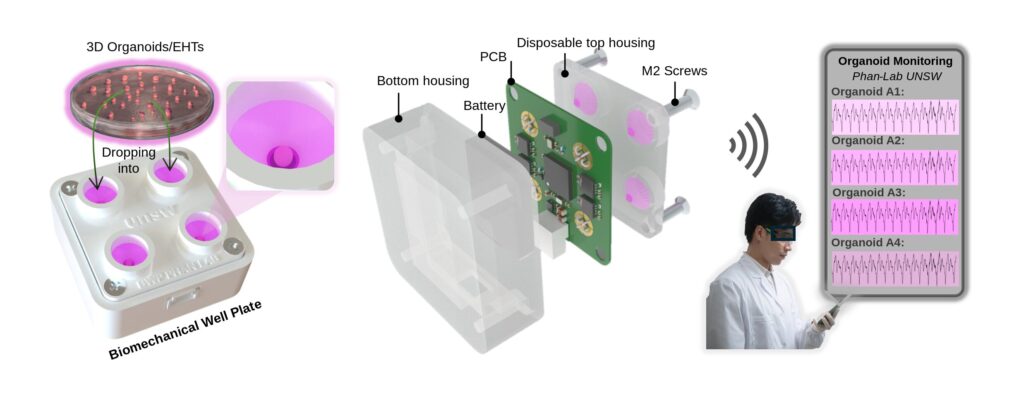
The new system, known as a biomechanical-well-plate (BWP) and developed by researchers at UNSW in partnership with cardiovascular researchers from the Victor Chang Cardiac Research Institute (VCCRI), takes a very different approach.
Instead of directly measuring the motion of the tissue, it detects the tiny pressure changes created when the organoid contracts while placed in a liquid—similar to how ripples spread when a stone is dropped into water.
These tiny vibrations of the liquid surface cause the surrounding air to compress and expand. A highly sensitive sensor beneath the liquid captures these pressure variations and converts them into electrical signals.
The work, published in Nature Sensors, was inspired by the fish lateral line—a row of tiny sensors along a fish’s body that detects movement and pressure changes in the water, helping them sense nearby objects, predators, prey and other fish. The result, in terms of the BWP, is a continuous, real-time readout of how the tissue is biomechanically behaving, without the need for microscopes or physical attachments.
“The problem that we want to address is to develop a new tool that supports biological study on human organoids that overcomes existing limitation in animal models,” said Scientia Associate Professor Hoang-Phuong Phan, the corresponding author from UNSW.
“The advantage of these organoids over animal models is the organoid can be cultured from human cells, so physiologically they are more relevant in drug testing. They are also much cheaper, and they can be cultured in a large quantity of sample.
“However, technologically, existing platforms to study how the organoids are biomechanically performing are still very limited. You have to put the organoid on a microscope, frequently transfer between the culture environment and the microscope, which can induce contamination, move the microscope from well to well, and also do a lot of post-recording data processing.
“What we have developed is a very simple tool that allows us to directly quantify the mechanical and physiological behavior of the organoids without using a microscope.”
Faster drug testing and personalized medicine
One of the most promising applications is in drug testing. Because the system can monitor changes in real time, researchers can see exactly how a cardiac organoid responds when a drug is introduced, as well as how that response evolves over time. This could make drug development faster and more reliable by identifying promising treatments earlier and filtering out those that are unlikely to work in humans.
The technology could also support the growing field of personalized medicine, where treatments are tailored to individual patients using cells derived from their own bodies.
“What we do is place the organoid in a chamber filled with liquid, and then we measure the contractions through the pressure propagated inside the liquid medium,” said Dr. Chi Cong Nguyen, an associate lecturer at UNSW and the first author of the paper.
“It’s relatively similar to the phenomenon of how ripples are created on a pond when you throw in a stone. When the organoid contracts, we get a very small deformation at the liquid surface, and we are able to measure that using a highly sensitive silicon-based sensor,” added Associate Professor Timothée Mouterde from the University of Tokyo, a co-corresponding author of the paper.
“From those readings, which happen in real time, we can calculate the dynamic response of the organoid, how it is developing and how it is responding to any drugs that are being administered in testing.
“All of that information is reflected in the vibration signal that we can capture with very precise sensors.”
Less animal testing
The research aligns with a broader global shift toward reducing reliance on animal models. With regulatory bodies increasingly encouraging alternative approaches, tools that make organoid research more practical and scalable are likely to play an important role.
By enabling high-throughput testing, potentially across dozens or even hundreds of samples at once, the system could significantly expand the use of human-based models in early-stage research and preclinical drug development.
“New approach methodologies, including human stem-cell-derived organoids, are quickly moving from specialist research tools into mainstream drug discovery and regulatory science,” said Associate Professor Adam Hill, the corresponding author from the Victor Chang Institute.
“In cardiac safety testing, the momentum is particularly strong. However, there is a clear need for robust, scalable sensors that can measure organoid contraction in a reproducible, high-throughput way. Technologies like this one will help us identify cardiotoxic drugs earlier and develop safer and more effective therapies.
“Beyond safety, cardiac organoids also give us a way to test medicines in human heart tissue before they ever reach a patient. We can even take stem cells from an individual patient and effectively grow a mini-replica of their own heart to test how they would react to certain drugs, because we know that different patients can react to the same drug in different ways.
“It would also help clinicians test different doses of drugs for each individual patient to optimize the best protocol for them.”
Jordan Thorp, a co-author of the paper from VCCRI, added, “We know that a very large percentage of drugs (about 90%) in development that have been tested on animals then fail in clinical trials. By using human organoids, we can bypass that step and go straight to checking whether the drugs are suitable for people, saving significant time and money.”
Despite its promise, the technology is still at an early stage, and several challenges remain before it can be widely adopted. Scaling up the system is a key priority. While the current prototype can measure multiple samples, researchers aim to expand this to larger formats to enable higher-throughput screening.
Consistency and manufacturing are also critical. The sensors must be produced reliably and at low cost, with consistent performance across large batches—something that requires further engineering and refinement.
The research team—a cross-institutional collaboration including Scientia Associate Professor Thanh Nho Do and Scientia Professor Nigel Lovell (UNSW Sydney), together with Syamak Farajikhah and Ann-Na Cho (the University of Sydney)—also aims to boost the sensitivity of its sensors, which would allow smaller organoids to be studied where the signals are weaker and harder to detect.
Beyond cardiac research, the platform could also be adapted for other types of organoids, including neuromuscular tissue, broadening its potential impact.
Publication details
Chi Cong Nguyen et al, Wireless and contactless biomechanic well plate for monitoring cardiac organoid and 3D-tissue contraction, Nature Sensors (2026). DOI: 10.1038/s44460-026-00087-3
Journal information:
Nature Sensors
Clinical categories


Citation:
Fish-inspired sensor tracks how human heart tissue responds to disease and treatment (2026, June 29)
retrieved 29 June 2026
from https://medicalxpress.com/news/2026-06-fish-sensor-tracks-human-heart.html
This document is subject to copyright. Apart from any fair dealing for the purpose of private study or research, no
part may be reproduced without the written permission. The content is provided for information purposes only.

Khamrah by Lattafa for Men - 3.4 oz EDP Spray
4% Off
Ghost Sweetheart Eau de Toilette | Pineapple, Jasmine and Sandalwood | Perfume for Women 50 ml
50% Off
Marc Jacobs Dot Eau De Parfum for Women, 100 ml
42% Off
Ted Baker W Eau de Toilette for Her, Fig Leaf, White Peony and Violet Top Notes, Pink Orchid and Raspberry Middle Notes, 75ml
£11.77 (£15.69 / 100 ml) (as of 29/06/2026 03:52 GMT +01:00 - More infoProduct prices and availability are accurate as of the date/time indicated and are subject to change. Any price and availability information displayed on [relevant Amazon Site(s), as applicable] at the time of purchase will apply to the purchase of this product.)
Ted Baker Woman Pink Eau de Toilette Spray Floral Green Feminine Fragrance, Opening Notes are Fresh Peach, Bergamot and Tangerine with Warm Musk, Vanilla and Vetiver Base, 100ml
11% Off
Vera Wang Princess Eau de Toilette - 30 ml

Choco Musk 50ml Eau De Parfum for men and women | Chocolate Musk by Jannat Aromas
17% Off
Christina Aguilera Signature Eau de Parfum (50ml) Floral, Fruity & Exotic Scent, Luxury Fragrance for Women
9% Off
Calvin Klein - Eau De Toilette CKIN2U - Calvin Klein Women, Ladies Perfume, Women's Perfume, Calvin Klein Perfume, Calvin Klein One - 150 ml
5% Off
Jimmy Choo Flash Eau de Parfum, 60 ml (Pack of 1)
3% Off
Fruit of the Loom Men's Heavy T Shirt, White, XL UK
28% Off
ATNKE LED Lighted Beanie Cap,USB Rechargeable Running Hat Ultra Bright 4 LED Waterproof Light Winter Warm Gifts for Men and Women/Pink
17% Off
Men's 1/4 Zip Pullover UK Sale Clearance, Fleece Sweatshirt Casual Jumper Long Sleeve T-shirt Top Stand Collar Sweater Plain Pullover Sports Leisure Workwear Quarter Zip Sweater Lightweight Jumpers
£5.88 (as of 12/11/2025 00:52 GMT +01:00 - More infoProduct prices and availability are accurate as of the date/time indicated and are subject to change. Any price and availability information displayed on [relevant Amazon Site(s), as applicable] at the time of purchase will apply to the purchase of this product.)
Crevice Cleaning Brush, Bathroom Tile Groove Gap Cleaning Brush,Premium Crevice Cleaning Tool Aluminum Support with 15° Angle Magic Brush, Thin Brush for Home Kitchen
19% Off
Wireless Earbuds, Bluetooth 5.3 Headphones in Ear with HiFi Stereo Deep Bass, 4 ENC Noise Cancelling Mic Wireless Earphones 40H Playtime, Bluetooth Earbuds Dual LED Display, IP7 Waterproof, USB-C
42% Off