[
[

Mount Sinai researchers have discovered blood RNA biomarkers that offer a promising, minimally invasive approach for earlier diagnosis of Alzheimer’s disease, according to findings published in Nature Communications.
An estimated 55 million people worldwide are living with Alzheimer’s disease, according to Alzheimer’s Disease International. Yet diagnosis remains challenging because symptoms often overlap with those of other conditions, and current diagnostic methods can be costly or invasive. Blood-based biomarkers could support routine clinical use while reducing the need for lumbar puncture and positron emission tomography (PET) imaging.
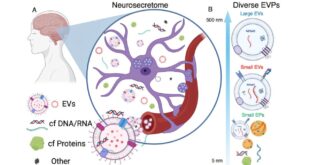
Recent research has shown that brain-specific RNA biomarkers are present in circulating blood nanoparticles, including exosomes, extracellular vesicles (EVs), and extracellular vesicles and particles (EVPs).
Researchers at the Icahn School of Medicine at Mount Sinai developed a simple, efficient and cost-effective method to isolate EVPs from blood and brain tissue. They measured RNA biomarkers in blood and brain tissue samples from people with Alzheimer’s disease and from controls to determine gene expression patterns and cellular origins. The researchers separated EVPs into three subpopulations: large EVs, small EVs and small extracellular particles (EPs).
The researchers also identified small blood nanoparticles known as “SECmeres” that carried Alzheimer’s-related brain signals more clearly than standard EVs. These nanoparticles were enriched with brain-specific markers and may offer a minimally invasive approach for earlier diagnosis of the progressive neurodegenerative disease.
“In 2025, FDA cleared the first protein-based blood test for Alzheimer’s disease diagnoses, which measures the pTau217/ß-amyloid 1-42 ratio,” said co-corresponding author Navneet Dogra, Ph.D., assistant professor of pathology, molecular and cell-based medicine, and member of the Icahn Genomics Institute at the Icahn School of Medicine at Mount Sinai.
“Our study demonstrates that blood EVPs carry brain-specific RNA information that could be used for liquid biopsy approaches, pending validation in larger blinded clinical trials. We believe EVP-derived RNAs may reveal disease-related changes earlier in the disease process, before proteins or pathology become detectable.”
“We provide evidence that novel brain-derived nanoparticles, termed ‘SECmeres,’ may play a key role in neurodegenerative disease development and hold promise as a real-time, non-invasive diagnostic tool for the living human brain,” Dogra added.
Dogra said the findings could have important implications for liquid biopsy technologies designed to detect neurodegenerative disorders, cancer and other diseases through minimally invasive testing.
“Alzheimer’s disease represents a major global health challenge due to its increasing prevalence, profound impact on patients and families, and substantial economic burden,” said co-corresponding author Panos Roussos, MD, Ph.D., professor of psychiatry, and genetics and genomic sciences, and director of the Center for Disease Neurogenomics at the Icahn School of Medicine at Mount Sinai. “Our findings support the development of RNA-based liquid-biopsy assays that may help advance earlier detection of Alzheimer’s disease.”
Publication details
Edgar Gonzalez-Kozlova et al, SECmeres outperform extracellular vesicles as potential blood RNA biomarkers for Alzheimer’s disease, Nature Communications (2026). DOI: 10.1038/s41467-026-74541-8
Journal information:
Nature Communications
Key medical concepts
Clinical categories


Citation:
RNA biomarkers identified that could offer a simple blood test for earlier Alzheimer’s diagnosis (2026, June 22)
retrieved 22 June 2026
from https://medicalxpress.com/news/2026-06-rna-biomarkers-simple-blood-earlier.html
This document is subject to copyright. Apart from any fair dealing for the purpose of private study or research, no
part may be reproduced without the written permission. The content is provided for information purposes only.

Khamrah by Lattafa for Men - 3.4 oz EDP Spray
4% Off
Ghost Sweetheart Eau de Toilette | Pineapple, Jasmine and Sandalwood | Perfume for Women 50 ml
50% Off
Marc Jacobs Dot Eau De Parfum for Women, 100 ml
42% Off
Ted Baker W Eau de Toilette for Her, Fig Leaf, White Peony and Violet Top Notes, Pink Orchid and Raspberry Middle Notes, 75ml
£11.77 (£15.69 / 100 ml) (as of 22/06/2026 03:34 GMT +01:00 - More infoProduct prices and availability are accurate as of the date/time indicated and are subject to change. Any price and availability information displayed on [relevant Amazon Site(s), as applicable] at the time of purchase will apply to the purchase of this product.)
Ted Baker Woman Pink Eau de Toilette Spray Floral Green Feminine Fragrance, Opening Notes are Fresh Peach, Bergamot and Tangerine with Warm Musk, Vanilla and Vetiver Base, 100ml
11% Off
Vera Wang Princess Eau de Toilette - 30 ml

Choco Musk 50ml Eau De Parfum for men and women | Chocolate Musk by Jannat Aromas
17% Off
Christina Aguilera Signature Eau de Parfum (50ml) Floral, Fruity & Exotic Scent, Luxury Fragrance for Women
9% Off
Calvin Klein - Eau De Toilette CKIN2U - Calvin Klein Women, Ladies Perfume, Women's Perfume, Calvin Klein Perfume, Calvin Klein One - 150 ml
5% Off
Jimmy Choo Flash Eau de Parfum, 60 ml (Pack of 1)
3% Off
Fruit of the Loom Men's Heavy T Shirt, White, XL UK
28% Off
ATNKE LED Lighted Beanie Cap,USB Rechargeable Running Hat Ultra Bright 4 LED Waterproof Light Winter Warm Gifts for Men and Women/Pink
17% Off
Men's 1/4 Zip Pullover UK Sale Clearance, Fleece Sweatshirt Casual Jumper Long Sleeve T-shirt Top Stand Collar Sweater Plain Pullover Sports Leisure Workwear Quarter Zip Sweater Lightweight Jumpers
£5.88 (as of 12/11/2025 00:52 GMT +01:00 - More infoProduct prices and availability are accurate as of the date/time indicated and are subject to change. Any price and availability information displayed on [relevant Amazon Site(s), as applicable] at the time of purchase will apply to the purchase of this product.)
Crevice Cleaning Brush, Bathroom Tile Groove Gap Cleaning Brush,Premium Crevice Cleaning Tool Aluminum Support with 15° Angle Magic Brush, Thin Brush for Home Kitchen
19% Off
Wireless Earbuds, Bluetooth 5.3 Headphones in Ear with HiFi Stereo Deep Bass, 4 ENC Noise Cancelling Mic Wireless Earphones 40H Playtime, Bluetooth Earbuds Dual LED Display, IP7 Waterproof, USB-C
42% Off