 [
[

After a cold Canadian winter, most of us look forward to the spring and summer months to get outside and experience the natural world, whether it’s hiking, biking, gardening or birdwatching.
In recent years, however, our outdoor activities have been challenged by a range of issues stemming from climate change: increased heat waves, lower air quality due to wildfire smoke, more intense and frequent storms, and more ticks.
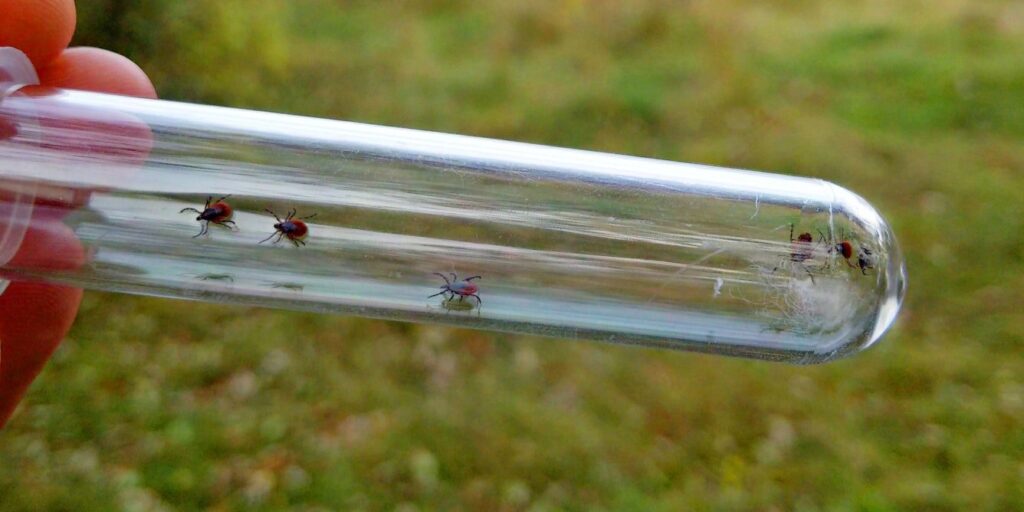
Over the last decade, there has been a steady northward expansion in the range of blacklegged ticks (deer ticks) and associated cases of tick-borne illnesses like Lyme disease in Canada.
Many of these expanding risk areas overlap with major population centers. More people may now come into contact with ticks in backyards bordering woodlands, or while hiking in forests and recreational green spaces.
Current recommendations for Lyme disease prevention mainly focus on personal protection measures to avoid tick bites, such as wearing long pants, tucking them into socks, applying repellent containing DEET or icaridin, doing a tick check and promptly removing ticks after time spent outdoors. These are valuable actions; however, it can be difficult for people to do them properly and consistently.
A recent study by our team at the University of Ottawa identified wood chips as a useful tool for keeping ticks off high-use walking or hiking trails in peri-urban and suburban woodlands. This project has been years in the making, and pilot testing was completed by the University of Ottawa INSIGHT lab in 2020. The most recent study spanned two years and was implemented on two Ottawa Greenbelt trails managed by the National Capital Commission (NCC).
Preventing disease with wood chips
There is an increasing need for preventive strategies to protect humans from ticks and the diseases they carry, while also preserving environmental and animal health. This approach to disease prevention is referred to as integrated control, or as a One Health approach.
One Health interventions often target multiple components of disease transmission. In the case of ticks, these interventions aim to protect people directly, change the environment ticks like to live in, and target the animals ticks feed on.
While a recent review study found that many recent tick control studies call for increased use of integrated strategies, few studies have actually tested these strategies in field experiments.
We found that when wood chips were distributed along trail borders at the forest edge, the number of blacklegged, or deer, ticks along these trail segments was reduced by nearly half.
Our team also target-sprayed some of the wood-chip segments with deltamethrin, a type of insecticide, at the beginning of each season in late spring. The number of ticks was reduced by nearly 99% along trail segments with deltamethrin-treated wood chips.
An environmentally sustainable solution
This targeted treatment of wood-chip borders using deltamethrin holds promise as a method of effectively reducing ticks while also limiting the impact of the insecticide on other insects, like pollinators, by avoiding broadcast spraying into surrounding trees and shrubs.
This intervention approach also holds promise for environmental sustainability. It used recycled ash tree wood chips from the NCC ash tree removal program, diverting land waste and providing land managers with a way to use wood chips from tree removal programs onsite in a way that benefits trail users.
Importantly, the study uses wood chips as an environmental management approach to target ticks where they live and feed.
Ticks tend to spend most of their time below leaf litter to avoid drying out, but climb blades of grass or low vegetation while searching for a passing host on which to feed.
This project was not without its challenges. The 2022 derecho storm disrupted field research activities in the project’s first year, and trial and error revealed that an all-terrain vehicle (ATV) was most efficient for distributing the wood chips along trail edges.
With storms predicted to increase in frequency and intensity in future years due to climate change, the feasibility of control interventions that make changes to the landscape needs to be carefully considered.
The need for ATV access means this type of intervention will likely be most feasible on wide, high-use paths with well-established tick populations if it is implemented at a larger scale in the future.
Finally, although the wood chips were successful in reducing the number of ticks near the trail edges, the method relies on people staying on marked paths and avoiding off-trail areas where ticks may be present.
While this is a practical solution, it should always be paired with other measures to reduce tick bites, like wearing repellent spray containing DEET or icaridin and completing tick checks.
Ultimately, our study identified wood chips as a potentially cost-effective way to reduce the number of ticks found on woodland recreational trails in peri-urban settings.
In the future, this approach could be considered for use in similar settings and paired with a robust tick surveillance program to evaluate results. With ticks on the rise, strategies like this might help Canadians better enjoy the outdoors and stay tick-safe.


This article is republished from The Conversation under a Creative Commons license. Read the original article.
Citation:
How woodchips can help keep ticks off trails (2026, June 21)
retrieved 21 June 2026
from https://medicalxpress.com/news/2026-06-woodchips-trails.html
This document is subject to copyright. Apart from any fair dealing for the purpose of private study or research, no
part may be reproduced without the written permission. The content is provided for information purposes only.

Khamrah by Lattafa for Men - 3.4 oz EDP Spray
4% Off
Ghost Sweetheart Eau de Toilette | Pineapple, Jasmine and Sandalwood | Perfume for Women 50 ml
50% Off
Marc Jacobs Dot Eau De Parfum for Women, 100 ml
42% Off
Ted Baker W Eau de Toilette for Her, Fig Leaf, White Peony and Violet Top Notes, Pink Orchid and Raspberry Middle Notes, 75ml
£11.77 (£15.69 / 100 ml) (as of 21/06/2026 03:33 GMT +01:00 - More infoProduct prices and availability are accurate as of the date/time indicated and are subject to change. Any price and availability information displayed on [relevant Amazon Site(s), as applicable] at the time of purchase will apply to the purchase of this product.)
Ted Baker Woman Pink Eau de Toilette Spray Floral Green Feminine Fragrance, Opening Notes are Fresh Peach, Bergamot and Tangerine with Warm Musk, Vanilla and Vetiver Base, 100ml
11% Off
Vera Wang Princess Eau de Toilette - 30 ml

Choco Musk 50ml Eau De Parfum for men and women | Chocolate Musk by Jannat Aromas
17% Off
Christina Aguilera Signature Eau de Parfum (50ml) Floral, Fruity & Exotic Scent, Luxury Fragrance for Women
9% Off
Calvin Klein - Eau De Toilette CKIN2U - Calvin Klein Women, Ladies Perfume, Women's Perfume, Calvin Klein Perfume, Calvin Klein One - 150 ml
5% Off
Jimmy Choo Flash Eau de Parfum, 60 ml (Pack of 1)
3% Off
Fruit of the Loom Men's Heavy T Shirt, White, XL UK
28% Off
ATNKE LED Lighted Beanie Cap,USB Rechargeable Running Hat Ultra Bright 4 LED Waterproof Light Winter Warm Gifts for Men and Women/Pink
17% Off
Men's 1/4 Zip Pullover UK Sale Clearance, Fleece Sweatshirt Casual Jumper Long Sleeve T-shirt Top Stand Collar Sweater Plain Pullover Sports Leisure Workwear Quarter Zip Sweater Lightweight Jumpers
£5.88 (as of 12/11/2025 00:52 GMT +01:00 - More infoProduct prices and availability are accurate as of the date/time indicated and are subject to change. Any price and availability information displayed on [relevant Amazon Site(s), as applicable] at the time of purchase will apply to the purchase of this product.)
Crevice Cleaning Brush, Bathroom Tile Groove Gap Cleaning Brush,Premium Crevice Cleaning Tool Aluminum Support with 15° Angle Magic Brush, Thin Brush for Home Kitchen
19% Off
Wireless Earbuds, Bluetooth 5.3 Headphones in Ear with HiFi Stereo Deep Bass, 4 ENC Noise Cancelling Mic Wireless Earphones 40H Playtime, Bluetooth Earbuds Dual LED Display, IP7 Waterproof, USB-C
42% Off