 [
[
Researchers at Rutgers University-New Brunswick are working to measure pain more accurately beyond the single, subjective question patients are often asked: “On a scale of 1 to 10, how bad is your pain?”
In their new study, published in Frontiers in Neuroscience, the researchers suggest a more precise way to quantify this discomfort by tracking tiny facial micromovement spikes. These rapid, high-speed motor fluctuations—too subtle for the human eye to notice—offer objective clues to what an individual is experiencing, particularly when they cannot articulate their level of distress.
“The motivation was to move beyond a one-size-fits-all pain scale,” said Elizabeth Torres, a psychology professor with the Rutgers School of Arts and Sciences who conducted the study with doctoral researcher Mona Elsayed. “Every individual has a different threshold for pain tolerance. By measuring that response directly from the body’s own signals, we can begin to tailor care in a much more individualized way.”
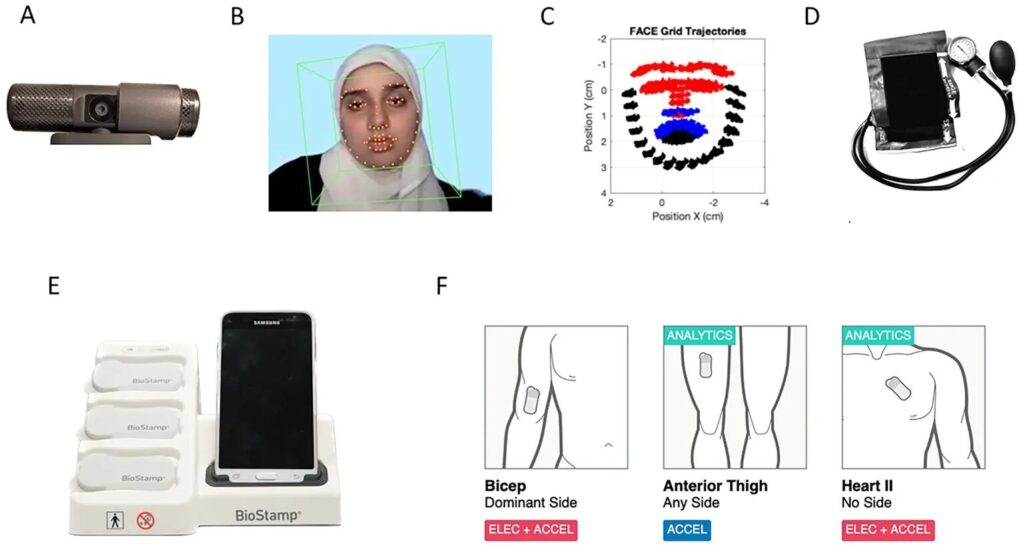
To test whether facial movements could reveal pain-related signals, Torres and Elsayed recorded 45 adults before and during episodes of controlled, brief pressure pain. Participants were observed at rest and while performing tasks involving movement, touch and memory.
Using video analysis and artificial intelligence (AI), the team tracked facial muscle activity alongside heart rate variability—a measure of the timing between heartbeats. This revealed a direct link between micromovement spikes and the body’s physiological response: As pain intensified, heart rhythms became increasingly irregular, with the most pronounced changes appearing around the eyes.
“Within seconds, we could see the body’s pain response reflected in tiny facial movements,” Torres said. “The more dysregulated the heart became, the more clearly it showed up in the face.”
The researchers also found that different activities changed how pain appeared in the data. Pain registered most clearly during tactile tasks, such as drawing or manipulating objects, when the link between facial movements and heart rhythm was strongest. In contrast, tasks requiring memory or attention weakened that connection.
“A higher cognitive load essentially crowds out the pain,” Torres said. “This kind of engagement may act as a natural distractor, offering a potential therapeutic tool for redirecting attention.”
The pain study emerged from a broader line of research in Torres’s Sensory Motor Integration Lab, which has long studied micromovements in people with autism, Parkinson’s disease and other neurological conditions.
Torres, a computational neuroscientist, uses mathematical modeling to decode internal states through subtle body language. In her studies of nonverbal autism, these patterns provided vital clues to physical distress that clinicians and caregivers might otherwise miss.
By applying this approach to facial movements and heart rhythms, Torres suggests clinicians can objectively evaluate pain in patients who are not able to describe their symptoms, including young children, stroke survivors, and individuals with dementia.
“Right now, we rely on caregivers’ interpretations, which are valuable but incomplete,” Torres said. “This gives us a window into the physiology itself.”
Monitoring these signals requires pairing facial videos with specialized heart monitors. But Torres said widely available tools, such as smartphones, eventually could capture this data. Advances in video analysis and AI now enable the detection of physical markers that previously required specialized equipment, which could make pain assessment easier to scale in clinics, nursing homes or remote settings.
The research remains in its early stages. Torres said the study’s size was modest but with significant statistical power, given the high sensitivity of the personalized micro-movements’ metrics. The next step is to test the approach in larger, more diverse populations, including patients with chronic pain.
Torres and her collaborators are also translating the technology into a smartphone tool through Neuroinversa LLC, a Rutgers-New Brunswick spinoff startup company that licensed the technology from Rutgers. Although the app is still in development, Torres said it eventually could help clinicians and individuals monitor treatment response.
“You can see whether a medication is working, how quickly it’s taking effect, and whether adjustments are needed,” Torres said. “It’s a much more precise way to monitor outcomes.”
Torres said the simplicity of a short facial scan is what could eventually make the approach useful beyond specialized research settings.
“Instead of a piece of paper with emojis, you have a digital dashboard where you can measure yourself day to day,” she said. “It gives people a sense of control over their own biorhythms.”
Publication details
Elizabeth B. Torres et al, Facial micro-movements as a proxy of increasingly erratic heart rate variability while experiencing pressure pain, Frontiers in Neuroscience (2026). DOI: 10.3389/fnins.2026.1702124
Journal information:
Frontiers in Neuroscience
Key medical concepts
Clinical categories


Citation:
Tracking tiny facial movements could offer a more objective way to measure pain (2026, May 19)
retrieved 19 May 2026
from https://medicalxpress.com/news/2026-05-tracking-tiny-facial-movements-pain.html
This document is subject to copyright. Apart from any fair dealing for the purpose of private study or research, no
part may be reproduced without the written permission. The content is provided for information purposes only.

Khamrah by Lattafa for Men - 3.4 oz EDP Spray
4% Off
Ghost Sweetheart Eau de Toilette | Pineapple, Jasmine and Sandalwood | Perfume for Women 50 ml
50% Off
Marc Jacobs Dot Eau De Parfum for Women, 100 ml
42% Off
Ted Baker W Eau de Toilette for Her, Fig Leaf, White Peony and Violet Top Notes, Pink Orchid and Raspberry Middle Notes, 75ml
£11.77 (£15.69 / 100 ml) (as of 19/05/2026 03:16 GMT +01:00 - More infoProduct prices and availability are accurate as of the date/time indicated and are subject to change. Any price and availability information displayed on [relevant Amazon Site(s), as applicable] at the time of purchase will apply to the purchase of this product.)
Ted Baker Woman Pink Eau de Toilette Spray Floral Green Feminine Fragrance, Opening Notes are Fresh Peach, Bergamot and Tangerine with Warm Musk, Vanilla and Vetiver Base, 100ml
11% Off
Vera Wang Princess Eau de Toilette - 30 ml

Choco Musk 50ml Eau De Parfum for men and women | Chocolate Musk by Jannat Aromas
17% Off
Christina Aguilera Signature Eau de Parfum (50ml) Floral, Fruity & Exotic Scent, Luxury Fragrance for Women
9% Off
Calvin Klein - Eau De Toilette CKIN2U - Calvin Klein Women, Ladies Perfume, Women's Perfume, Calvin Klein Perfume, Calvin Klein One - 150 ml
5% Off
Jimmy Choo Flash Eau de Parfum, 60 ml (Pack of 1)
3% Off
Fruit of the Loom Men's Heavy T Shirt, White, XL UK
28% Off
ATNKE LED Lighted Beanie Cap,USB Rechargeable Running Hat Ultra Bright 4 LED Waterproof Light Winter Warm Gifts for Men and Women/Pink
17% Off
Men's 1/4 Zip Pullover UK Sale Clearance, Fleece Sweatshirt Casual Jumper Long Sleeve T-shirt Top Stand Collar Sweater Plain Pullover Sports Leisure Workwear Quarter Zip Sweater Lightweight Jumpers
£5.88 (as of 12/11/2025 00:52 GMT +01:00 - More infoProduct prices and availability are accurate as of the date/time indicated and are subject to change. Any price and availability information displayed on [relevant Amazon Site(s), as applicable] at the time of purchase will apply to the purchase of this product.)
Crevice Cleaning Brush, Bathroom Tile Groove Gap Cleaning Brush,Premium Crevice Cleaning Tool Aluminum Support with 15° Angle Magic Brush, Thin Brush for Home Kitchen
19% Off
Wireless Earbuds, Bluetooth 5.3 Headphones in Ear with HiFi Stereo Deep Bass, 4 ENC Noise Cancelling Mic Wireless Earphones 40H Playtime, Bluetooth Earbuds Dual LED Display, IP7 Waterproof, USB-C
42% Off