 [
[
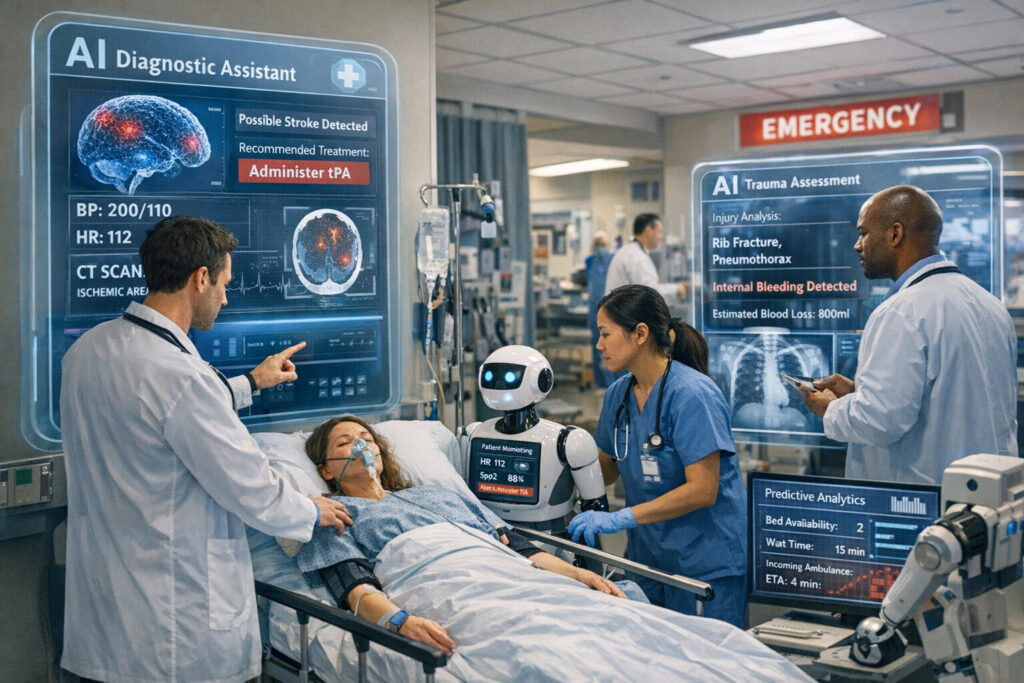
Artificial intelligence can now outperform doctors at diagnosing patients in the emergency department, according to a new study in Science.
The AI was given written notes from real emergency department records from a hospital in Boston, US, and asked to weigh in at different points during the patient’s care. At the earliest stage—triage, when a patient first arrives—the AI identified the correct diagnosis, or something closely related, in 67% of cases.
The two doctors used for comparison managed 50% and 55%. That’s a meaningful gap, especially at the moment when information is scarcest and uncertainty is highest.
This study matters because the field is moving so fast. Earlier research showed that large language models—the technology behind systems like ChatGPT—could pass medical licensing exams. Interesting, but not all that illuminating. Passing an exam is not the same as being useful on a ward.
This new study goes further. It puts AI alongside doctors across several tasks, using genuine clinical text from a real emergency department. That makes it more directly relevant to medical practice than most of what’s come before. It suggests these systems are developing into something that could genuinely help doctors think through a wide range of possible diagnoses, especially in situations where missing a serious condition is the main concern.
There are good reasons, though, not to get carried away.
The AI was working entirely from written text. It never saw the patient, never noticed how breathless or frightened they looked, never examined them, spoke to their family, weighed up the chaos of a busy department, or took any responsibility for what happened next. It was not practicing emergency medicine. It was offering a written opinion based on selected information.
There’s also a gap between producing a list of possible diagnoses and actually improving patient outcomes. A longer list might help a doctor think more broadly, but it could equally generate new problems: unnecessary tests, over-treatment, extra workload, or unwarranted confidence in an answer that sounds plausible but turns out to be wrong.
And some of the benchmark cases used in studies like this may have been publicly available when the AI was trained, which doesn’t undermine the emergency department findings, but is another reason to treat headline numbers with some skepticism.
The hard question
So the question isn’t really whether AI can help doctors think through difficult cases. The harder question is how this should be tested and governed in real clinical settings like the NHS.
That question is already urgent. A Royal College of Physicians snapshot found that 16% of UK doctors were using AI tools in clinical practice every day, with another 15% doing so weekly. Doctors are already using these tools in their daily work—before hospitals and health systems have properly worked out how to assess them, train staff to use them safely, spot when they’re causing harm, or decide who is responsible when something goes wrong.
It’s tempting to say that the solution is to keep a human in the loop. But that phrase does very little work on its own. We need to know which human, in which loop, and with what authority. A doctor’s ability to override an AI suggestion is not, by itself, a safety system. Someone still has to decide which tools get used, who can change how they behave, how harms are spotted, and who is responsible when the tool quietly starts failing.
This study represents genuine progress. But it doesn’t, on its own, change how medicine should be practiced. The right response is neither to prohibit these systems nor to let them quietly become part of the routine before anyone has thought it through. They should be trialed in real clinical settings, used as a form of second-opinion support rather than a substitute for clinical judgment, and measured against what actually matters to patients: care that is better, safer and faster.
Journal information:
Science
Clinical categories
This article is republished from The Conversation under a Creative Commons license. Read the original article.
Citation:
AI in the emergency department: Promising, powerful but still unproven (2026, May 7)
retrieved 7 May 2026
from https://medicalxpress.com/news/2026-05-ai-emergency-department-powerful-unproven.html
This document is subject to copyright. Apart from any fair dealing for the purpose of private study or research, no
part may be reproduced without the written permission. The content is provided for information purposes only.

Khamrah by Lattafa for Men - 3.4 oz EDP Spray
4% Off
Ghost Sweetheart Eau de Toilette | Pineapple, Jasmine and Sandalwood | Perfume for Women 50 ml
50% Off
Marc Jacobs Dot Eau De Parfum for Women, 100 ml
42% Off
Ted Baker W Eau de Toilette for Her, Fig Leaf, White Peony and Violet Top Notes, Pink Orchid and Raspberry Middle Notes, 75ml
£11.77 (£15.69 / 100 ml) (as of 07/05/2026 03:12 GMT +01:00 - More infoProduct prices and availability are accurate as of the date/time indicated and are subject to change. Any price and availability information displayed on [relevant Amazon Site(s), as applicable] at the time of purchase will apply to the purchase of this product.)
Ted Baker Woman Pink Eau de Toilette Spray Floral Green Feminine Fragrance, Opening Notes are Fresh Peach, Bergamot and Tangerine with Warm Musk, Vanilla and Vetiver Base, 100ml
11% Off
Vera Wang Princess Eau de Toilette - 30 ml

Choco Musk 50ml Eau De Parfum for men and women | Chocolate Musk by Jannat Aromas
17% Off
Christina Aguilera Signature Eau de Parfum (50ml) Floral, Fruity & Exotic Scent, Luxury Fragrance for Women
9% Off
Calvin Klein - Eau De Toilette CKIN2U - Calvin Klein Women, Ladies Perfume, Women's Perfume, Calvin Klein Perfume, Calvin Klein One - 150 ml
5% Off
Jimmy Choo Flash Eau de Parfum, 60 ml (Pack of 1)
3% Off
Fruit of the Loom Men's Heavy T Shirt, White, XL UK
28% Off
ATNKE LED Lighted Beanie Cap,USB Rechargeable Running Hat Ultra Bright 4 LED Waterproof Light Winter Warm Gifts for Men and Women/Pink
17% Off
Men's 1/4 Zip Pullover UK Sale Clearance, Fleece Sweatshirt Casual Jumper Long Sleeve T-shirt Top Stand Collar Sweater Plain Pullover Sports Leisure Workwear Quarter Zip Sweater Lightweight Jumpers
£5.88 (as of 12/11/2025 00:52 GMT +01:00 - More infoProduct prices and availability are accurate as of the date/time indicated and are subject to change. Any price and availability information displayed on [relevant Amazon Site(s), as applicable] at the time of purchase will apply to the purchase of this product.)
Crevice Cleaning Brush, Bathroom Tile Groove Gap Cleaning Brush,Premium Crevice Cleaning Tool Aluminum Support with 15° Angle Magic Brush, Thin Brush for Home Kitchen
19% Off
Wireless Earbuds, Bluetooth 5.3 Headphones in Ear with HiFi Stereo Deep Bass, 4 ENC Noise Cancelling Mic Wireless Earphones 40H Playtime, Bluetooth Earbuds Dual LED Display, IP7 Waterproof, USB-C
42% Off