 [
[

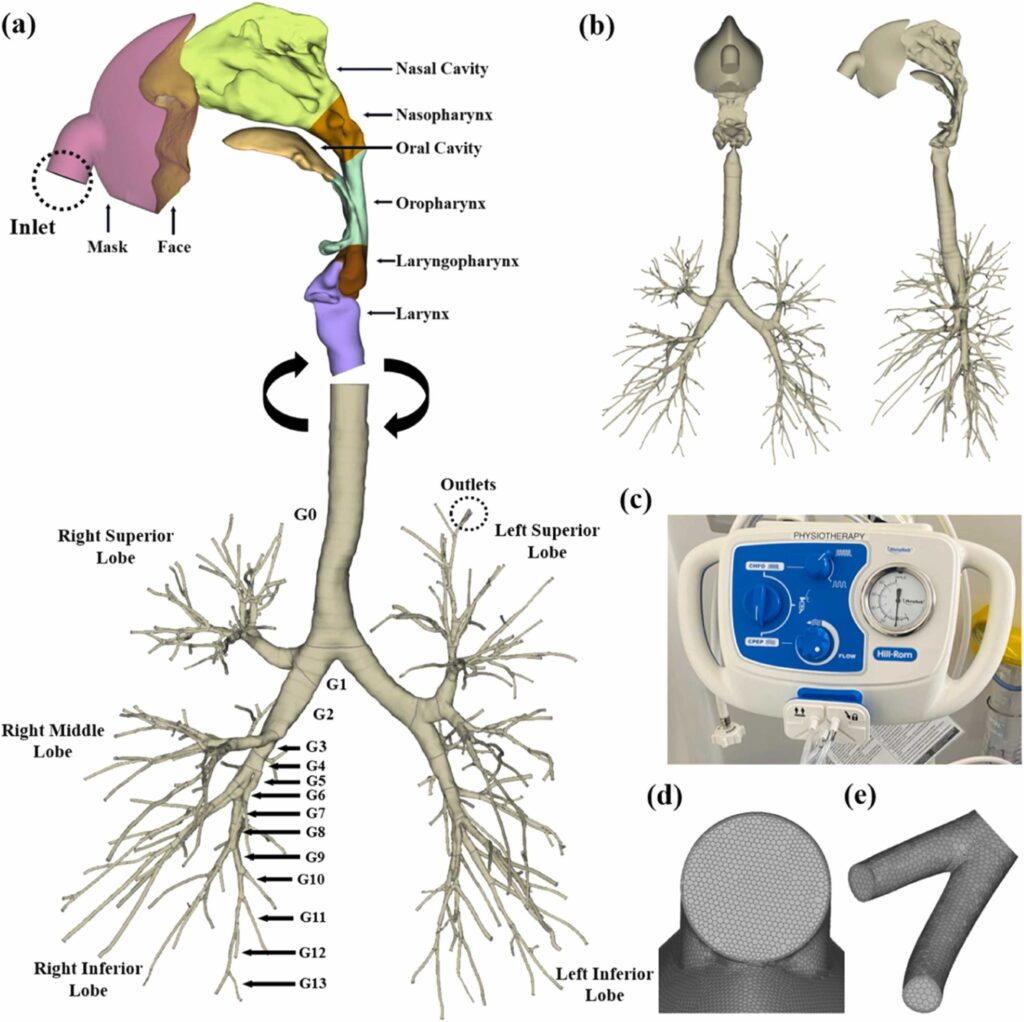
A computational study shows for the first time how different parts of the human airway experience levels of pressure and friction from breathing therapy devices. Using a patient-specific 3D airway model derived from CT imaging to simulate how breathing-support therapy behaves inside the human airway, University of Technology Sydney (UTS) researchers found the therapy doesn’t affect all parts of the airway equally. The study shows the potential to support the design of better devices and personalized treatment settings for patients with conditions such as bronchiectasis, cystic fibrosis and postoperative atelectasis.
The paper, titled “Modeling and simulation of conducting airways during continuous high-frequency oscillation therapy,” was recently published in Respiratory Physiology & Neurobiology.
Lead author Dr. Suvash C. Saha, Senior Lecturer in the UTS School of Mechanical and Mechatronic Engineering, said the study gives one of the clearest pictures yet of how breathing therapy moves through the human airway.
“Continuous high-frequency oscillation therapy (CHFO) is used clinically to support airway clearance and lung expansion, yet the way its oscillatory pressure is transmitted through the human conducting airways has remained poorly measured,” said Dr. Saha. “Our study helps fill that gap by mapping how CHFO reshapes pressure, wall shear stress and wall-normal loading throughout the conducting airway tree under both standard and high-pressure settings.”
The findings show that different parts of the airway, especially around the throat and upper airway, experience different levels of pressure and friction, so device settings may need to be chosen more carefully for different patients and clinical goals.
“We found that some areas, especially around the throat and voice box, experience much stronger pressure and friction than others, while larger upper-airway regions carry more of the overall force,” said Dr. Saha. “Turning the therapy up to a higher-pressure setting increases the strength of the support, but it does not change where the main effects happen.
“The airway anatomy itself plays a dominant role in fixing where mechanical loading is concentrated. Even when the therapy setting changes, those key anatomical hot spots remain,” said Dr. Saha.
“We need a greater understanding of where and how the therapy acts to help improve safety, comfort and effectiveness in the future. It can eventually support the design of better devices and treatment settings.”
Dr. Saha believes using advanced engineering and medical research together has the potential to improve health care such as CHFO.
“A computer model based on real human anatomy can reveal things that are very difficult to measure directly in patients, helping doctors and researchers make more informed decisions,” he said.
“This work supports the need for more evidence-based design and testing of respiratory support devices, including patient-specific modeling where possible,” he said. “It also points to the value of future clinical guidelines that consider not just whether a therapy is used, but how different settings may affect different parts of the airway.”
More information
Xinlei Huang et al, Modeling and simulation of conducting airways during continuous high-frequency oscillation therapy, Respiratory Physiology & Neurobiology (2026). DOI: 10.1016/j.resp.2026.104570
Key medical concepts
Clinical categories
Citation:
New study clears the way for improving devices and treatment for respiratory disorders (2026, April 12)
retrieved 12 April 2026
from https://medicalxpress.com/news/2026-04-devices-treatment-respiratory-disorders.html
This document is subject to copyright. Apart from any fair dealing for the purpose of private study or research, no
part may be reproduced without the written permission. The content is provided for information purposes only.

Khamrah by Lattafa for Men - 3.4 oz EDP Spray
4% Off
Ghost Sweetheart Eau de Toilette | Pineapple, Jasmine and Sandalwood | Perfume for Women 50 ml
50% Off
Marc Jacobs Dot Eau De Parfum for Women, 100 ml
42% Off
Ted Baker W Eau de Toilette for Her, Fig Leaf, White Peony and Violet Top Notes, Pink Orchid and Raspberry Middle Notes, 75ml
£11.77 (£15.69 / 100 ml) (as of 21/05/2026 03:17 GMT +01:00 - More infoProduct prices and availability are accurate as of the date/time indicated and are subject to change. Any price and availability information displayed on [relevant Amazon Site(s), as applicable] at the time of purchase will apply to the purchase of this product.)
Ted Baker Woman Pink Eau de Toilette Spray Floral Green Feminine Fragrance, Opening Notes are Fresh Peach, Bergamot and Tangerine with Warm Musk, Vanilla and Vetiver Base, 100ml
11% Off
Vera Wang Princess Eau de Toilette - 30 ml

Choco Musk 50ml Eau De Parfum for men and women | Chocolate Musk by Jannat Aromas
17% Off
Christina Aguilera Signature Eau de Parfum (50ml) Floral, Fruity & Exotic Scent, Luxury Fragrance for Women
9% Off
Calvin Klein - Eau De Toilette CKIN2U - Calvin Klein Women, Ladies Perfume, Women's Perfume, Calvin Klein Perfume, Calvin Klein One - 150 ml
5% Off
Jimmy Choo Flash Eau de Parfum, 60 ml (Pack of 1)
3% Off
Fruit of the Loom Men's Heavy T Shirt, White, XL UK
28% Off
ATNKE LED Lighted Beanie Cap,USB Rechargeable Running Hat Ultra Bright 4 LED Waterproof Light Winter Warm Gifts for Men and Women/Pink
17% Off
Men's 1/4 Zip Pullover UK Sale Clearance, Fleece Sweatshirt Casual Jumper Long Sleeve T-shirt Top Stand Collar Sweater Plain Pullover Sports Leisure Workwear Quarter Zip Sweater Lightweight Jumpers
£5.88 (as of 12/11/2025 00:52 GMT +01:00 - More infoProduct prices and availability are accurate as of the date/time indicated and are subject to change. Any price and availability information displayed on [relevant Amazon Site(s), as applicable] at the time of purchase will apply to the purchase of this product.)
Crevice Cleaning Brush, Bathroom Tile Groove Gap Cleaning Brush,Premium Crevice Cleaning Tool Aluminum Support with 15° Angle Magic Brush, Thin Brush for Home Kitchen
19% Off
Wireless Earbuds, Bluetooth 5.3 Headphones in Ear with HiFi Stereo Deep Bass, 4 ENC Noise Cancelling Mic Wireless Earphones 40H Playtime, Bluetooth Earbuds Dual LED Display, IP7 Waterproof, USB-C
42% Off