 [
[

Variants in a nicotine receptor gene are associated with a lower likelihood of heavy smoking, according to a study published in Nature Communications. The findings are based on data from populations in Mexico and validated in populations with Asian and European ancestries.
Variants in the genes encoding nicotinic acetylcholine receptors, which mediate the “rewarding” effects of nicotine on the brain, have been linked to changes in smoking behavior in individuals. For example, variants in a gene called CHRNB2, which encodes one subunit (β2) of these receptors (of which there are at least nine subunit types) have been linked to reduced likelihood of heavy smoking. However, further insights may be gained from studying the relationship between smoking frequency and variants in the genes coding for other nicotinic acetylcholine receptor subunits.
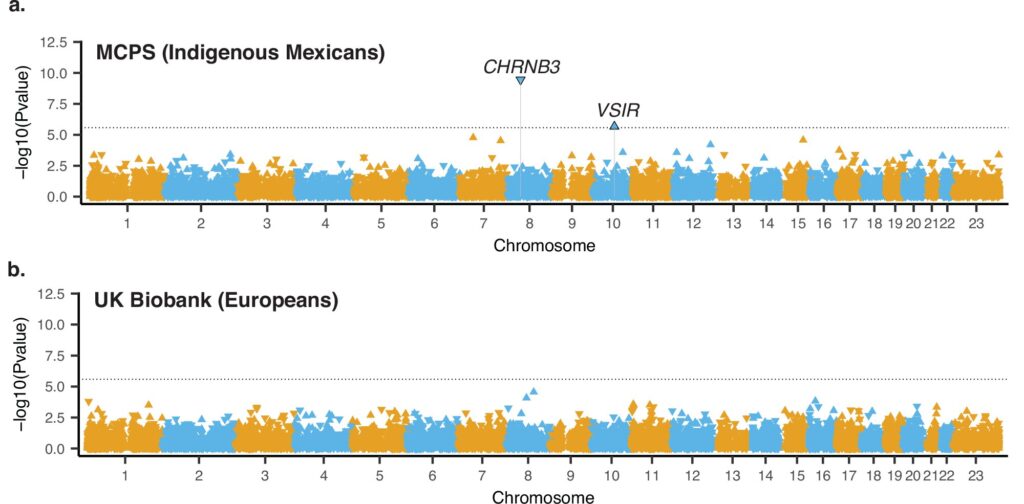
Veera Rajagopal and colleagues sequenced the genomes of 37,897 current smokers who participated in the Mexico City Prospective Study (a study into the factors affecting the health of this population). The authors identified a variant in CHRNB3 (the gene which encodes the subunit) that is associated with lower daily cigarette consumption among smokers.
Compared with individuals carrying the more common version of the gene, those with one or two copies of the variant gene smoked approximately 21% or 78% fewer cigarettes, respectively. This variant was more commonly observed among people of Indigenous Mexican ancestry than in other populations.
Similar effects involving variants in CHRNB3 were found in populations of approximately 130,000 people with European ancestry from UK Biobank and roughly 180,000 with East Asian ancestry from the Biobank Japan. The authors note that larger cohorts and more robust investigation of the clinical measures indicating nicotine dependence will be needed to fully evaluate the relationship between these variants and smoking dependency.
Together, these data indicate that genetic variants affecting the activity of CHRNB3 may reduce the number of cigarettes that smokers consume per day across diverse ancestries. This finding suggests that inhibition of the β3 subunit may be a potential therapeutic strategy for nicotine addiction.
Publication details
Veera M. Rajagopal et al, Rare coding variants in CHRNB3 associate with reduced daily cigarette smoking across ancestries, Nature Communications (2026). DOI: 10.1038/s41467-026-68825-2
Journal information:
Nature Communications
Key medical concepts
Provided by
Regeneron Genetics Center
Citation:
Could a gene lower nicotine dependence? What a CHRNB3 variant suggests (2026, February 24)
retrieved 24 February 2026
from https://medicalxpress.com/news/2026-02-gene-nicotine-chrnb3-variant.html
This document is subject to copyright. Apart from any fair dealing for the purpose of private study or research, no
part may be reproduced without the written permission. The content is provided for information purposes only.

Khamrah by Lattafa for Men - 3.4 oz EDP Spray
4% Off
Ghost Sweetheart Eau de Toilette | Pineapple, Jasmine and Sandalwood | Perfume for Women 50 ml
50% Off
Marc Jacobs Dot Eau De Parfum for Women, 100 ml
42% Off
Ted Baker W Eau de Toilette for Her, Fig Leaf, White Peony and Violet Top Notes, Pink Orchid and Raspberry Middle Notes, 75ml
£11.77 (£15.69 / 100 ml) (as of 04/06/2026 03:27 GMT +01:00 - More infoProduct prices and availability are accurate as of the date/time indicated and are subject to change. Any price and availability information displayed on [relevant Amazon Site(s), as applicable] at the time of purchase will apply to the purchase of this product.)
Ted Baker Woman Pink Eau de Toilette Spray Floral Green Feminine Fragrance, Opening Notes are Fresh Peach, Bergamot and Tangerine with Warm Musk, Vanilla and Vetiver Base, 100ml
11% Off
Vera Wang Princess Eau de Toilette - 30 ml

Choco Musk 50ml Eau De Parfum for men and women | Chocolate Musk by Jannat Aromas
17% Off
Christina Aguilera Signature Eau de Parfum (50ml) Floral, Fruity & Exotic Scent, Luxury Fragrance for Women
9% Off
Calvin Klein - Eau De Toilette CKIN2U - Calvin Klein Women, Ladies Perfume, Women's Perfume, Calvin Klein Perfume, Calvin Klein One - 150 ml
5% Off
Jimmy Choo Flash Eau de Parfum, 60 ml (Pack of 1)
3% Off
Fruit of the Loom Men's Heavy T Shirt, White, XL UK
28% Off
ATNKE LED Lighted Beanie Cap,USB Rechargeable Running Hat Ultra Bright 4 LED Waterproof Light Winter Warm Gifts for Men and Women/Pink
17% Off
Men's 1/4 Zip Pullover UK Sale Clearance, Fleece Sweatshirt Casual Jumper Long Sleeve T-shirt Top Stand Collar Sweater Plain Pullover Sports Leisure Workwear Quarter Zip Sweater Lightweight Jumpers
£5.88 (as of 12/11/2025 00:52 GMT +01:00 - More infoProduct prices and availability are accurate as of the date/time indicated and are subject to change. Any price and availability information displayed on [relevant Amazon Site(s), as applicable] at the time of purchase will apply to the purchase of this product.)
Crevice Cleaning Brush, Bathroom Tile Groove Gap Cleaning Brush,Premium Crevice Cleaning Tool Aluminum Support with 15° Angle Magic Brush, Thin Brush for Home Kitchen
19% Off
Wireless Earbuds, Bluetooth 5.3 Headphones in Ear with HiFi Stereo Deep Bass, 4 ENC Noise Cancelling Mic Wireless Earphones 40H Playtime, Bluetooth Earbuds Dual LED Display, IP7 Waterproof, USB-C
42% Off