 [
[

The tiny opaque tube that Yonghui Ding holds up to the light in his laboratory looks like a bit of debris from a dismantled ballpoint pen.
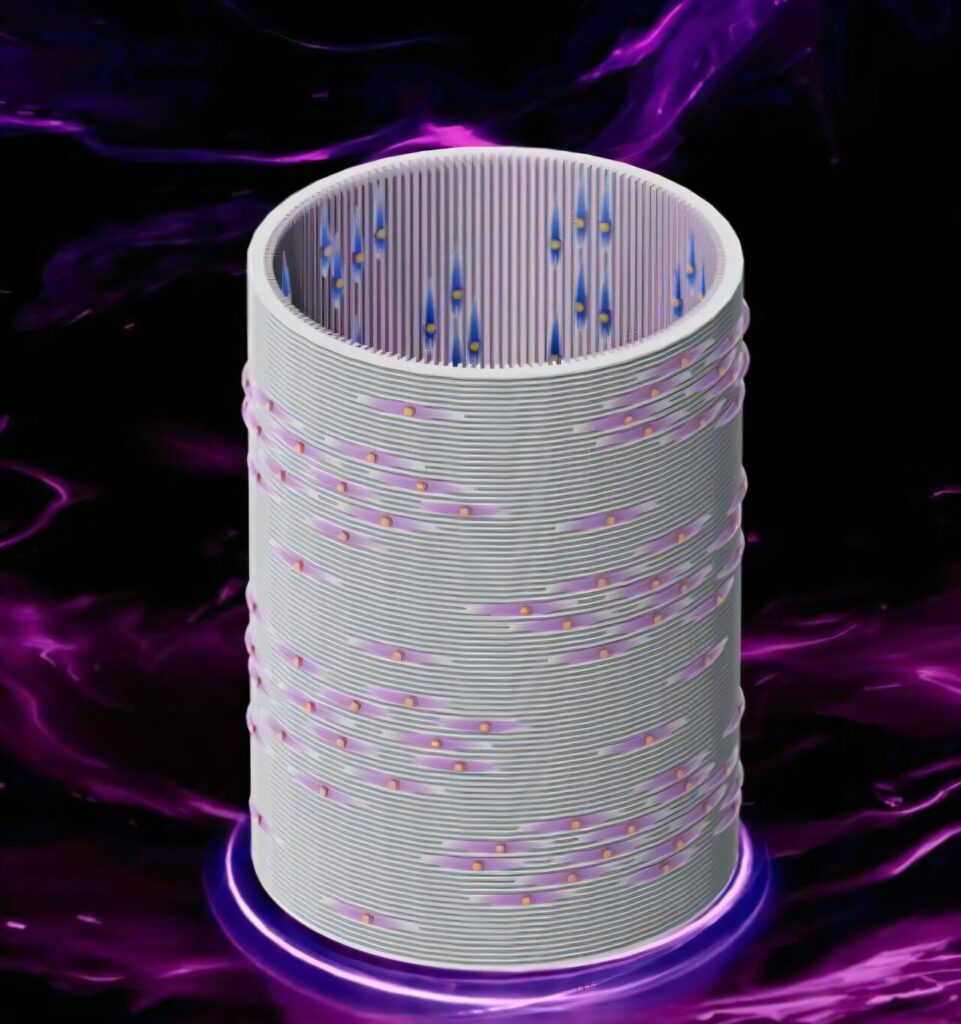
Just 1 centimeter long and about 2 to 3 millimeters in diameter, the biodegradable tube is too small for the grooves and channels on its surfaces to be easily visible. Yet those microscopic textures represent an advance that Ding, an assistant professor in WPI’s Department of Biomedical Engineering, thinks may someday lead to big improvements in heart bypass surgeries.
In a new paper published in the journal Advanced Healthcare Materials, Ding and research collaborators from Northwestern University reported that they developed a rapid 3D-printing process using biodegradable “ink” and light to produce tubular implantable scaffolds with grooves and channels. The textures created pathways for cells to migrate across the implant’s surfaces and line up with each other, a critical step in regenerating blood vessels to the heart.
“The goal of this research is to regenerate arteries, not just replace them,” says Ding. “To achieve that goal, it will be important to develop grafts that temporarily provide the structure for tissue growth and enable new cells to grow into healthy and functional blood vessels.”
The research aims to improve surgical treatment for one of the nation’s leading public health challenges—heart disease. The leading cause of heart attacks is blockage in the vessels supplying blood to the heart. A common surgical treatment is coronary artery bypass grafting, which involves attaching a vein or synthetic tube to reroute circulation around a blockage to restore healthy blood flow to the heart.
To improve grafting procedures, the researchers have focused on building better temporary grafts. Their work has revolved around a novel process of multiscale microscopic 3D printing called MµCLIP.
Using a specialized 3D printer built in the Ding Lab, the researchers deposited layers of liquid polymer onto a flat plate to carefully build a tube, layer by layer. They also used ultraviolet light to project patterns onto the tube as it took shape.
The citrate-based polymer was then cured into a flexible and biodegradable material. Patterns on the tube surfaces created routes for endothelial cells and smooth muscle cells, which are found in blood vessels, to move and line up with each other on the tube surfaces. In a head-to-head comparison, the researchers found that endothelial cells migrated and lined up better on textured scaffolds than on smooth scaffolds.
In addition to Ding, WPI authors on the paper were Ph.D. student Rao Fu; postdoctoral fellow Ni Chen; research scientist Biao Si; and Zhenglun Alan Wei, assistant professor in the WPI Department of Biomedical Engineering and an adjunct faculty member at UMass Chan Medical School. Authors at Northwestern were Guillermo Ameer, professor and director of the Center for Advanced Regenerative Engineering; Professor of Mechanical Engineering Cheng Sun; Ph.D. student Evan Jones; and master’s degree student Boyuan Sun.
The research reflects Ding’s focus on the design and manufacturing of biomaterial scaffolds for the regeneration of tissues, such as vascular and musculoskeletal tissues. He joined the WPI faculty in 2023 after serving as a research assistant professor at Northwestern.
“I’m really excited about translational research that breaks ground scientifically but also has the potential to improve people’s lives,” Ding says. “Many people need bypass surgery, and our research could result in better grafts that lead to better health outcomes for patients.”
More information:
Rao Fu et al, Multiscale 3D Printing of Nanoporous Scaffolds with Surface Topography for Guiding 3D Cell Alignment, Advanced Healthcare Materials (2025). DOI: 10.1002/adhm.202504630
Citation:
3D-printed scaffolds for blood vessels point to new approach for heart bypass grafts (2025, December 9)
retrieved 9 December 2025
from https://medicalxpress.com/news/2025-12-3d-scaffolds-blood-vessels-approach.html
This document is subject to copyright. Apart from any fair dealing for the purpose of private study or research, no
part may be reproduced without the written permission. The content is provided for information purposes only.

Khamrah by Lattafa for Men - 3.4 oz EDP Spray
4% Off
Ghost Sweetheart Eau de Toilette | Pineapple, Jasmine and Sandalwood | Perfume for Women 50 ml
50% Off
Marc Jacobs Dot Eau De Parfum for Women, 100 ml
42% Off
Ted Baker W Eau de Toilette for Her, Fig Leaf, White Peony and Violet Top Notes, Pink Orchid and Raspberry Middle Notes, 75ml
£11.77 (£15.69 / 100 ml) (as of 05/09/2026 04:58 GMT +01:00 - More infoProduct prices and availability are accurate as of the date/time indicated and are subject to change. Any price and availability information displayed on [relevant Amazon Site(s), as applicable] at the time of purchase will apply to the purchase of this product.)
Ted Baker Woman Pink Eau de Toilette Spray Floral Green Feminine Fragrance, Opening Notes are Fresh Peach, Bergamot and Tangerine with Warm Musk, Vanilla and Vetiver Base, 100ml
11% Off
Vera Wang Princess Eau de Toilette - 30 ml

Choco Musk 50ml Eau De Parfum for men and women | Chocolate Musk by Jannat Aromas
17% Off
Christina Aguilera Signature Eau de Parfum (50ml) Floral, Fruity & Exotic Scent, Luxury Fragrance for Women
9% Off
Calvin Klein - Eau De Toilette CKIN2U - Calvin Klein Women, Ladies Perfume, Women's Perfume, Calvin Klein Perfume, Calvin Klein One - 150 ml
5% Off
Jimmy Choo Flash Eau de Parfum, 60 ml (Pack of 1)
3% Off
Fruit of the Loom Men's Heavy T Shirt, White, XL UK
28% Off
ATNKE LED Lighted Beanie Cap,USB Rechargeable Running Hat Ultra Bright 4 LED Waterproof Light Winter Warm Gifts for Men and Women/Pink
17% Off
Men's 1/4 Zip Pullover UK Sale Clearance, Fleece Sweatshirt Casual Jumper Long Sleeve T-shirt Top Stand Collar Sweater Plain Pullover Sports Leisure Workwear Quarter Zip Sweater Lightweight Jumpers
£5.88 (as of 12/11/2025 00:52 GMT +01:00 - More infoProduct prices and availability are accurate as of the date/time indicated and are subject to change. Any price and availability information displayed on [relevant Amazon Site(s), as applicable] at the time of purchase will apply to the purchase of this product.)
Crevice Cleaning Brush, Bathroom Tile Groove Gap Cleaning Brush,Premium Crevice Cleaning Tool Aluminum Support with 15° Angle Magic Brush, Thin Brush for Home Kitchen
19% Off
Wireless Earbuds, Bluetooth 5.3 Headphones in Ear with HiFi Stereo Deep Bass, 4 ENC Noise Cancelling Mic Wireless Earphones 40H Playtime, Bluetooth Earbuds Dual LED Display, IP7 Waterproof, USB-C
42% Off