When we’re sick, the first step on the road to recovery is a visit to the doctor’s office.
It turns out the same may also be true for breathing life into America’s democracy.
A Rutgers University–New Brunswick study published in the journal JAMA Health Forum finds that physicians can play a crucial role in strengthening political inclusion of marginalized groups by aiding patients in voter registration.
“Hospitals aren’t the first place we think of when it comes to voter registration,” said Katherine McCabe, an associate professor of American politics at Rutgers University-New Brunswick and lead author of the paper. “But our study finds that by bringing voting registration resources into health care institutions, health care professionals have the potential to reach a type of voter that otherwise might be left out of the political process.”
In the United States, 72 million eligible voters aren’t registered, nearly a quarter of the voting-age population. Three decades ago, lawmakers seeking to expand voting access passed the National Voter Registration Act, which mandated that government facilities—including state motor vehicle agencies and federal assistance offices—provide voter registration support. Hospitals and health care settings weren’t included in the law.
To gauge whether mobilizing people to vote in health care settings could help close the voting gap and encourage lower-propensity voters to register, McCabe analyzed data from Vot-ER, a nonprofit organization that integrates civic engagement into health care.
Emergency departments disproportionately care for low-income, minority and uninsured individuals, populations that are also less likely to vote. In 2019, alumni Alister Martin, RC ’10, an emergency medical specialist at Massachusetts General Hospital, founded Vot-ER to engage these potential voters.
Working with Martin and Vot-ER, McCabe conducted a cross-sectional study to analyze the demographics and voting behavior of people reached by the nonprofit.
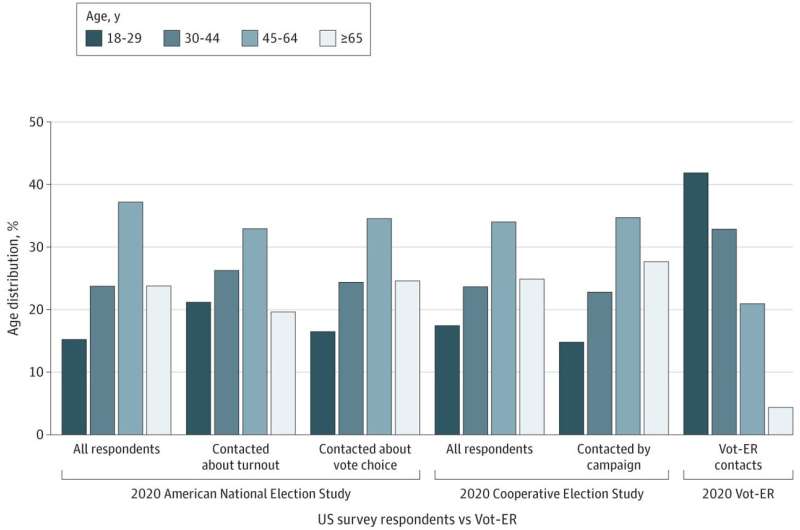
By comparing age, race and ethnic identity data from Vot-ER outreach during the 2020 election cycle with data from the Cooperative Election Study (CES) and the American National Election Study (ANES), which survey US adults, McCabe found that voters contacted in health care settings tended to be more racially and ethnically diverse, and younger, than registration efforts in non-health-care settings.
“Of the 12,441 health care-based contacts reported by Vot-ER, a significantly larger proportion were young (41.9%) and racial and ethnic minority individuals (39.6%) relative to the nationally representative data,” McCabe wrote.
Martin, who co-authored the paper, said these findings could have profound implications for voter turnout in national elections, including the presidential election this fall.
“Health care-based voter mobilization reaches a distinctly younger and more diverse population than those contacted only by political campaigns,” he said. “Rutgers’ analysis of our work points to the unique impact that medical professionals may have on voter registration and turnout in US elections—including the one fast approaching in November.”
More information:
Katherine McCabe et al, Increasing Voter Participation Through Health Care–Based Voter Registration, JAMA Health Forum (2024). DOI: 10.1001/jamahealthforum.2024.1563
Citation:
The prescription for a healthier democracy: Physicians’ role in political inclusion (2024, August 6)
retrieved 6 August 2024
from https://medicalxpress.com/news/2024-08-prescription-healthier-democracy-physicians-role.html
This document is subject to copyright. Apart from any fair dealing for the purpose of private study or research, no
part may be reproduced without the written permission. The content is provided for information purposes only.

Khamrah by Lattafa for Men - 3.4 oz EDP Spray
4% Off
Ghost Sweetheart Eau de Toilette | Pineapple, Jasmine and Sandalwood | Perfume for Women 50 ml
50% Off
Marc Jacobs Dot Eau De Parfum for Women, 100 ml
42% Off
Ted Baker W Eau de Toilette for Her, Fig Leaf, White Peony and Violet Top Notes, Pink Orchid and Raspberry Middle Notes, 75ml
£11.77 (£15.69 / 100 ml) (as of 18/07/2026 03:59 GMT +01:00 - More infoProduct prices and availability are accurate as of the date/time indicated and are subject to change. Any price and availability information displayed on [relevant Amazon Site(s), as applicable] at the time of purchase will apply to the purchase of this product.)
Ted Baker Woman Pink Eau de Toilette Spray Floral Green Feminine Fragrance, Opening Notes are Fresh Peach, Bergamot and Tangerine with Warm Musk, Vanilla and Vetiver Base, 100ml
11% Off
Vera Wang Princess Eau de Toilette - 30 ml

Choco Musk 50ml Eau De Parfum for men and women | Chocolate Musk by Jannat Aromas
17% Off
Christina Aguilera Signature Eau de Parfum (50ml) Floral, Fruity & Exotic Scent, Luxury Fragrance for Women
9% Off
Calvin Klein - Eau De Toilette CKIN2U - Calvin Klein Women, Ladies Perfume, Women's Perfume, Calvin Klein Perfume, Calvin Klein One - 150 ml
5% Off
Jimmy Choo Flash Eau de Parfum, 60 ml (Pack of 1)
3% Off
Fruit of the Loom Men's Heavy T Shirt, White, XL UK
28% Off
ATNKE LED Lighted Beanie Cap,USB Rechargeable Running Hat Ultra Bright 4 LED Waterproof Light Winter Warm Gifts for Men and Women/Pink
17% Off
Men's 1/4 Zip Pullover UK Sale Clearance, Fleece Sweatshirt Casual Jumper Long Sleeve T-shirt Top Stand Collar Sweater Plain Pullover Sports Leisure Workwear Quarter Zip Sweater Lightweight Jumpers
£5.88 (as of 12/11/2025 00:52 GMT +01:00 - More infoProduct prices and availability are accurate as of the date/time indicated and are subject to change. Any price and availability information displayed on [relevant Amazon Site(s), as applicable] at the time of purchase will apply to the purchase of this product.)
Crevice Cleaning Brush, Bathroom Tile Groove Gap Cleaning Brush,Premium Crevice Cleaning Tool Aluminum Support with 15° Angle Magic Brush, Thin Brush for Home Kitchen
19% Off
Wireless Earbuds, Bluetooth 5.3 Headphones in Ear with HiFi Stereo Deep Bass, 4 ENC Noise Cancelling Mic Wireless Earphones 40H Playtime, Bluetooth Earbuds Dual LED Display, IP7 Waterproof, USB-C
42% Off