

David Gregory-KumarWest Midlands science correspondent, Shropshire

 BBC
BBCAlmost 10 years ago, I stood at Harper Adams University inside a huge hall, watching a massive drone move around the space spraying the floor below.
It was perfectly technically capable of being used outside to treat a crop with fertiliser or even pesticides, but all of that was then banned.
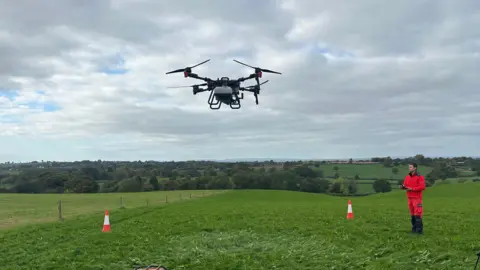
Today, I’m standing on a Shropshire hillside covered in a mix of herbs and grasses planted by an agricultural drone, which swoops overhead delivering a spray of liquid seaweed fertiliser.
It’s a massive drone, 3m (9.8ft) from spinning blade to spinning blade and weighing up to 160kg (352 lb).
The large batteries it uses charge so quickly and generate so much heat that they have to be water-cooled.
The technology has certainly improved but what has really changed, and very rapidly, is the attitude of the government.
Once the use of large drones was frowned upon, especially if you wanted to drop stuff out of them or spray things, but now the regulations are evolving and agricultural drones are taking off.

Driving much of this is a Stoke-on-Trent company called Autospray Systems.
Rob Pearson, its CEO, explained to me: “We train the farmers to use the kit and then sell them the machines.”
The firm is also helping to shape policy, he said, through telling regulators that since farmland is usually remote and private, flying large drones overhead is safe and has huge benefits.
“Flying means no heavy tractors compacting the soil,” Mr Pearson said.
In some remote or very hilly areas it is too difficult or even dangerous to use tractors, but none of that is a problem for a drone.
Flying the drone is Shropshire dairy farmer and drone pilot Frazer Bloor.
“The drone is a lot safer for applying liquids and seeds on these hills,” he told me.
The traditional way to seed grass on hills is to feed it to the cattle and let nature take its course.
Flying a drone allows for much more accurate planting and, today, even a boost of natural fertiliser.
Of course, the drone could just as easily apply more traditional chemical fertiliser, pesticides and fungicides but, for now, that is still not allowed.
However, according to Mr Pearson, there are moves being made to alter this.
Today, 50 of these drones are in the air across the country and the prediction is that will be 500 by the end of next year.
“Everyone is committed to making that change happen,” Mr Pearson said.
BBC News

Khamrah by Lattafa for Men - 3.4 oz EDP Spray
4% Off
Ghost Sweetheart Eau de Toilette | Pineapple, Jasmine and Sandalwood | Perfume for Women 50 ml
50% Off
Marc Jacobs Dot Eau De Parfum for Women, 100 ml
42% Off
Ted Baker W Eau de Toilette for Her, Fig Leaf, White Peony and Violet Top Notes, Pink Orchid and Raspberry Middle Notes, 75ml
£11.77 (£15.69 / 100 ml) (as of 24/05/2026 03:21 GMT +01:00 - More infoProduct prices and availability are accurate as of the date/time indicated and are subject to change. Any price and availability information displayed on [relevant Amazon Site(s), as applicable] at the time of purchase will apply to the purchase of this product.)
Ted Baker Woman Pink Eau de Toilette Spray Floral Green Feminine Fragrance, Opening Notes are Fresh Peach, Bergamot and Tangerine with Warm Musk, Vanilla and Vetiver Base, 100ml
11% Off
Vera Wang Princess Eau de Toilette - 30 ml

Choco Musk 50ml Eau De Parfum for men and women | Chocolate Musk by Jannat Aromas
17% Off
Christina Aguilera Signature Eau de Parfum (50ml) Floral, Fruity & Exotic Scent, Luxury Fragrance for Women
9% Off
Calvin Klein - Eau De Toilette CKIN2U - Calvin Klein Women, Ladies Perfume, Women's Perfume, Calvin Klein Perfume, Calvin Klein One - 150 ml
5% Off
Jimmy Choo Flash Eau de Parfum, 60 ml (Pack of 1)
3% Off
Fruit of the Loom Men's Heavy T Shirt, White, XL UK
28% Off
ATNKE LED Lighted Beanie Cap,USB Rechargeable Running Hat Ultra Bright 4 LED Waterproof Light Winter Warm Gifts for Men and Women/Pink
17% Off
Men's 1/4 Zip Pullover UK Sale Clearance, Fleece Sweatshirt Casual Jumper Long Sleeve T-shirt Top Stand Collar Sweater Plain Pullover Sports Leisure Workwear Quarter Zip Sweater Lightweight Jumpers

Crevice Cleaning Brush, Bathroom Tile Groove Gap Cleaning Brush,Premium Crevice Cleaning Tool Aluminum Support with 15° Angle Magic Brush, Thin Brush for Home Kitchen
19% Off
Wireless Earbuds, Bluetooth 5.3 Headphones in Ear with HiFi Stereo Deep Bass, 4 ENC Noise Cancelling Mic Wireless Earphones 40H Playtime, Bluetooth Earbuds Dual LED Display, IP7 Waterproof, USB-C
42% Off


