
 [


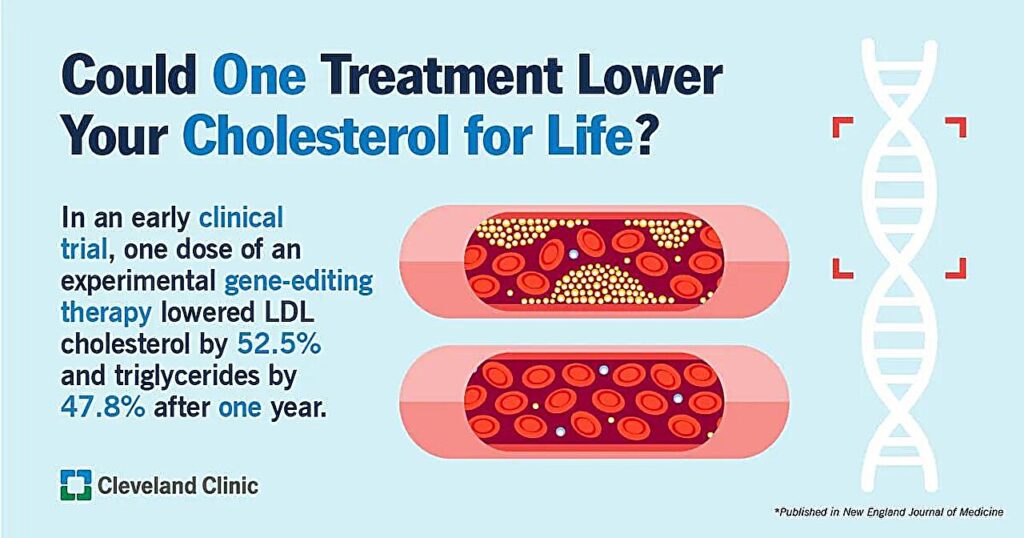
A Cleveland Clinic first-in-human clinical trial has shown that a one-time infusion of a gene-editing therapy using CRISPR-Cas9 was effective and safe in reducing LDL (“bad”) cholesterol and triglycerides in people with medication-resistant lipid disorders through one year of follow-up across all doses.
The Phase I trial, which included 15 patients, aimed to see if the reductions in LDL cholesterol and triglycerides previously reported after two months would persist for 12 months. After 12 months, patients treated with the highest dose saw a 52.5% reduction from baseline in LDL cholesterol and a 47.8% reduction in triglycerides. There were no serious adverse events related to the therapy during the one-year follow-up.
The trial results were presented at the 2026 European Society of Cardiology annual meeting and simultaneously published in the New England Journal of Medicine.
How CTX310 targets ANGPTL3
“Building upon the initial data presented in November 2025, the durability of the lipid-lowering effect was impressive,” said Cleveland Clinic cardiologist Dr. Luke Laffin, first author of the study. “It is encouraging that there were no serious safety events related to CTX310 in the trial and in the year following treatment. We look forward to continuing to investigate this therapy in a larger number of patients.”
CRISPR-Cas9 is a gene-editing technology that can be used to modify or correct specific regions of a person’s DNA to treat serious diseases.
This trial tested CTX310, an experimental CRISPR-Cas9 gene-editing treatment delivered as a one-time infusion. CTX310 carries the CRISPR editing mechanism into the liver, where it switches off a gene called ANGPTL3. Turning off this gene can lower LDL cholesterol and triglycerides, which are both linked to heart disease.
One infusion, years of follow-up
During the trial, CTX310 was administered at doses from 0.1 to 0.8 mg/kg during a single infusion, after pretreatment with corticosteroids and antihistamines. Participants were monitored for treatment safety and the effects of this gene therapy on ANGPTL3, LDL cholesterol and triglyceride levels. CTX310 reduced both LDL cholesterol and triglycerides by approximately 50% on average at the highest dose 12 months after treatment.
The study participants were monitored for one year following the trial, with additional long-term safety follow-up planned for the next 15 years, as recommended by the FDA for all gene-editing therapies.
Publication details
Luke J. Laffin et al, Durability of CRISPR-Cas9 Gene Editing Targeting ANGPTL3 with CTX310, New England Journal of Medicine (2026). DOI: 10.1056/nejmc2609825
Journal information:
New England Journal of Medicine
Key medical concepts


Citation:
CRISPR gene-editing therapy safely and continuously lowers cholesterol and triglycerides, first-in-human trial shows (2026, September 4)
retrieved 4 September 2026
from https://medicalxpress.com/news/2026-09-crispr-gene-therapy-safely-lowers.html
This document is subject to copyright. Apart from any fair dealing for the purpose of private study or research, no
part may be reproduced without the written permission. The content is provided for information purposes only.

Khamrah by Lattafa for Men - 3.4 oz EDP Spray
4% Off
Ghost Sweetheart Eau de Toilette | Pineapple, Jasmine and Sandalwood | Perfume for Women 50 ml
50% Off
Marc Jacobs Dot Eau De Parfum for Women, 100 ml
42% Off
Ted Baker W Eau de Toilette for Her, Fig Leaf, White Peony and Violet Top Notes, Pink Orchid and Raspberry Middle Notes, 75ml
£11.77 (£15.69 / 100 ml) (as of 16/10/2026 06:35 GMT +01:00 - More infoProduct prices and availability are accurate as of the date/time indicated and are subject to change. Any price and availability information displayed on [relevant Amazon Site(s), as applicable] at the time of purchase will apply to the purchase of this product.)
Ted Baker Woman Pink Eau de Toilette Spray Floral Green Feminine Fragrance, Opening Notes are Fresh Peach, Bergamot and Tangerine with Warm Musk, Vanilla and Vetiver Base, 100ml
11% Off
Vera Wang Princess Eau de Toilette - 30 ml
Choco Musk 50ml Eau De Parfum for men and women | Chocolate Musk by Jannat Aromas
17% Off
Christina Aguilera Signature Eau de Parfum (50ml) Floral, Fruity & Exotic Scent, Luxury Fragrance for Women
9% Off
Calvin Klein - Eau De Toilette CKIN2U - Calvin Klein Women, Ladies Perfume, Women's Perfume, Calvin Klein Perfume, Calvin Klein One - 150 ml
5% Off
Jimmy Choo Flash Eau de Parfum, 60 ml (Pack of 1)
3% Off
Fruit of the Loom Men's Heavy T Shirt, White, XL UK
28% Off
ATNKE LED Lighted Beanie Cap,USB Rechargeable Running Hat Ultra Bright 4 LED Waterproof Light Winter Warm Gifts for Men and Women/Pink
17% Off
Men's 1/4 Zip Pullover UK Sale Clearance, Fleece Sweatshirt Casual Jumper Long Sleeve T-shirt Top Stand Collar Sweater Plain Pullover Sports Leisure Workwear Quarter Zip Sweater Lightweight Jumpers
£5.88 (as of 12/11/2025 00:52 GMT +01:00 - More infoProduct prices and availability are accurate as of the date/time indicated and are subject to change. Any price and availability information displayed on [relevant Amazon Site(s), as applicable] at the time of purchase will apply to the purchase of this product.)
Crevice Cleaning Brush, Bathroom Tile Groove Gap Cleaning Brush,Premium Crevice Cleaning Tool Aluminum Support with 15° Angle Magic Brush, Thin Brush for Home Kitchen
19% Off
Wireless Earbuds, Bluetooth 5.3 Headphones in Ear with HiFi Stereo Deep Bass, 4 ENC Noise Cancelling Mic Wireless Earphones 40H Playtime, Bluetooth Earbuds Dual LED Display, IP7 Waterproof, USB-C
42% Off