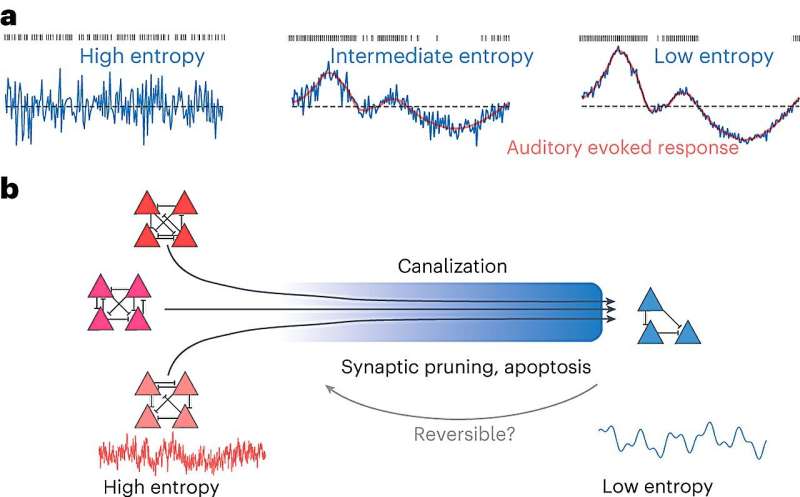
A team of neurologists and biotechnicians at University Hospital and University of Tübingen, working with a colleague from Imperial College London, reports that brain complexity decreases during fetal maturation and continues after birth.
In their paper published in the journal Nature Mental Health, the group describes how they used a relatively new type of technology called magnetoencephalography (MEG) to record fetal magnetic brain signals and what they learned from the results.
Prior research has suggested that many brain disorders such as autism and schizophrenia get their start in the womb—findings suggest early interventions may prevent the development of such disorders. Because of that, medical researchers have been looking for ways to study brain development in utero.
That has led to the development of new technology, such as red-light-based MEG, which allows researchers to record fetal magnetic brain signals without causing injury to the mother or the fetus. In this study, the research team used this new technology to study the complexity of signals as a general means of studying brain development.
The researchers recruited several pregnant women and used MEG to record fetal magnetic brain signals starting at 35 weeks and running until birth. This was repeated after birth. Each of the tests involved playing auditory signals in a way that the fetus could hear and recording the response to the signals. To measure complexity, the researchers played patterns of signals, which they then interrupted, giving the fetus or newborn an opportunity to respond to the sudden change.
The researchers found evidence of a decrease in complexity as the fetuses matured, reaching the least complexity just before birth. They also found that complexity continued to decrease after birth and that there were gender differences—male fetuses/babies tended to undergo decreases in complexity faster than females.
The researchers were surprised by their results, but after further review, found that they made sense because they suggest that as the brain matures, it moves from disorder toward more ordered patterns of connections, allowing the brain to process more complicated types of information.
More information:
Joel Frohlich et al, Sex differences in prenatal development of neural complexity in the human brain, Nature Mental Health (2024). DOI: 10.1038/s44220-024-00206-4
© 2024 Science X Network
Citation:
Complexity of brain activity found to decrease with fetal maturation and to continue decline after birth (2024, March 5)
retrieved 5 March 2024
from https://medicalxpress.com/news/2024-03-complexity-brain-decrease-fetal-maturation.html
This document is subject to copyright. Apart from any fair dealing for the purpose of private study or research, no
part may be reproduced without the written permission. The content is provided for information purposes only.

Khamrah by Lattafa for Men - 3.4 oz EDP Spray
4% Off
Ghost Sweetheart Eau de Toilette | Pineapple, Jasmine and Sandalwood | Perfume for Women 50 ml
50% Off
Marc Jacobs Dot Eau De Parfum for Women, 100 ml
42% Off
Ted Baker W Eau de Toilette for Her, Fig Leaf, White Peony and Violet Top Notes, Pink Orchid and Raspberry Middle Notes, 75ml
£11.77 (£15.69 / 100 ml) (as of 09/06/2026 03:31 GMT +01:00 - More infoProduct prices and availability are accurate as of the date/time indicated and are subject to change. Any price and availability information displayed on [relevant Amazon Site(s), as applicable] at the time of purchase will apply to the purchase of this product.)
Ted Baker Woman Pink Eau de Toilette Spray Floral Green Feminine Fragrance, Opening Notes are Fresh Peach, Bergamot and Tangerine with Warm Musk, Vanilla and Vetiver Base, 100ml
11% Off
Vera Wang Princess Eau de Toilette - 30 ml

Choco Musk 50ml Eau De Parfum for men and women | Chocolate Musk by Jannat Aromas
17% Off
Christina Aguilera Signature Eau de Parfum (50ml) Floral, Fruity & Exotic Scent, Luxury Fragrance for Women
9% Off
Calvin Klein - Eau De Toilette CKIN2U - Calvin Klein Women, Ladies Perfume, Women's Perfume, Calvin Klein Perfume, Calvin Klein One - 150 ml
5% Off
Jimmy Choo Flash Eau de Parfum, 60 ml (Pack of 1)
3% Off
Fruit of the Loom Men's Heavy T Shirt, White, XL UK
28% Off
ATNKE LED Lighted Beanie Cap,USB Rechargeable Running Hat Ultra Bright 4 LED Waterproof Light Winter Warm Gifts for Men and Women/Pink
17% Off
Men's 1/4 Zip Pullover UK Sale Clearance, Fleece Sweatshirt Casual Jumper Long Sleeve T-shirt Top Stand Collar Sweater Plain Pullover Sports Leisure Workwear Quarter Zip Sweater Lightweight Jumpers
£5.88 (as of 12/11/2025 00:52 GMT +01:00 - More infoProduct prices and availability are accurate as of the date/time indicated and are subject to change. Any price and availability information displayed on [relevant Amazon Site(s), as applicable] at the time of purchase will apply to the purchase of this product.)
Crevice Cleaning Brush, Bathroom Tile Groove Gap Cleaning Brush,Premium Crevice Cleaning Tool Aluminum Support with 15° Angle Magic Brush, Thin Brush for Home Kitchen
19% Off
Wireless Earbuds, Bluetooth 5.3 Headphones in Ear with HiFi Stereo Deep Bass, 4 ENC Noise Cancelling Mic Wireless Earphones 40H Playtime, Bluetooth Earbuds Dual LED Display, IP7 Waterproof, USB-C
42% Off